Budget 2022: Here's everything you need to know

Brigid O'Hora and Gideon Jasper from Kildare with their children Jude, left, Beatrice, and Will, triplets who will be five years old at the end of the month. Picture: Moya Nolan
Finance Minister Paschal Donohoe and Public Expenditure Michael McGrath have introduced Budget 2022 in the Dáil.
- The establishment of a Covid-19 contingency fund of over €4bn
- Core welfare payments and the state pension are to increase.
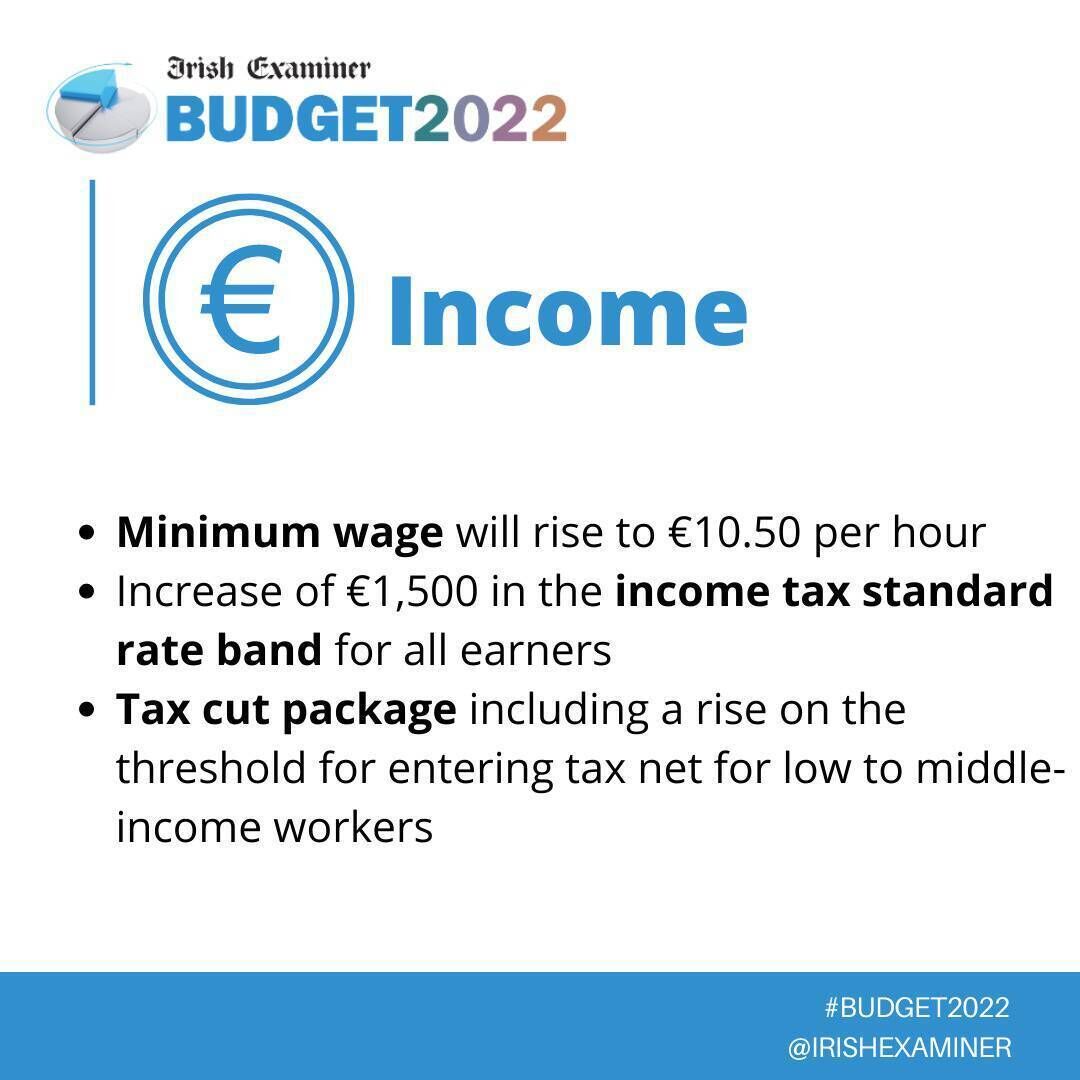
- An increase of €1,500 in the income tax standard rate band for all earners from €35,300 to €36,800 and from €44,300 to €45,800 for married couples and civil partners.
- The minimum wage will rise by 30c to €10.50 per hour.
- Tax cut package including a rise on the threshold for entering tax net for low to middle-income workers.
- The extension of the childcare subsidy to under 15's
- Funding for more than 1,000 special needs assistants and an increase in the SUSI grant for the first time in 10 years.
- €50m in ICT grants for primary and post-primary schools.
- Extension of the Help to Buy Scheme
- An increase of 50c to the price of cigarettes.
- A rise in the prices of both petrol and diesel
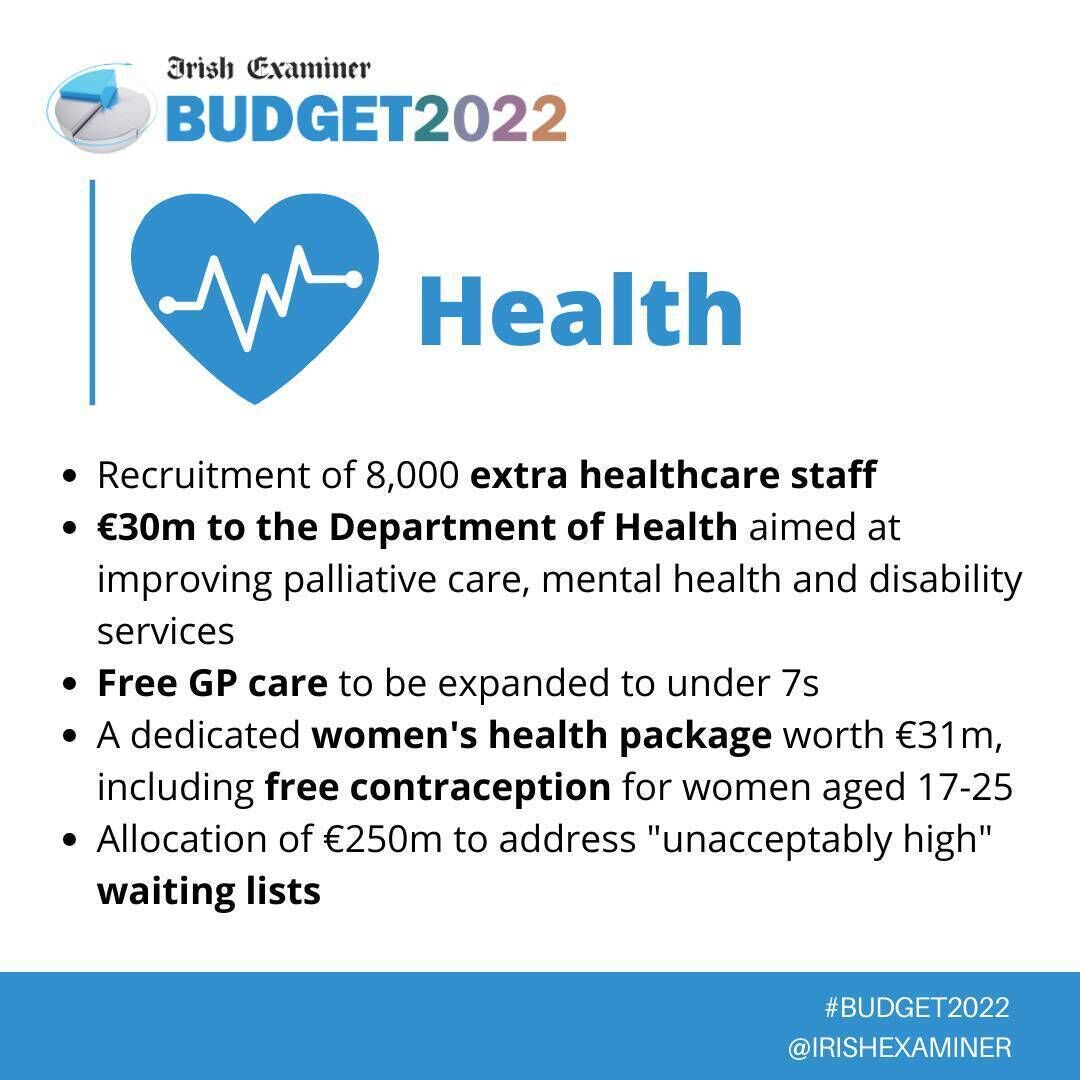
- The recruitment of 8,000 extra healthcare staff
- €30m to the Department of Health aimed at improving palliative care, mental health and disability services
- Free GP care to be expanded to under 7s
- A dedicated women's health package worth €31m
- Free contraception to be offered to women aged 17 - 25
- A carbon tax increase and a range of new climate-focused measures
- A €90m funding package for aviation
- The establishment of a 'progressive' national retrofitting programme.
- The extension of the banking levy, but with Ulster Bank and KBC excluded
- €60m to extend the commercial rates waiver until the end of the year
- The allocation of €3.4bnfor the provision of transport infrastructure, €360m of which will fund the development of more greenways around the country
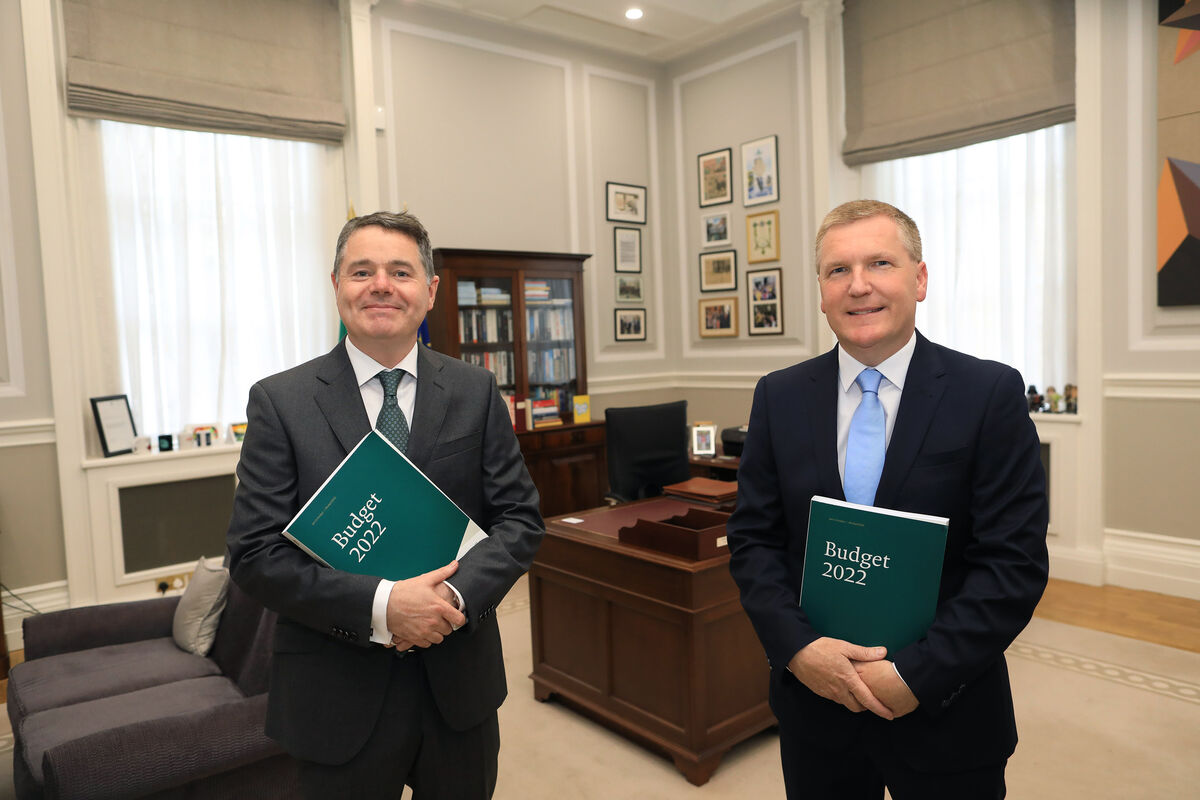
Opening his speech, Mr Donohoe said that this time last year, "none of us could have foreseen that the worst global pandemic in a century awaited us."
"We could not have predicted the devastation Covid-19 would leave in its wake," he said.
The Minister said the pandemic was an "unprecedented experience for all of us."
Paying tribute to ordinary citizens, Mr Donohoe said the country's solidarity "saved lives and allowed our society and economy to reopen."
"Our country reaches for a better and brighter future. Budget 2022 is a path to that future," he said.
Mr Donohoe said the economy was now entering "a new phase."
"Budget 2022 meets the twin goals of investing in our future while putting the public finances on a sustainable path."
Mr Donohoe said the national debt will top €240 billion next year, almost €50,000 for every man, woman and child in the country.
He said however domestic demand has rebounded strongly with modified domestic demand growing by 8.5% in the second quarter of this year.
For this year as a whole, Mr Donohoe said the economy will grow by 5.25% and by 6.5% in 2022.
However, he sounded a warning on the impact of inflation on the economy in the short run including the normalisation of oil prices.
He said the numbers on the PUP have fallen from 500,000 earlier this year to under 100,000 for the first time.
He said by year-end, the rate of unemployment will fall to 9% from a peak of 17% during the pandemic. He said the unemployment rate will fall next year by 6.5%.
Overall, 400,000 jobs will be added to the economy between this year and next year and the number of jobs will exceed pre-pandemic levels during 2022, he said.
The Finance Minister said the government’s policy to only borrow for capital spending will be met next year - one year earlier than had been planned.
He said in the Summer Economic Statement he forecast a combined deficit in 2021 and 2022 of €34.5 billion, but he revising that forecast downward substantially to €21.5 billion.
The most urgent health priority under Budget 2022 will involve immediate actions to address waiting lists which are now at an all-time high.
To counter this:
- An extra 8,000 healthcare staff will be recruited next year, bringing the total workforce to 144,000.
- Some €10.5m is to be provided for an extra 19 critical care beds, bringing the total number of ICU beds to 340. This is an increase of 85 beds since the start of the pandemic.
- A further €8m will be pumped into modernising the National Ambulance Service and €22m is being provided for additional Winter Plan measures during 2022.
- Health will receive an extra €1bn in core current funding next year, including €300m for new measures. When capital and Covid provision is taken into account, the total health expenditure will be €22.2bn.
In an effort to address "unacceptably high" waiting lists, an additional allocation of €250m, comprised of €200m to the HSE and €50m for the National Treatment Purchase Fund (NTPF) has been allocated.
A number of measures targeting women's health are to be rolled out next year.
These include making contraception freely available to women aged between 17 and 25 and increased investment in a new approach to menopause care.
In his Budget speech, Minister for Public Expenditure Michael McGrath said: "One of the most important legacies we can leave following this pandemic is a reformed public health service that provides for the people of this country based on medical need regardless of income".
Among the measures aimed at achieving this are:
- An extension of free GP care to children under the age of seven.
- A lowering of the Drug Payment Scheme threshold to €100.
- A €30million package for new drugs to ensure patients have access to the best high-tech drugs available across the world
- An extra €105million for disability services.
Free GP care extended to children under 7 is good news for families, Anna Grunder said commenting in Cork after #Budget2022 pic.twitter.com/OaOecXctcX
— Liz Dunphy (@LizDunphy1) October 12, 2021
A €4 billion housing budget will be used to deliver 11,820 social homes, 4,000 affordable purchase and cost rental homes and a €50 million fund to revitalise town and city centres.
In total, the Department of Housing will have €2.58 billion to spend on capital projects, with the Budget saying that this will go towards "supporting the needs of 31,000 households".
In total, the Government commits to:
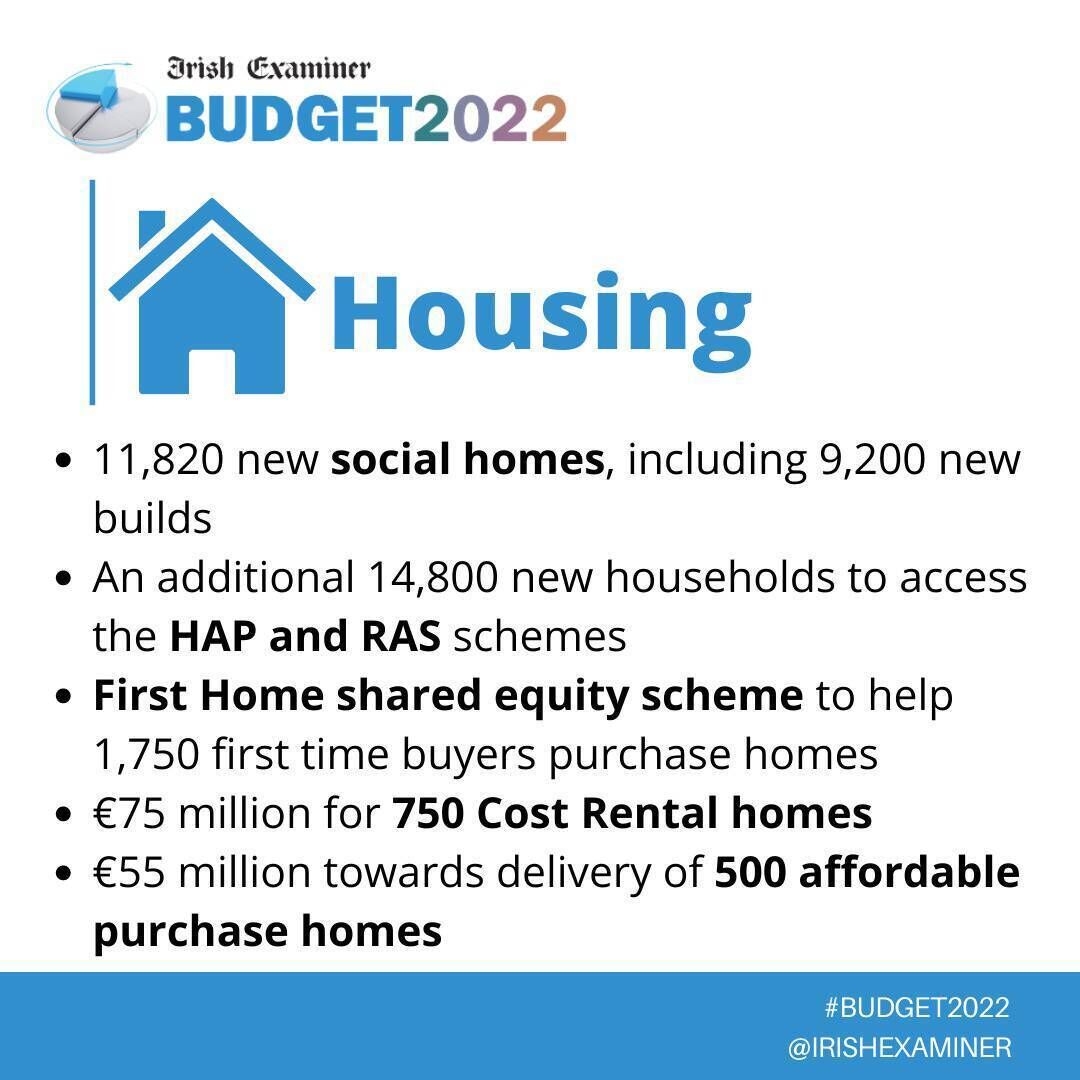
- 11,820 new social homes, 9,200 of which are new builds with 2,620 through leasing schemes
- Funding to allow an additional 14,800 new households access the HAP and RAS schemes, bringing the bill for these schemes to €585 million
- Assist 1,750 first time buyers purchase homes under the €44 million First Home shared equity scheme
- €75 million for 750 Cost Rental homes. 700 of these will be supplied by Approved Housing Bodies (AHBs) with 50 coming from local authorities
- A further €55 million will be put towards the delivery of 500 affordable purchase homes
The rest of the Housing capital plan sees €18 million for Traveller accommodation, €65 million for 11,000 adaptation grants, €50 million for regeneration of disadvantaged communities and €20 million for pyrite remediation, though there was no financial commitment to a Mica scheme just yet.
However, Michael McGrath said that the Government would bring forward proposals in the coming weeks for a “significantly enhanced scheme” to address the mica crisis.
“The Government acknowledges the devastation being experienced by thousands of households impacted by defective mica blocks," he said.
Families affected by the defective blocks have been calling on the Government to introduce a 100% redress scheme.
Later in his speech, Mr McGrath said €85 million will be used to retrofit 2,400 social homes and €30 million will go towards remediating 1,500 homes.
The €50 million Croí Conaithe fund will be used to "stimulate non-activated planning permissions" in cities and to service sites close to regional and rural town centres. A total of €194 million will be given to tackling homelessness.
The Housing and Local Government budget also commits €12.5 million to the Cork Event Centre and €148 million for Irish Water projects in Athlone and Ringsend.
The sizeable budget includes a carryover of €246 million from 2021 and €92 in Local Property Tax.
Jobseekers and pensioners are among those who will receive an extra €5 each week under a €558m social welfare package.
Mr McGrath said that as the country emerged from the pandemic the priority has to be "quality of life, our health, our home, our environment, and the things we perhaps at times took for granted, but have now come to value even more."
To support a more equal society a range of welfare increases and a broadening of thresholds has been announced:
- This includes a €3 increase on the Living Alone Allowance "to ensure the well-being of many thousands of our older citizens". This will bring the payment up to €22 a week.
- To directly address the rising cost of energy, the weekly rate of the Fuel Allowance will increase by €5 from midnight, at a cost of €55.8m.
- The income threshold for qualification for the Fuel Allowance has been increased by €20 and those on Jobseekers Allowance and Supplementary Welfare Allowance will get the support after 12 months, down from the current 15 months.
- Parents Benefit is to be extended by two weeks bringing the support up to seven weeks from July of next year.
- The Qualified Child Increase will also go up by €3 for children aged 12 and over, and by €2 a week for children under 12.
- The Back to School Clothing and Footwear Allowance will increase by €10 and the income thresholds for the support will be equalised meaning the same income levels will apply to both one parent and two-parent families.
- The Government has confirmed that the Christmas bonus will be paid in full this year.
Outlining the measures, Mr McGrath said people have "developed a new appreciation of what we value in life; family and friends, community, nature, and the rich diversity our beautiful country has to offer".
The Education budget for 2022 will be €9.238 billion, with the Budget promising "significant levels of public services". This will see:
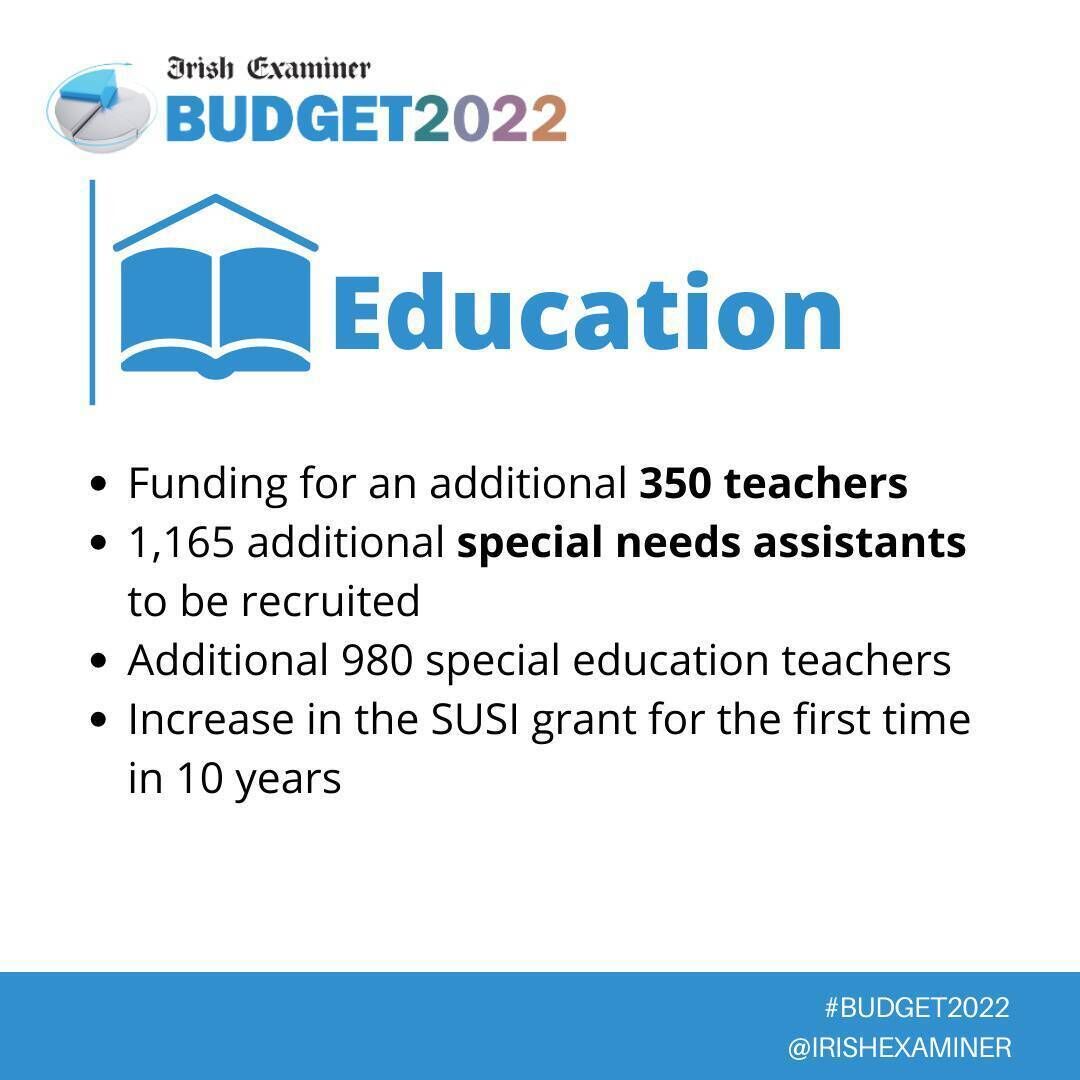
- Funding for an additional 350 teachers to reduce school staffing schedules by one point for all primary schools at a cost of €6 million
- The recruitment of 1,165 additional special needs assistants, bringing the overall number of 19,200 at a cost of €12 million
- €16 million for an additional 980 special education teachers in special classes, special schools and mainstream schools
- An €18 million expansion of the DEIS programme
- More administrative principals in special schools and mainstream schools with two or more special classes
- More funding for voluntary secondary schools in the Free Education Scheme to equalise school capitation grants at a cost of €2 million
- €792 million for capital works to "facilitate a continued strong rollout of school building projects to add capacity and support the operation of the school system".
Up to 40,000 more children will come under the National Childcare Scheme (NCS) as part of budget measures to support parents.
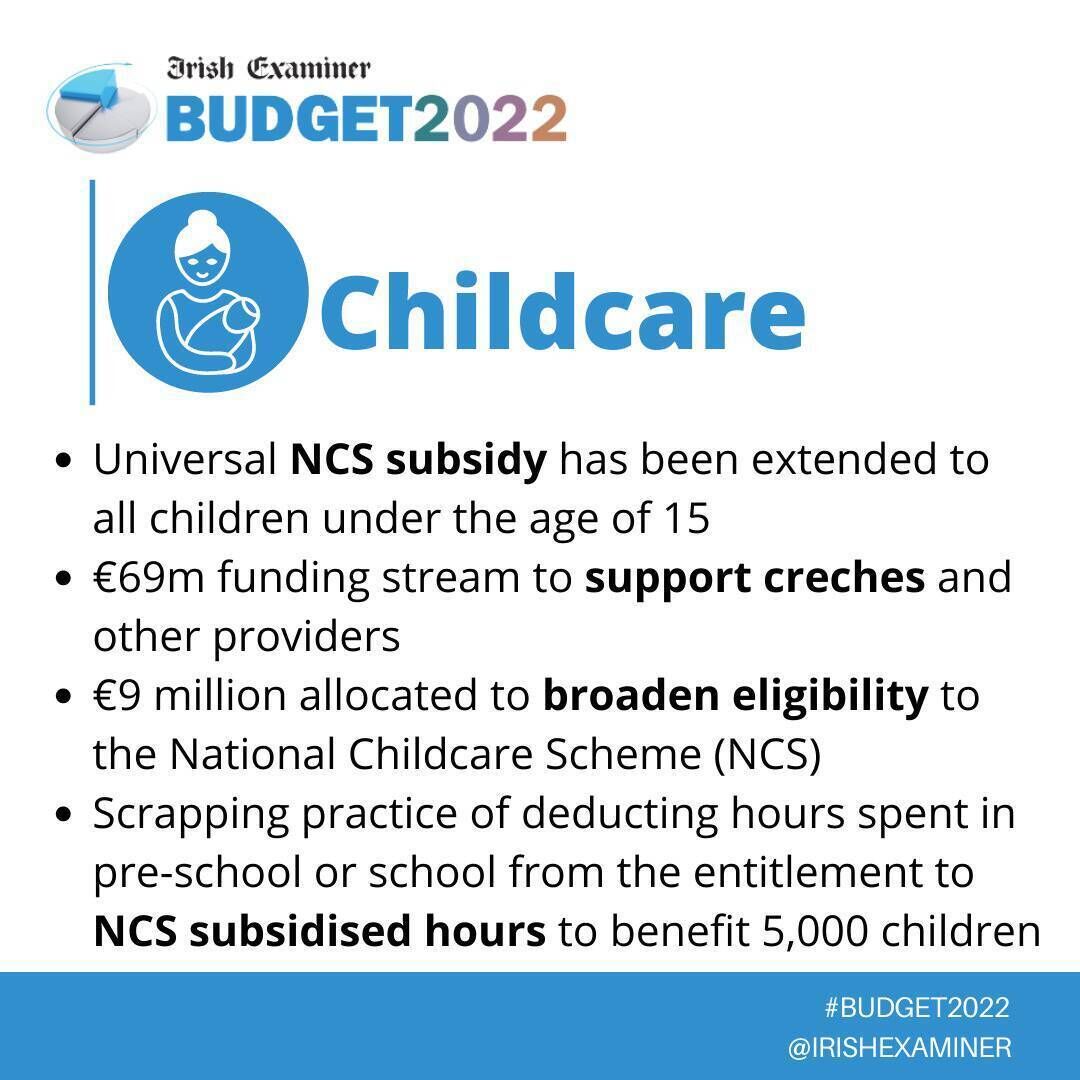
The universal NCS subsidy has been extended to all children under the age of 15.
This subsidy will not be means-tested and currently provides 50c per hour towards the cost of a registered childcare place for a maximum of 45 hours per week.
In a bid to attract and retain childcare staff a new funding stream to support creches and other providers is being introduced.
This €69m package will help providers employ degree-qualified staff, establish career structures and improve services without increasing fees for parents.
On top of this, around 5,000 children from low-income families will benefit from the scrapping of the practice of deducting hours spent in pre-school or school from the entitlement to NCS subsidised hours.
Vanda McBride welcomed the news that childcare subsidies are to be extended but said that #childcare should be free to some #Budget2022 pic.twitter.com/ZYXkuKWf31
— Liz Dunphy (@LizDunphy1) October 12, 2021
Other measures include:
- An allocation of €9m to broaden eligibility to the NCS, which the Government says shows the commitment to reform the childcare sector.
- A €41m or 4.8% increase for Tusla next year, bringing the total allocation to €899m. The extra funds will address the increasing demand for Tulsa service and the complexity of cases.
- Investment will also go into improving ICT systems and data management processes and addressing issues that emerged in the aftermath of the HSE ransomware attack in May.
- €28m has been allocated to implementing reform set out in the White Paper to End Direct Provision and to establish a new international protection support service.
Overall, Minister for Children Roderic O'Gorman has received an extra €182m in current expenditure and an extra €1m in capital expenditure.
Paschal Donohoe has announced an increase of €1,500 in the income tax standard rate band for all earners from €35,300 to €36,800 and from €44,300 to €45,800 for married couples and civil partners.
He is also increasing the personal tax credit, employee tax credit and earned income credit by €50.
The overall cost of this package is €520 million next year and €597 million in a full year.
He said to ensure that the salary of a full-time worker on the minimum wage will remain outside the top rates of the USC, the ceiling of the second band will be increased from €20,687 to €21,295, a move which he said will give a benefit to workers whose income is above that amount.
He announced:
- The retention of the exemption from the top rate of USC for all medical cardholders and those over 70 earning less than €60,000.
- The 9% VAT rate for the hospitality sector will remain in place until the end of August 2022.
- For the aviation sector, Mr Donohoe will use the Finance Bill to amend the taxation arrangements which apply to international aircrews, a move which will benefit workers.
He said he will be introducing a Zoned Land Tax to encourage the use of land for building homes.
- The primary objective is to increase supply rather than to raise revenue.
- The tax will apply to land which is zoned suitable for residential development and is serviced but has not been developed for housing.
- Maps will be prepared and published by local authorities in advance of the tax being introduced. He said he is proposing a two-year lead-in time for land zoned before January 2022.
- He also announced the continuation of the Help to Buy Scheme at its current rates for 2022.
Also announced was:
- Annual increases of €7.50 in Carbon Taxes and Mr Donohoe said monies raised will be used in targeted social welfare benefits to avoid fuel poverty and to enable a just transition.
- From January 2022, further changes to VRT are to be introduced to incentivise the move away from diesel and petrol cars.
- An increase of VRT by 1% for vehicles that fall between bands 9-12, 2% increase for bands 13-15 and 4% increase for bands 16-20.
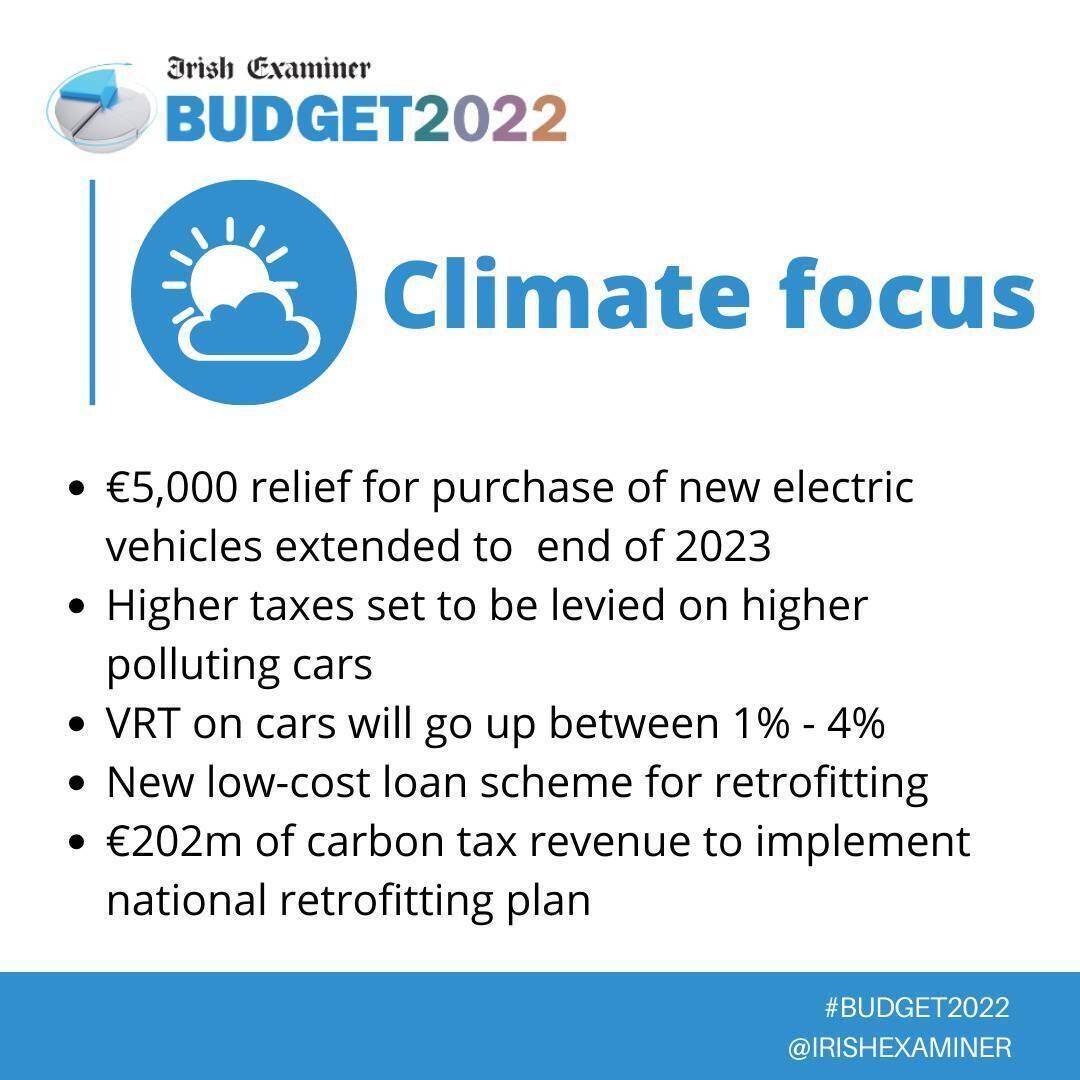
- The extension of the €5,000 relief for Battery Electric Vehicles to the end of 2023.
- For remote workers, Mr Donohoe announced an income tax deduction of 30% of the cost of vouched expenses for heat, electricity and broadband for those working from home.
- Ulster Bank and KBC will be excluded from the Bank Levy which brings in about €150 million a year on foot of their decision to leave the market. Mr Donohoe extended the levy for another year and will hope to raise €88 million this year.
Mr Donohoe also increased the excise on a pack of 20 cigarettes by 50c with a pro-rata increase on all tobacco products. He said this will bring the cost of a packet of cigarettes to €15.
A €5,000 relief for the purchase of new electric vehicles will be extended to the end of 2023, with higher taxes set to be levied on higher polluting cars.
From January, VRT on cars from bands 9 to 12 will go up 1%, cars in bands 13-15 will go up 2%, and those in the heaviest polluting range will go up 4%, with band 20 vehicles up to 41%.
The prices of both Diesel and Petrol will increase under Budget 2022.
A 60-litre tank of diesel will increase by €1.48 from midnight tonight, while a similar tank of petrol will cost €1.28 more.
In total, the Environment, Climate and Communications budget for 2022 will be €867m, with four strategic goals laid out.
The first of these is titled "Be a recognised leader in climate action", which will come at a cost of €26m.
Under this heading, the department says that it will aim to support projects in the areas most affected by a just climate transition. These include the Bord na Móna Peatlands Rehabilitation Scheme.
The money will also be used to strengthen air quality rules and enforcement, including the first-ever clean air strategy.
Under the goal of transforming Ireland's energy system, €202m of carbon tax revenue will be used to implement the national retrofitting plan, with €10m used for solar panel schemes.
These schemes will fund energy upgrades for 22,000 home energy upgrades, getting 6,000 homes to a BER of B2.
There will also be the introduction of a new low-cost loan scheme for retrofitting, the first Offshore Renewable Electricity Support Scheme to advance the offshore electricity generation of the country.
There will also be €40m for supports of the circular economy, including plans for the remediation of landfills and a policy framework for mining and minerals exploration and €18 million for connectivity and communications.
The latter will see high-speed internet delivered to 700 primary schools and more than doubling the staff in the National Cyber Security Centre from 20 to 45.
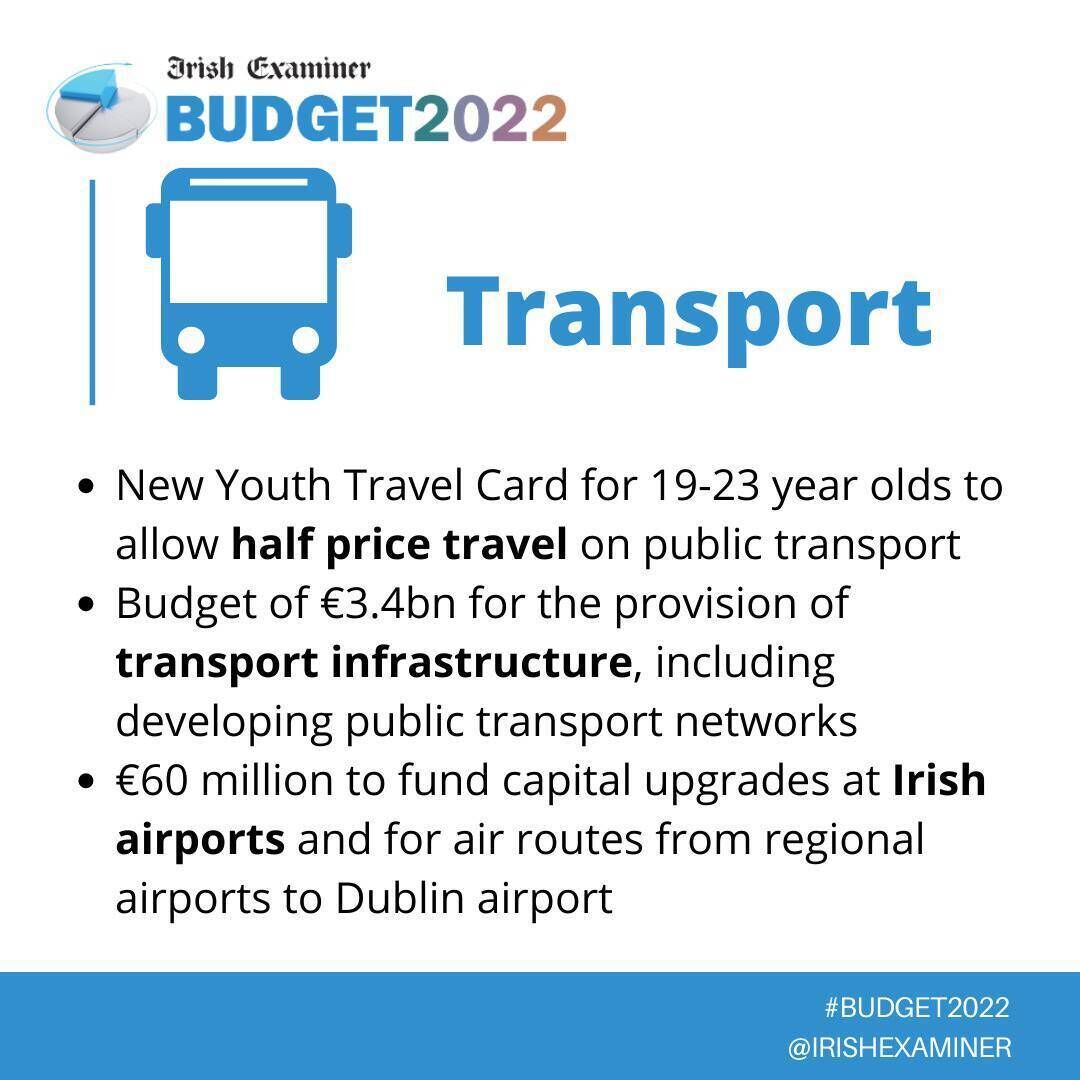
A new Youth Travel Card is being introduced for those aged between 19-23 to allow them to travel for half price on public transport. The cost of this new measure is €25 million.
A total Budget of €3.4bn is being made available for 2022 for the provision of transport infrastructure. Of that, €1.4 billion will be provided to further develop our public transport networks and to support a decarbonization of the State’s bus fleet.
There will be new funding for the roll-out of BusConnects, Metrolink and DART+.
A fund of €360 million is being made available to fund the delivery of more greenways across the country.
A total of €1.4 billion is being assigned to develop and fund major road projects outlined in the recent National Development Plan (NDP).
In aviation, €60 million is being extended to fund a number of capital upgrades at Irish airports and to help fund publicly funded air routes from regional airports to Dublin airport.

The recruitment of 800 new trainees and 400 specialist Garda staff are the key measures in the €3.1 billion Justice budget.
The additional gardaí are aimed at "prioritising visible policing in both rural and urban communities", with the staff aimed at "filling valuable specialist roles" including IT, scene of crime duties and back-office functions.
These staff will come at a cost of €28 million, while Garda operations will be boosted by €10.5 million to enhance the work of the Garda National Protective Services Bureau, which leads the investigation in more complex cases.
There will also be equipment provided for specialist units and the rollout of Garda-enabled mobile devices.
There will be €39 million for the building of the replacement facility for the Harcourt Court building on Military Road in Dublin 8, with €25 million being committed to the completion of the Forensic Science Ireland building in Backweston, Co Kildare.
A further €10 million will go towards the modernisation of facilities at Limerick Prison.
In prisons, €850,000 will be spent to recruit additional psychologists for early engagement with people convicted of sexual violence and €1 million for extra doctors and nurses in the prison system.
IT modernisation is also targeted, with €450,000 to be spent on prisons, €300,000 on the Courts Service and €5 million by the Department itself.
The recently-launched Youth Justice Strategy will be funded with €6.7 million and the Community Safety Fund will get €2 million.
There is a €3.9 million commitment to "significantly" increase the staffing numbers of the Data Protection Commission, €1.2 million for the Regularisation of Undocumented Migrant Scheme and €1.2 million to speed up processing times of the International Protection Office.
- Follow all of the Irish Examiner's coverage of Budget 2022 .

CONNECT WITH US TODAY



Be the first to know the latest news and updates