Rotunda hospital say low vaccine uptake among pregnant women part of reason for restrictions
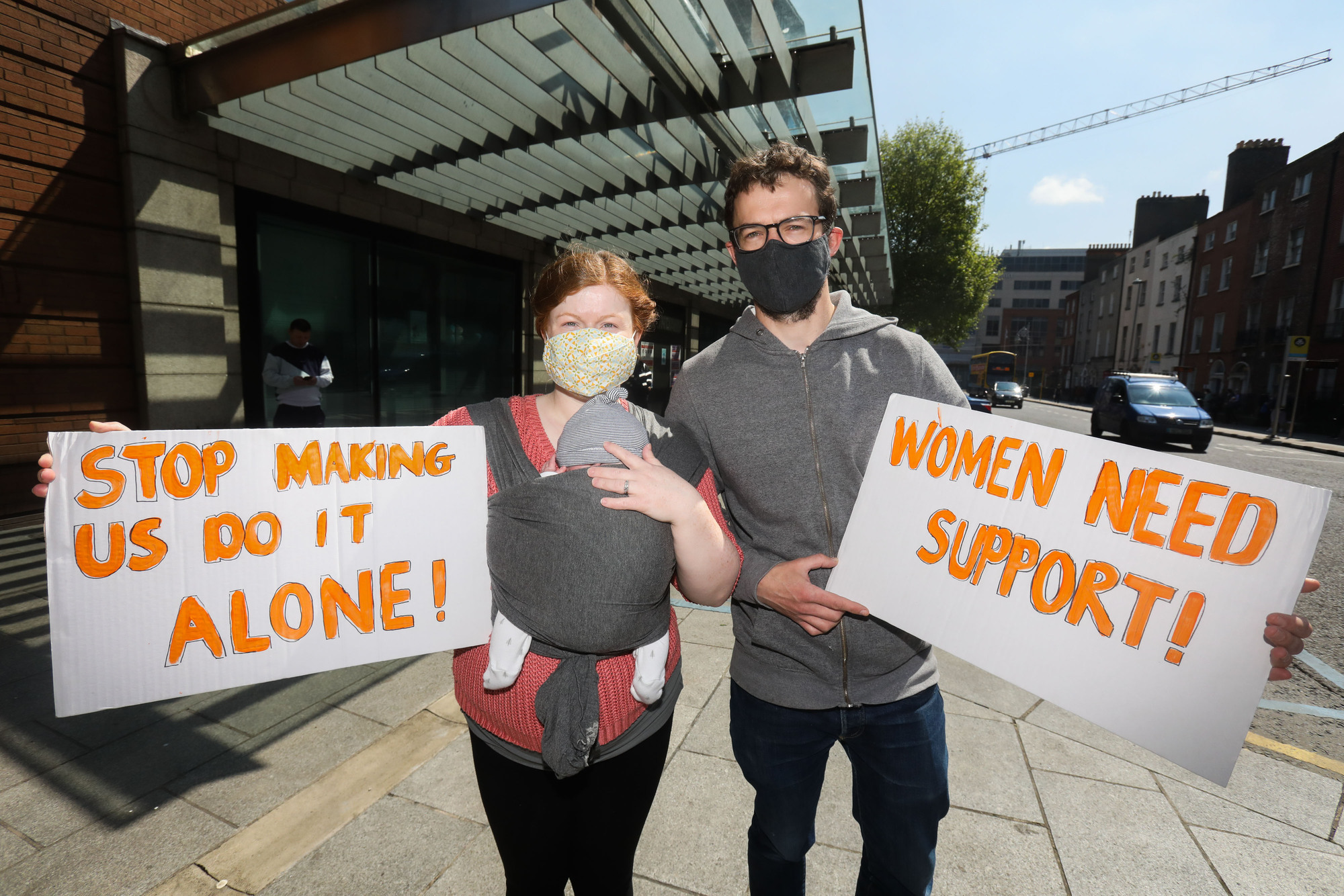
Carol Mulligan and Nigel Wheatley with baby Nora Wheatley (5 weeks) from Cabra, outside the Rotunda maternity hospital recently, at a protest against Covid-19 restrictions on partner visits in maternity care. Photo: Leah Farrell / RollingNews.ie
The Master of the Rotunda maternity hospital, Professor Fergal Malone has said that 60% of patients and partners “walking around the Rotunda hospital” were not vaccinated which meant that restrictions could not be lifted.
The hospital carries out surveys of the vaccination status of patients and their partners every week, he told RTÉ radio’s Morning Ireland.
This week only 39% of expectant mothers were vaccinated and only 41% of their partners were fully vaccinated.
“To be honest, that's disappointing. It’s not surprising that there's some vaccine hesitancy – but what that means is 60% of patients and their partners walking around the Rotunda hospital today are not vaccinated and are therefore vulnerable to Covid infection - more likely to transmit.
“If we can get that vaccination number up - we will see it being safe to relax all restrictions. I would encourage every single pregnant woman, please get vaccinated.”
Prof Malone defended the Rotunda hospital’s record on visiting hours and said there were new pathways for early pregnancy units scans, also for any exceptional news or complex situations, “we always make exceptions. That continues to happen.”
However, he pointed out that parts of the hospital date back to 1757 and there is no ventilation or air conditioning in the old building. Included in that section are the main waiting rooms for the emergency department and ultrasound department.
“There just isn't physically the space to put large numbers of adults sitting together in a confined space. The ultrasound waiting room has just 12 seats in it.
"If eight or nine mothers are sitting there, suddenly there are 16 or 18 adults because they have a partner with them in a small room that is not ventilated and not capable of being ventilated. That is a very serious risk.
"It's the same with the emergency department waiting room area – there are only 10 seats.”
Each of the hospital's eight delivery suites is private and once a patient is admitted to the delivery room - whether one cm dilated or 10cm dilated, the patient's partner will be with them “for every minute of that journey,” added Prof Malone.
But if it was not certain that a patient was in full labour, they could be in a room with six others, that was in the old building with no ventilation.
“So if you have six mothers in a single room and then suddenly 12 adults - if not vaccinated, that is a very serious risk,” he warned.
Former master of Holles Street national maternity hospital Peter Boylan says he can understand the hospital's position.
The Rotunda has said that they have had a 20% increase in births over the past year and will have over 9,000 births this year.
"You can understand the kind of difficulties that they have through basic overcrowding," said Dr Boylan.

The Midwives Association of Ireland has called on maternity hospitals to further ease visiting restrictions to offer “respectful and dignified care” to pregnant women.
Restrictions were imposed to protect women and staff during the pandemic but families have queried why they are still in place. Pregnant women can now be vaccinated against Covid-19 which carries the risk of Covid Placentitis in pregnancy.
This is the first time the association has taken a collective stance on restrictions. A spokeswoman said maternity care changed dramatically when services “entered uncharted water" during the pandemic.
“The Midwives Association of Ireland (MAI) acknowledges that the HSE and government have a duty of care to protect midwives and all other hospital workers," she said.
“It is now time to urgently turn the focus to women's human right to have respectful and dignified care.” Hospital midwives, who are employees of the HSE, have been in “a very difficult position” she said.
“To those expectant parents accessing maternity care; we see you, we hear you and we care,” she said.
In March 2020 the association wrote to the HSE and Department of Health with suggestions including working with community midwives and providing more antenatal care outside of hospitals.
“The MAI at that time acknowledged that we were then in a very fluid and developing situation,” the spokeswoman said. “However, 19 months into the pandemic and particularly following the high rates of uptake in the vaccination program, we would consider that these alternative solutions should be revisited immediately.”
The MAI welcomed an international study on restrictions led by Professor Joan Lalor at Trinity College Dublin which found that many restrictions are not evidence-based.
The midwifery spokeswoman said: “Most importantly, concerns were identified that restrictions may have a long-term negative impact on mothers and their families.”
She also warned of the pandemic’s effect on midwives.
“We acknowledge the impact this has had both physically and emotionally, impacting not only on themselves but on their families and workplace too during this extraordinary life event,” she said.
Over the summer some maternity hospitals were able to ease restrictions. This was most obvious in the standalone Dublin hospitals, and recently University Hospital Galway (UHG) was praised for changes.
Campaigner Yvonne Aherne said she is relieved and grateful her husband can attend their 20-week scan next week in Galway.
Ms Aherne, a representative of the Irish Birth Movement, said: “I am very lucky, it’s a bit different now. They have gone beyond the (HSE) guidelines and relaxed the restrictions beyond them.” However she said parts of the pathway remain inaccessible.
She said: “Still my husband couldn’t be with me for my antenatal appointment, the first time hearing the heart-beat. That was a huge loss for him.” She took part in protests outside the hospital, and described the earlier part of her pregnancy as “isolating and difficult”.
Ms Aherne said it is hard to understand why the hospitals cannot ease restrictions at similar rates, or why they do not offer partners PCR tests. A spokeswoman for UHG confirmed changes to restrictions are available on their website.

CONNECT WITH US TODAY



Be the first to know the latest news and updates