Taoiseach hails Ballymurphy families 'extraordinary perseverance' after inquest's innocent verdict
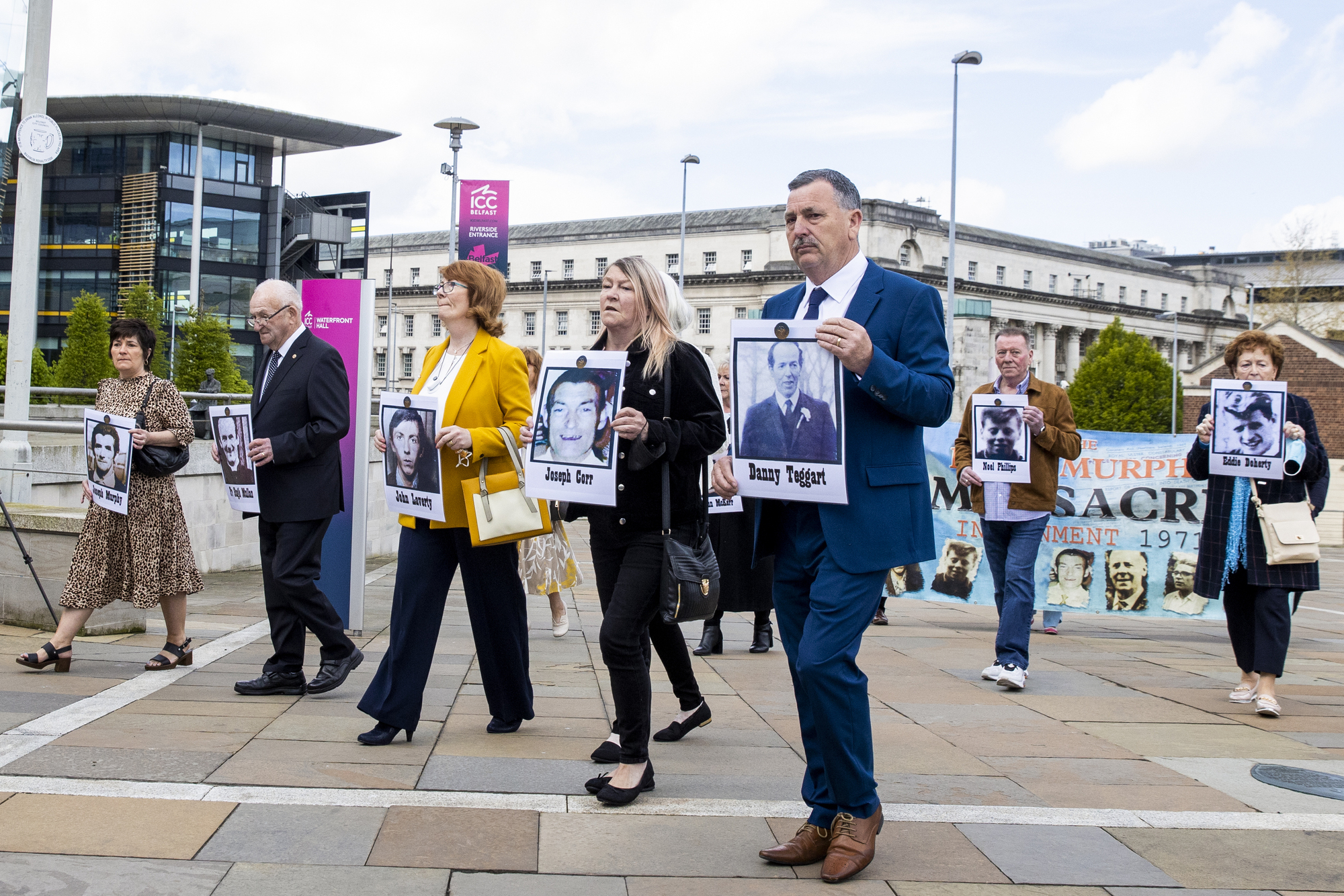
Taoiseach Micheál Martin has paid tribute to the families of those killed in the Ballymurphy killings in 1971, saying Dáil statements will be heard next week.
Speaking in the wake of the inquest verdicts, Mr Martin said the Government stands in solidarity with the Ballymurphy families.
"The Government has supported the Ballymurphy families for many years and we will continue to stand in solidarity with them.
"The legacy of violence in Northern Ireland remains a deep wound," he said in the Dáil on Tuesday afternoon.
"We also should at some stage, maybe next week, have statements on the Ballymurphy inquest.
"Our thoughts today are with the families of those who were killed unjustifiably in Ballymurphy on those terrible three days in August of 1971," he said.
The inquest has been clear in its conclusions that all were entirely wrongly killed, all were entirely innocent, he said.
"I myself would have toured that area as Minister for Foreign Affairs.
"I acknowledge the extraordinary perseverance and commitment of the families involved who have waited nearly 50 years to get some sense of justice for their loved ones.
"It speaks more broadly to the legacy issue more generally.
"This inquest and its outcome deserve to be debated in this House," he said.
Ten people killed in west Belfast 50 years ago were “entirely innocent”, a coroner has ruled.
There was applause at Belfast Coroner’s Court as the findings were delivered following fresh inquests into the 10 deaths in Ballymurphy in August 1971, which included a mother-of-eight and a Catholic priest.
Presiding Coroner Mrs Justice Keegan acknowledged it was a chaotic time but ruled that the use of force by soldiers had been “disproportionate” in the nine deaths the Army was found to have been responsible for.
She ruled out any paramilitary involvement by any of those killed, and described them as “entirely innocent of any wrongdoing on the day in question”.
There was applause within the courtroom as she made that pronouncement.
Ten fresh inquests were heard in terms of the five incidents in which they occurred.
Parish priest Father Hugh Mullan, 38, and Frank Quinn, 19, were shot in the Springfield Park area of Ballymurphy at around 9pm on August 9.
Around the same time, outside an Army barracks at the Henry Taggart Hall in Divismore Park, Noel Philips, 19, Joseph Murphy, 41, Joan Connolly, 44, and Daniel Teggart, 44, were fatally wounded by gunfire.
The following day, Eddie Doherty, 31, died after being shot in the Whiterock Road as he came across an encounter between soldiers and protesters who had erected a barricade across the road.
In the fourth incident, on the third day of shooting, Joseph Corr, 43, and John Laverty, 20, were shot in the Whiterock Road area in the early hours of the morning. Mr Corr died from his injuries 16 days later.
And later that morning former soldier John McKerr, 49, was shot later in Westrock Drive, close to Corpus Christi Church as he took a break from maintenance work. He died from his injuries on August 20.
Mrs Justice Keegan described the inquests as the longest-running to date in Northern Ireland.
While outlining the context in which the deaths happened, in terms of the start of what has become known as the Troubles and the introduction of the policy of internment without trial on August 9, she said she assessed each incident on its own facts.
The standard of proof used was on balance of probability.
She noted that, 50 years on, the deaths remain “stark” for the families.
Responding to the delivery of the findings of the Coroner in the Ballymurphy inquest today, the Minister for Foreign Affairs Simon Coveney TD said the findings of the coroner's report cast a "tremendous new light on one of the darkest pages" of The Troubles.
He said they will come as relief and vindication for the families of the victims.
Mr Coveney said: "Only through a collective approach can we hope to deal with these issues comprehensively and fairly, and in a way that responds to the needs of victims and survivors, and society as a whole.”