Schools facing 'serious challenges' in securing substitute teachers
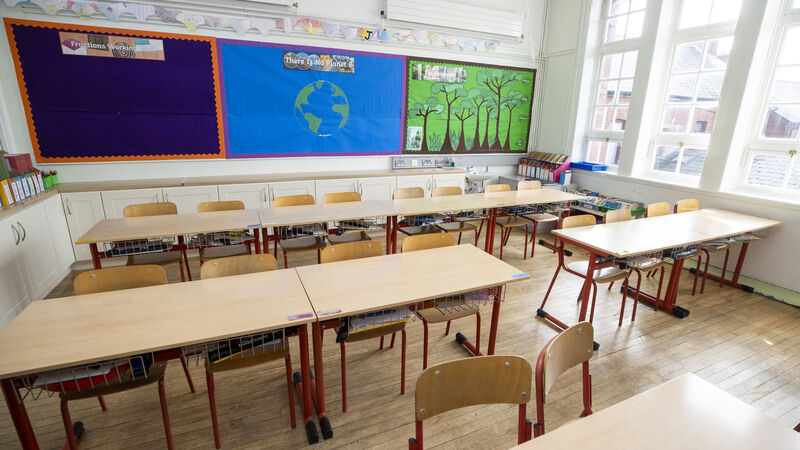
The Teaching Council has written to all teachers asking them to register to be available for emergency substitution needs if they are not currently working, or if they have the capacity to be available. Picture: Liam McBurney/PA
Ahead of the return of students to in-person learning on Monday, schools are facing “serious challenges” in securing substitute teachers, at both primary and post-primary level.
The Teaching Council has written to all teachers asking them to register to be available for emergency substitution needs if they are not currently working, or if they have the capacity to be available.
In an email to teachers, seen by the , the council said the reopening of schools and keeping them open safely during Covid-19 is an absolute priority for the State.
“Schools are facing serious challenges in securing substitute teachers at both primary and post-primary level.
“One of the most critical areas of need is ensuring that as many registered teachers as possible are available to fill substitution requirements arising because of Covid-19. Schools need more substitute teachers than ever before to fill the resulting gaps which Covid-19 has imposed across the school community.”
Teachers have been encouraged to register with 'Sub Seeker', and to keep their availability up to date on a weekly basis. "These are extraordinary times," the email added."By encouraging the maximum possible availability among teachers for ongoing and current substitution needs, we can collectively ensure that our school communities receive all the help and support they need."
Meanwhile, the three teachers' unions have written a joint letter to the Department of Education, seeking an "urgent meeting" about the rollout of the Covid-19 vaccine.
At their annual conferences earlier this week, the three unions — the Teachers' Union of Ireland, the Association of Secondary Teachers in Ireland, and the Irish National Teachers' Organisation — each agreed to ballot for industrial action, if the Government did not re-prioritise them.
In a letter sent to the department, the unions said they are "very anxious" to engage with the relevant officials to "get clarity on timeframes for the vaccination of our members".
"We would also wish to discuss several anomalies in the rollout of the vaccination programme that have arisen, and which have impacted on educational settings already," the letter said. "We are keen to work with you to progress the rollout of vaccines, so that all teachers can be given assurance that they will be fully vaccinated at the earliest possible opportunity."
The letter also sought reassurance that pregnant teachers, those in higher-risk categories, and those who work in special schools, special classes, and also home-school community liaison teachers, would be prioritised within the education workforce.
Education Minister Norma Foley has previously explained that the re-prioritisation was based on the most recent clinical guidance, which shows that age is the biggest predictor of who will be most severely affected if they contract the virus.
Data from the National Immunisation Advisory Committee (NIAC) shows that if you compare a healthy 20-to-34-year-old person with someone aged between 55 and 65, the older person is 70 times more likely to die from Covid-19, and more than 20 times more likely to be admitted to intensive care.


CONNECT WITH US TODAY



Be the first to know the latest news and updates