Stricter restrictions on international travel to remain for the 'foreseeable' future
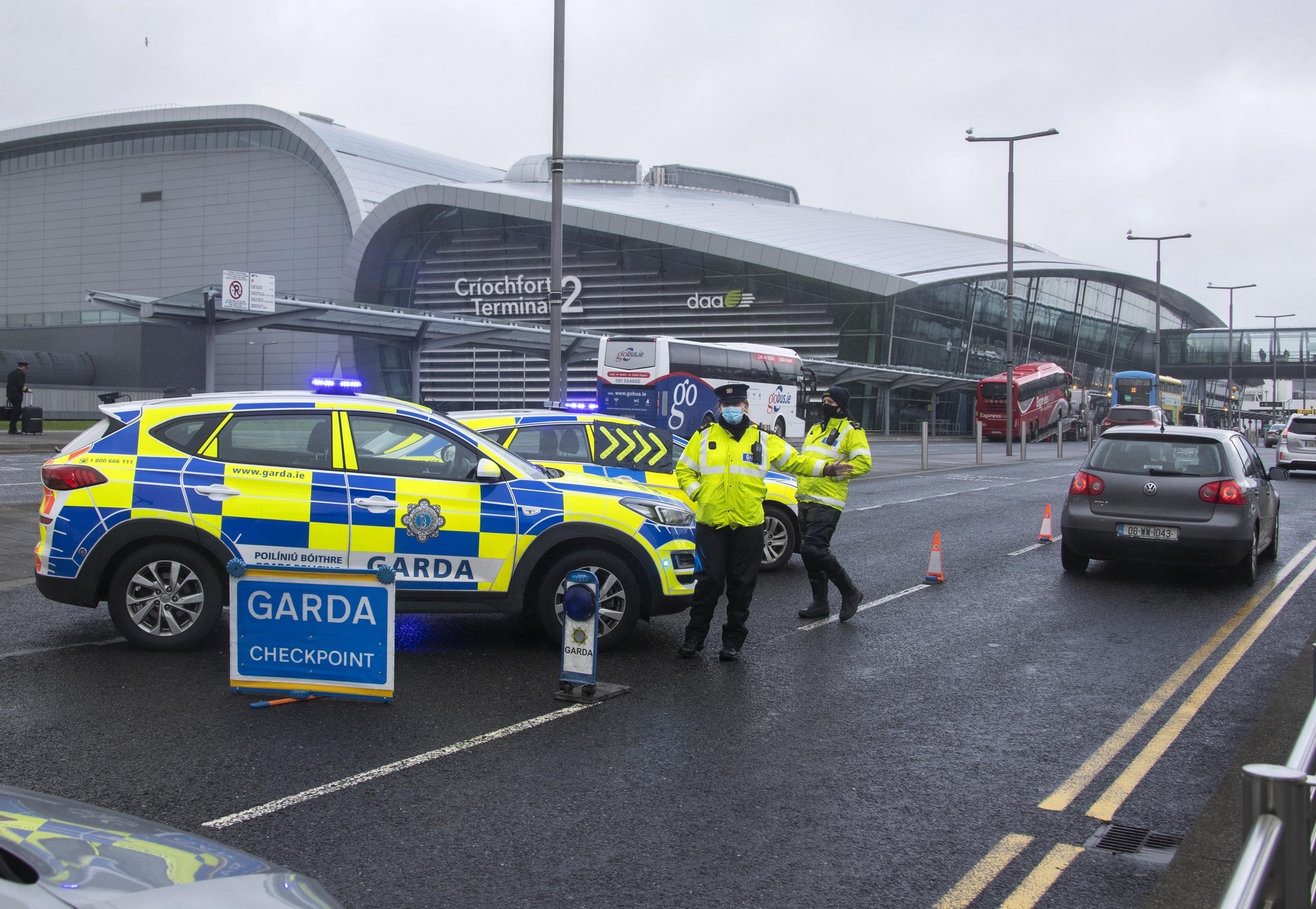
Strict travel measures will remain in place for the foreseeable future, Darragh O'Brien has said. Pictured are Gardai manning a Covid-19 Checkpoint at the entrance to Terminal 2, Dublin Airport. Picture: Colin Keegan, Collins Dublin
Stricter measures around international travel will remain in place for the “foreseeable” future, Housing Minister Darragh O’Brien has said.
Speaking on Monday morning, he said that while air connectivity is crucial for Ireland as an island nation, the first priority is to suppress the virus.
“For the foreseeable future, as vaccines are being rolled out across the European Union in Ireland and in Britain, that it is likely that we will see stricter measures remaining in place,” he said.
“We're within the European Union itself. And obviously, we look at what our what our European Union and colleagues have done. And indeed with Britain, and they've grappled with this issue, too. It's not just as easy that you click your fingers and borders closed, and quarantine comes in place.
“But in the short term, and medium-term, of course, we're going to continue to protect our country, protect our borders and take whatever measures are required to do that,” he said.
He said the measures that we have in place right now, are “extremely strict.”
“We want to get to a situation whereby life returns back to normal as soon as we can, later this year or early next year,” he said.
Mr O’Brien said that as an island, we need connectivity into the future as well.
He noted that "less than 1% of the third wave of infection is related to foreign travel".
This comes as HSE Chief Executive Officer Paul Reid has said he would find it “frankly inexcusable” for a frontline worker to refuse to take a Covid-19 vaccine.
Speaking on Monday morning, Mr Reid was asked about mandatory vaccination of staff and said while take-up of the vaccines has been “very high” among staff and residents, there is a minor issue of those refusing to take it.
“Frankly, I would find it inexcusable for someone not to take the vaccine,” he said.
“We've seen almost 100% of residents and high 90s in terms of staff taking up the vaccine. Legislation does facilitate that if a risk assessment determines that there is a need to take a vaccine, in such a frontline role, not just in nursing homes but in any frontline care role, legislation does facilitate that with deployment then to another roll,” he said.
“We've had a huge take-up of the vaccine. It is a very minor issue but you know it is an issue. It's a smaller number,” he added.
As for the vaccine rollout, Mr Reid said the country can expect more than one million vaccines to be delivered from May and June. He said the only issue about delivering the vaccine has been supply.
“Whatever volume of supply we will vaccinate, if those levels of supply come then we will vaccinate,” when asked if the entire country could be vaccinated by September.
He also said the South African variant of Covid-19 is “will have a low presence in Ireland” amid reports of its resistance to vaccines.
Mr Reid, speaking on , sought to allay fears that the worrying reports of that resistance to the AstraZeneca vaccine is a worry here.
Speaking as 21,000 doses of the AstraZeneca arrived into Ireland, he confirmed that frontline workers including ambulance staff and fire brigade staff will begin to be vaccinated this week.
Mr Reid admitted that he and his team had to rewrite their plan for the vaccine roll-out last week when the National Immunisation Advisory Committee (NIAC) recommended the AstraZeneca not be given to older patients.
“Yes, we have had to rewrite our plan. But it is the right decision. This first phase was always going to be bumpy, it has been bumpy,” he said.
Meanwhile, HSE Chief Clinical Officer Dr Colm Henry has reiterated the HSE's priority to get over-70s vaccinated as quickly as possible.
“No person will be left behind,” he told RTÉ radio, responding to concerns that some people in the over-70 age group would not be able to leave their homes to be vaccinated.
The sequence of vaccinations will be from the highest age downwards, he said. The great majority will be able to travel directly to either their GP’s surgery or the vaccination hub, but the HSE would make sure that vaccinators would go to “everybody’s home if absolutely necessary.”
There would have to be “agility and flexibility” with the plan to roll out the scheme through GPs.
CONNECT WITH US TODAY



Be the first to know the latest news and updates