Watch: Planets align for extraordinary 'Christmas star' solstice spectacle
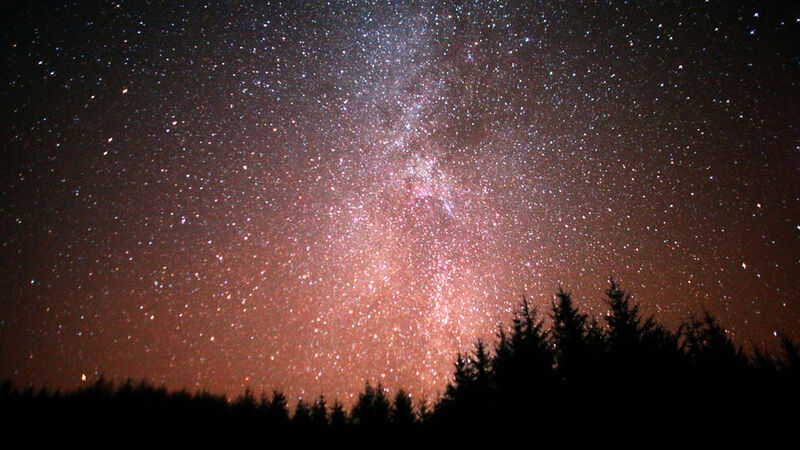
Saturn and Jupiter will come the closest they have done in hundreds of years, creating what the researcher described as a "spectacular event in the sky" tonight - which also happens to be the winter solstice. Picture: International Dark Sky Associati/PA Wire
Tonight marks a spectacular event - an event in our solar system so rare that it can take decades to get a good view.
Jupiter and Saturn will appear closer to each other than they have done in hundreds of years, which also happens to be the winter solstice.

So-called ‘conjunctions’, where objects appear very close to each other in the sky, are not rare, but this is special, astronomers have said.
Education and outreach officer at CIT Blackrock Castle Observatory (BCO) Frances McCarthy told the Irish Examiner the event would be a treat for those gazing in wonder at the sky.
Ms McCarthy said the science behind the event starts with planets going around the sun, farther-away planets go around more slowly, with Earth going around in a year. It takes Jupiter 12 years, and Saturn 29.5 years.
Skywatchers, you're in for a once-in-a-lifetime treat! Jupiter & Saturn are doing a planetary dance that will result in the Great Conjunction on Dec 21, just after sunset. Find out:
— NASA (@NASA) December 20, 2020
🤩 When and where to look up
📷 How to photograph the conjunction
Visit: https://t.co/SdQSLex2Ex pic.twitter.com/DkaB5XyO9B
“So Jupiter is like a runner on a track, with Saturn on the next track out — which is a larger orbit, and the planet is going a bit slower,” she said.
"Jupiter will go around the track about two-and-a-bit times, while Saturn goes around once. At the same time, Earth is zipping around on an inner track, going around 12 times for every time Jupiter goes around.
“From our perspective, we are looking across the other side of the track and seeing two runners as we look in one direction — one is closer to us [Jupiter], and one is much further away [Saturn] — but we are looking the same direction to see them.
"The sun is a little bit in the way, as they are on the other side of the sun from us, so we can see them just at sunset.” They line up from our perspective about every 20 years, Ms McCarthy said.
“The last time was May 2000, but at that time Jupiter and Saturn were also on the opposite side of the solar system, so the sun was really in the way and it was very difficult to see. In 1980 and 1981, they lined up a few times, but not quite as closely as they are right now,” she said.
Monday is an exceptional event for two reasons – we can see it, and they are really close, according to Ms McCarthy.
“To consider how close, we measure position in the sky in degrees. If two things are one degree apart, they are about twice the width of the full moon apart. These will be a lot less than a degree apart — one-10th of a degree.
"When we talk about the 'closest' conjunction, we’re talking about how close they appear to each other in the sky. They are still physically really far apart.
“So you need to go when the planets are lined up, which Nasa did with the Voyager Missions in the 1970s, using the every 175-year alignment of the outer planets."
Unfortunately, Astronomy Ireland predicts the weather tonight will ruin the view of the conjunction for many in Ireland.
For those who have a clear view, they are advised to look to the southwest after sunset.
Alternatively, check out the livestream below from CosmoSapiens.