Covid-19: Officials considered limiting contacts to six for at least six months
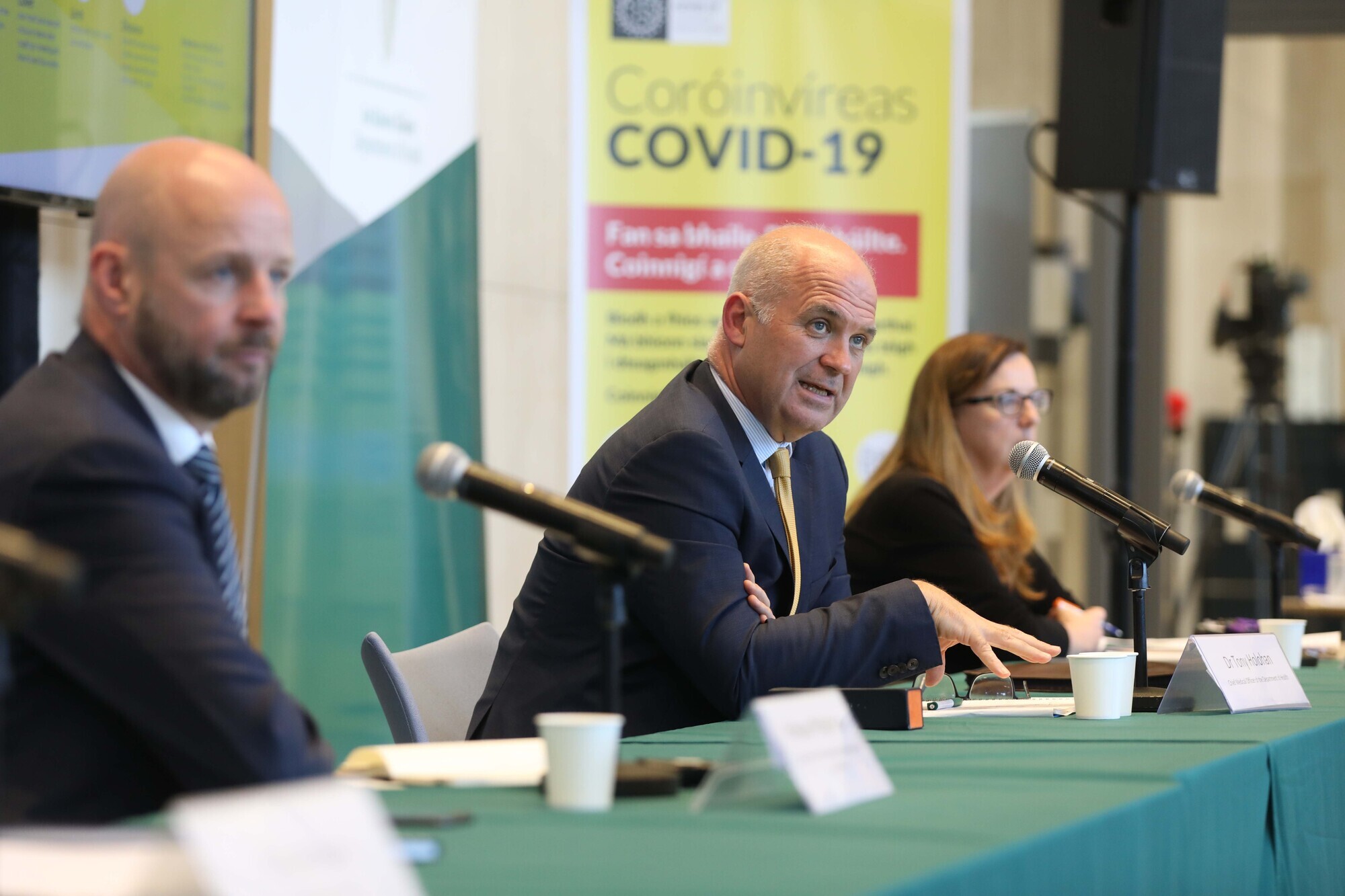
Professor Philip Nolan, Chair of the NPHET Irish Epidemiological Modelling Advisory Group; Dr Tony Holohan, Chief Medical Officer, Department of Health; and Kathleen McLellan, Assistant Secretary, Department of Health at the NPHET daily briefing in the Department of Health. Picture: Leah Farrell / RollingNews.ie
Public health officials considered a proposal by the Department of Health to reduce Irish people’s allowable social contacts to a strict group of six for at least the next six months, but dismissed it for being “unrealistic”.
Newly released minutes detail the considerable deliberations the National Public Health Emergency Team (NPHET) has engaged in on how best to reduce virus restrictions coming up to Christmas.
They also note a general malaise among the public regarding the extended nature of the pandemic, and the nature of Irish health advice and restrictions.
“Perceived unfairness of restrictions is beginning to affect overall trust in guidance, but people are willing to make some sacrifices if they can do the things they value most,” the meeting of November 5 noted.
The minutes say the pandemic has now become “normalised”, with people now focused “on how to cope with the restrictions” in terms of finances and mental health.
However, the team noted that the introduction of seemingly arbitrary or illogical restrictions is becoming less viable.
“People want to know the Government strategy for the next year and to understand the logic behind the guidelines,” the minutes state.
“In the absence of this they feel blinkered and disempowered.”
The minutes show reservations among NPHET members when considering the ‘safe socialising’ proposal brought to the table on November 5 by the Department of Health’s communications team.
Key to that proposal was the idea that “people should socialise with an exclusive group of six people from outside their household for the next six months or until a vaccine is distributed”, with dispensation for young adults living at home to have a “group of six separate to their parents”.
However, many members of NPHET saw the proposal as a non-runner, particularly given its reliance on the implementation of a successful vaccine.
They also noted that the idea could be seen as “exclusionary”, particularly for younger people.
Regarding the then pending lifting of Level Five restrictions, NPHET repeatedly stressed the special importance of the Christmas period for Ireland and agreed that restrictions should be temporarily stood down some time after December 1 - when the lockdown was due to end - before being reapplied for three weeks to gauge the fallout from the festive period.
That specific period has come to fruition, and will apply from December 18 until January 14.
This elevation of the Christmas period as being of special importance ran contrary to NPHET’s own public research however, detailed in minutes from the following week’s meeting on November 12, which noted that only just over 50% of people were in favour of a “special” easing of restrictions at Christmas.
Separately, the introduction of wastewater surveillance as an early warning system for the detection of surges in the virus has been approved, with the Health Protection Surveillance Centre and the National Virus Research Laboratory to work in tandem to that end.
The finished project could see 69 wastewater treatment plants across the country, covering 84% of the population, sampled weekly to detect the prevalence of Covid on a regional basis.


CONNECT WITH US TODAY



Be the first to know the latest news and updates