Dig finds severed foot with skeleton in Co Roscommon
Mystery surrounds the discovery of a skeleton that had a severed foot placed between its legs.
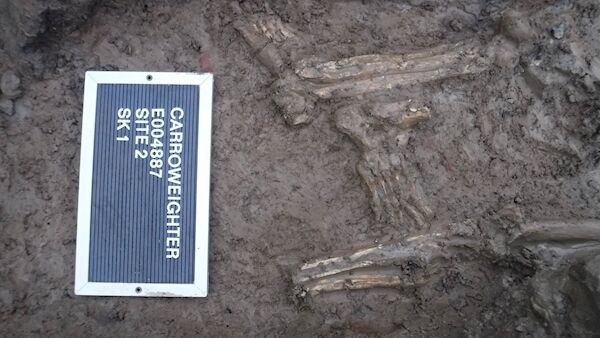
The remains were uncovered by archaeologists working for Transport Infrastructure Ireland (TII) during excavations at the N60 Oran scheme in Co Roscommon.
They were unearthed during one of 27 excavations by TII on road projects in Ireland this year.
TII archaeologist Michael Stanley said two “enclosure sites” stood out as unusual, among several sites excavated on the Oran scheme.
“The people who created the enclosures appear to have piled the material excavated from the deep ditches to form a bank on the outside, rather than on the inside,” said Mr Stanley.
“This suggests a prehistoric date and ceremonial function for these sites.
“However, a human skeleton, with its severed foot placed between its legs, was discovered at the base of one of the ditches and scientific dating is eagerly awaited to help try and solve this grisly mystery.”
A sheaf of flax, approximately 1.5 m long, was found in the ditch of an early medieval ringfort, called Lissaniska (‘the fort of the water’), on the N70 near Milltown, Co Kerry.
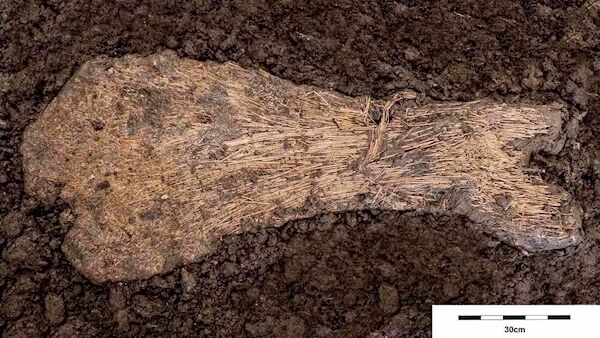
Because of the environmental conditions in the ditch, the normal decay processes were inhibited and the organic remains were preserved.
Flax is used to make linen and Mr Stanley said this is “the first time that direct evidence has been found for its cultivation in early medieval Ireland. “
This unique find is currently being conserved and studied by specialists.
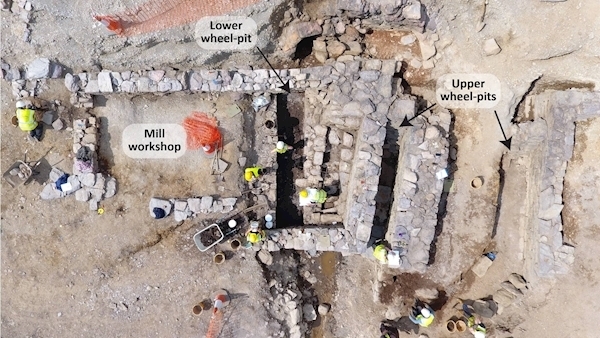
Meanwhile, a previously unknown, multi-phase watermill site was discovered at Killaclug, Co Cork, during archaeological investigations on the N22 Baile Bhuirne–Macroom road project.
The excavations revealed two phases of watermills and an associated mill building.
Unusually, the upper and more recent mill had two wheel-pits side by side.
The mills used the water from a local river to power mechanical processes, such as milling, grinding, rolling, or hammering.
Post-excavation analysis of the excavation findings is ongoing, but the structures broadly date from the post-medieval period.
Mr Stanley pointed out that an Ordnance Survey (OS) triangulation tile used by 19th-century mapmakers was an intriguing find, made during the excavation of a medieval enclosure on the N81 Knockroe bend realignment in Co Wicklow.
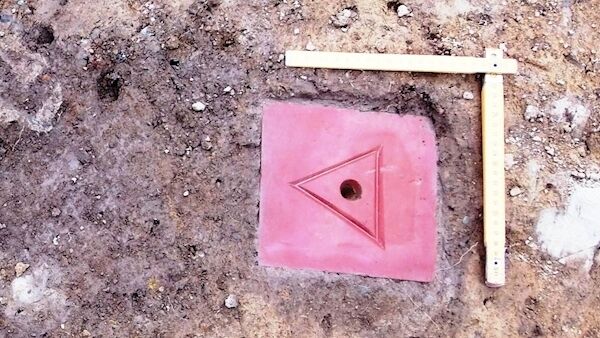
The ceramic tile, measuring 174mm x 171mm x 32mm, had been set in a carefully dug hole by Royal Engineer soldiers, called sappers.
The tile had an incised triangle, with a conical hole in the centre, marking this fixed coordinate.
It is marked as a trigonometrical station on the OS 25-inch map of 1907-9, but nothing is depicted here on the first-edition (1839), OS 6-inch map.
The tile represents a secondary ‘trig point’, derived from a main trigonometrical station.

CONNECT WITH US TODAY



Be the first to know the latest news and updates