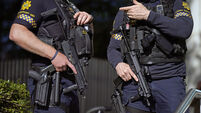
Garda chief: Charleton report a ‘clarion call’ for reform of force
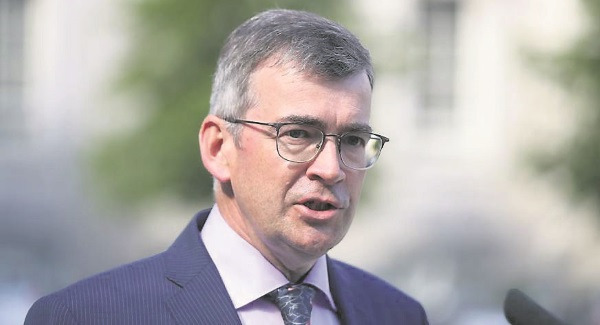
Garda commissioner Drew Harris has said the recommendations of Mr Justice Peter Charleton were a “clarion call” for action to reform the police force.
He advised the Oireachtas justice committee yesterday of a planned afternoon meeting with whistleblower Sergeant Maurice McCabe to discuss the Disclosures Tribunal report.
Sgt McCabe, who has been on sick leave for the last two years, met the commissioner at an undisclosed location for the private meeting.
The Garda chief told Fine Gael senator Martin Conway he had telephoned the whistleblower on the afternoon the Disclosures report was published, on October 11.
He said “very bitter lessons” had been learned and gave his “absolute assurance” that Garda members could voice their concerns and be taken seriously.
Mr Justice Charleton found that Sgt McCabe had been the subject of a “campaign of calumny” by former commissioner Martin Callinan and former press officer David Taylor.
The Supreme Court judge had expressed serious concern about the discipline of the organisation and warned that a country with an undisciplined police force was “at risk” from the force.
He said gardaí had seven obligations: To have pride in their uniform and work; to always be honest; to be visible; to be polite; to serve the people of Ireland; to treat their obligation to the public and above that to each other; and to analyse issues.
Mr Harris told the committee he had read the report, particularly the recommendations.
“The last few pages I feel were written towards me, a clarion call for action,” he said, adding he would take action to reform the force and reassure people it was there to protect them.
Asked by Fianna Fáil justice spokesman Jim O’Callaghan if An Garda Síochána was a disciplined force, Mr Harris, taking a moment, said:
I think it is a disciplined force, but it is not helped by its disciplinary procedures.
He said the Charleton tribunal, the Policing Commission, and the Morris tribunal had found the disciplinary process was “not fit for purpose”. He said they needed a management intervention process to deal with poor performance by way of support, supervision, and training.
He said cases of serious misconduct, where trust in an individual had “entirely broken down” and the person had “no place” in the organisation, should be dealt with by a disciplinary process.
Addressing concerns on police visibility, he said the organisation will be more visible due to increasing Garda recruits and transfer of gardaí from administrative roles to the frontline.
Sinn Féin justice spokesman Donnchadh Ó Laoghaire said the commissioner had introduced an effective ban on overtime until the end of the year.
He said that, when canvassing in south Dublin, he had been told gardaí did not have adequate numbers to deal with racially motivated attacks in Inchicore or safely respond to serious anti-social behaviour in Drimnagh.
Mr Harris said there was only a “slight tightening of the belt”, that there was still €7.3m available for overtime, and that he had to take “corrective action”.
He said the Policing Commission report would provide a roadmap for the next three to five years.
Mr Harris appeared to differ with the commission on whether all gardaí should be community police, saying that he envisaged “dedicated community policing teams” in urban areas, with a “hybrid model” in rural areas, where gardaí were both community police and responders to incidents.