Waterford man who sent money to Isis became radicalised in the UK, family says
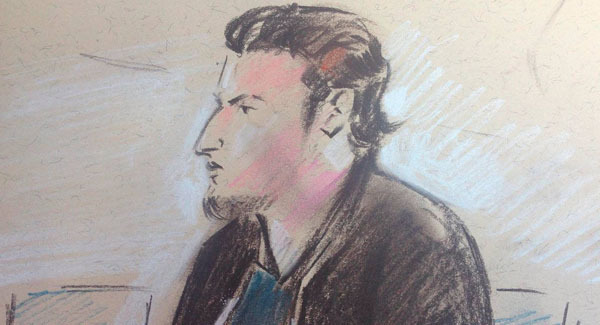
Hassan Bal, who was sentenced today for sending money to Islamic State, was born in the UK in 1991, to a UK-born mother of Irish descent and a Turkish father.
The family moved to Wexford in 2005 but the parents separated and the father moved back to the UK. Hassan Bal then moved to Waterford with his mother and siblings.
When he was 20, he moved back to the UK to be with his father and stayed there until June of 2014.
A report was carried out on the accused by Dr Daniel Koehler of the German Institute of Radicalisation and De-Radicalisation Studies, who found that he initially had a “strict Muslim” upbringing but it was the father who was the “dominant presence” at that time.
“There was a period of time, as he grew up, in which things were much less strict and he became very guilty about his feeling that he wasn’t a good Muslim,” his senior counsel Giollaoisa O Lideadha said, a point agreed by Superintendent Anthony Pettit who said the accused felt “he was living a western lifestyle, against his beliefs”.
Part of dealing with that guilt was to explore and adopt “more and more extreme religious beliefs,” the court heard.
War in Syria
The war in Syria was also heavily influential on his thinking, as he perceived a “non-Muslim, brutal dictatorship” in place, which added to his sense of guilt that he wasn’t doing enough “to protect the victims of war”.
It was during his time in the UK between 2011 and 2014 that he became radicalised, according to his family, the court heard.
In April 2015, he made arrangements to go to Syria but was turned back at Attaturk Airport in Istanbul.
Hassan Bal did some training as an electrician when in the UK and was married at the time of his arrest in April of 2017. He has been in custody since that time and his wife gave birth to their daughter.
In a letter written to the court, the accused said: “I don’t know how to put into words how deeply sorry I am for what I have done, and how remorseful”. After his arrest he said he “came to my senses,” he said.
“My eyes started to open and I saw what I was doing was wrong and that my actions didn’t aid the Syrian people”.
He appealed to the judge: “My life is in your hands.”
He wanted to become a “positive” influence, against the use of violence, his lawyer said.
The court heard that Hassan Bal was a “valued member” of the Islamic community in Waterford.
“It is in the public interest that Hassan Bal is rehabilitated into society on his release,” Judge Eugene O’Kelly said. “He will face many challenges re-asserting himself into daily life, but the hope is that he will be able to participate fully in society.”
An unprecedented case
Mr Bal, who admitted sending funds to Islamic State was in contact with “medium to high level” operatives in the international terrorist group, and tried to travel to Syria to fight in the ongoing war, has been jailed for two and a half years.
In the first prosecution of its kind in this country, 26-year-old Hassan Bal from Waterford admitted unlawfully transferring €400 for use by Isis and to attempting to collect money for the group.
His activities were detected following a newspaper sting and an investigation by a number of police forces.
Judge Eugene O’Kelly found at Waterford Circuit Court that the accused had the confidence of “significant members” of Isis and had proven his credentials to them by attempting to travel to Syria to join them.
He sentenced Hassan Bal to four and a half years in prison, with two years suspended, for attempting to collect funds for Iris and three years, one suspended, for sending funds to the terrorist group. The suspensions were on condition that he remains “totally disassociated” with any group promoting “a radical view of Islam”.
The investigation started in 2015 when an investigative journalist with the Daily Mail in London, Omar Wahid, created an account on the Kik social media network and made contact with Omar Hussain, known in the UK as “the supermarket jihadi,” with the intention of giving Omar the impression there was money available for Isis, Superintendent Anthony Pettit told the court.
The journalist received a message to say Isis was “desperate for money” to assist with its activities to expand in Syria. In the same message, Omar Hussain told the journalist to contact an Abu Issa Amriki, a jihadist based in Isis-controlled Syria.
The journalist, Mr Wahid, did this via Kik and Amriki eventually suggested he contact a “brother” who was in the UK.
A few days later, the journalist was given the name of an individual, Abu Abdul Rahman Britani, which was a name being used on Kik by Hassan Bal.
He made contact with Bal and a total of 435 messages were exchanged. Mr Bal had a brother in London, Omar Bal who was changing his name to Adam Locksley, and an arrangement was made with the journalist by Hassan Bal whereby the journalist would make a “drop-off” of money in an envelope at a builder’s merchant in London, and this would be collected by Hassan Bal’s brother. The latter had no knowledge of what was going on and simply thought he was doing his brother a favour.
The journalist contacted the Metropolitan Police in London, just after the drop-off was made. The envelope did not contain money, but instead had a street guide “to bulk it up”.
Complex investigations
The investigations which followed were “necessarily trans-jurisdictional and complex,” Superintendent Pettit said, and led to Hassan Bal’s address in Waterford. Bal was arrested on December 22 of 2015.
After the drop-off didn’t include any money, the journalist involved received various messages from a number of people, including Hassan Bal, “giving out” and that he had “taken him for a ride”. Some of the messages were “threatening in nature”.
One message found on Bal’s phone after his arrest said “I swear brother, get me some toys and I will go straight to the Daily Mail”. There was also a photo of him in combat dress with an imitation pistol and gardaí found a Western Union money transfer slip in his bedroom, in the amount of €400 and dating from October 2 of 2015.
While being interviewed by gardaí in December 2015, Hassan Bal accepted he had arranged the drop-off but said the money wasn’t intended for Isis, but was a fraud for himself or a charity.
His phone also had a document containing guidelines for travelling to Syria as well as propaganda videos showing executions and suicide bombs.
The accused was arrested again on April 27 of 2017 and more contents of his phone were put to him and he accepted that the money was going to Isis. “He accepted it was meant to be used for fighting in Syria.” Both Omar Hussain and Abu Issa Amriki were “prominent members of Isis.”
While being questioned by Giolliosa O Lideadha SC, defending, Superintendent Pettit said the two people Hassan Bal was in contact with were at a “medium to high level within [Isis]”.
Hassan Bal pleaded guilty in January at the circuit court to unlawfully transferring €400, by means of an An Post/Western Union transaction, to a Stevo Maksimovic in the Bosnian city of Brako on October 2 of 2015.
This was done with him intending or knowing that the money would be used in whole or in part for the benefit of Islamic state.
He also pleaded guilty to communicating by phone with an intermediary in London on October 23 of 2015, in an attempt to collect or receive cash for Islamic State, from a person known to him as Omar Abu Azid, at an address at Geron Way, London.
Both charges are contrary to Section 13 of the Criminal Justice Act (Terrorist Offences) of 2005 and the maximum sentence is 20 years in prison.