I have been vindicated, says Fiona Doyle after rapist father jailed
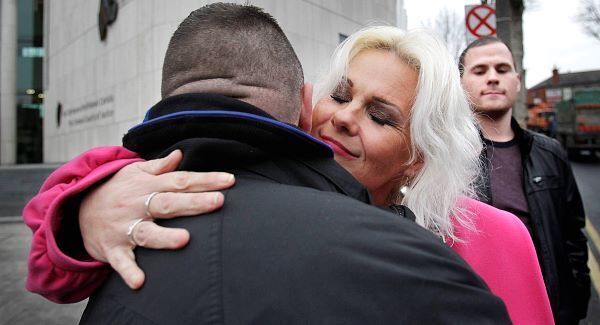
Rape victim Fiona Doyle said today that she felt vindicated after her father was jailed today for raping her over a 10-year period.
Patrick O’Brien had his bail revoked by sentencing judge Mr Justice Paul Carney, after he admitted he was wrong and insensitive to let the 72-year-old walk free from Dublin’s Central Criminal Court on Monday.
"Justice has been served today, and I have been vindicated," said Mrs Doyle.
"I accept judge Carney's regret in what happened."
She also praised the support she has received in the media, from the people of Bray and on social media, paying special tribute to her husband, children and extended family.
"I feel vindicated, and that is all I wanted," she said.
"I would just like to ask my Dad, as a sign of remorse, not to appeal this three-year sentence.
"This three-year sentence, now, in his present state, is a lifetime for him."
She expressed her surprise that O'Brien had applied for bail, saying: "I remember looking over at him and thinking: 'You can't do that to me'. But he did.
"He might now feel the loneliness, the lack of support, the isolation that I have felt, the past over 40 years."
"I've waited for this day for over 20 years, since I first brought the first complaint to the gardaí and the HSE.
"They were everybody else, my schools, my teachers, my doctors, my hospitals - they let me down and nobody believed me."
She also encouraged other victims of sexual violence to come forward.
"Look at my face today compared to last week," she said. "It’s been a rough ride, but it's worth it."
She added later: "Somebody will listen to you. Somebody will come on board."
When asked if the DPP should appeal the leniency of the three-year sentence, she said: "I'm not sure what the DPP is going to do. Whatever they decide, I will support."
Ms Doyle said she is now looking forward to her meeting next Wednesday with the Taoiseach and telling him about her hurt and the problems she found with the justice system and the issues the case brought to light.
She said everyone who sent her an email, called her, marched or even dropped an apple pie in to her home in recent days could take some responsibility for the judge’s U-turn.
“I did crumble, I admit I crumbled, it picked me up and I came back,” she added.
Earlier, O’Brien was heckled as he arrived at the courthouse supported by his wife Breda.
Mr Justice Carney told each legal team he had no difficulty in accepting the procedure he adopted in the sentencing was inappropriate.
The judge added it was now clear for the Director of Public Prosecutions (DPP) to appeal against the leniency of the sentence, or for O’Brien to appeal against the severity of the sentence.
"To be honest with you, because of the case, I'm not going to go out an celebrate," she said.
"It’s not something that I had planned on celebrating.
"I found it quite sad. When it all boils down to it, that's my Dad walking through those doors and I'll never see him again."
When asked if she will ever speak to him again, she replied: "No."
Brendan Grehan SC, for the DPP, said that there was a question mark over a trial court’s jurisdiction to grant bail pending appeal.
He said that the effect of Section 31 of Criminal Procedure Act 2010 was to give a person an automatic right of appeal and to repeal section 31 of the Courts of Justice Act, 1934.
He said before that act it was necessary to first seek leave to appeal from the trial court but that this provision has been repealed. He said there is now no provision that allows a trial court to certify that a case is a fit case for appeal.
He said that bail was granted to O'Brien on a contingency basis which might not come to pass and that an intention to appeal is not an appeal in itself.
He said that bail was unenforceable if there was no appeal in place.
Mr Justice Paul Carney responded: “I am prepared absolutely to accept that this sentencing was dealt with in a procedurally confused manner.
“I was fully aware of the gravity of this case and I set that out in the opening words of the sentence. An issue raised by the defence in relation to the state of health of the accused man.
“He’s on constant oxygen which he carries around with him and he is under nine consultants for various serious disorders and diseases which he suffers. That issued raised, I had to deal with it.
“It is part of our jurisprudence from the Court of Criminal Appeal and the Supreme Court that the sentencing judge has not to only sentence in terms of the offence but in also in relation to that particular offender.
“Any matters that can be found in favour of the accused have to be taken into account in meaningful way by the trial judge.
“In this case I sought to express the gravity of this case and sought to take account of predominantly the heath situation and other factors I mandatorily have to deal with.
“Having designed the sentence, I was concerned as to whether I might be giving too much weight to the health situation and was anxious for an immediate involvement in the case of other judges.
“I did not want to take the responsibility of this case entirely on my own and wanted the burden to be shared with me by others. That may be due to my recent experience in a divisional court.
“I certified the case for appeal. This emanated from the court and not by any application by any of the other parties. What I had in mind was to get the involvement of other judges onto the case as quickly as possible.
“The sentence was designed to ensure that nobody would be able to say the accused walked but of course people were able to say that.
“The practice over many decades is where an appeal is certified it attracts bail. It was that practice I was averting to in fixing bail and had in mind that it would be short term.
“I accept that to follow that precedent was inappropriate and something I shouldn’t have done. The procedure I adopted was not appropriate. It was insensitive.
“I have absolutely no doubt or hesitation or difficulty in saying that - I set aside the certification which I gave and accordingly, the bail falls.
“Each side can bring this matter before the Court of Criminal Appeal. I wasn’t canvassing any reduction in sentencing but was looking for the opinion of three experienced colleagues to see if I was putting too much weight on the medical issues.
“It is now open to the DPP to appeal on the grounds of undue leniency or the defence to appeal on the grounds for severity.
“I have no hesitation in expressing my profound regret to Ms Doyle for the distress which has been caused to her in this case. I trust that there is an appreciation that these matters are not open and shut.
“I am absolutely prepared to expect that a procedurally confused method of dealing with this case was carried out by me.”

CONNECT WITH US TODAY



Be the first to know the latest news and updates