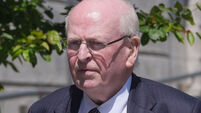
Convicted bank robber has €95k seized by State
The State has seized €95,000 from a convicted bank robber who claimed the money originated in a lottery win.
Mark Fitzgerald (aged 43) was found with the cash wrapped in clingfilm in his luggage as he was getting a flight to Malaga. Judge Martin Nolan at Dublin Circuit Criminal Court said he was satisfied the cash was either the proceeds of crime or was going to be used in crime.
In such cases the State only has to prove “on the balance of probability” that the money was associated with crime. This differs from criminal trials which have to prove a case beyond a reasonable doubt.
Fitzgerald of Dunmore Park, Kingswood, Dublin 24, said he was using the money to buy an apartment in Spain but that he could not remember the name of his estate agents. He claimed he was bringing the money over in cash because he does not trust banks and thought he would get a better deal if he paid cash.
Fitzgerald, who runs a car dealership, admitted his tax affairs are “a bit of a mess” and said he didn’t know if he had ever sent a cheque to Revenue. The court heard the last VAT returns he filed date to 2006 and show no car sales for that year.
Fitzgerald admitted during cross examination by Mr John Byrne BL, acting for the State, that he had sold cars during 2006 but that he hadn’t returned VAT for them.
Mr Byrne read an affidavit stating that Fitzgerald was stopped at Dublin Airport on November 5, 2008 as he was going to board a flight to Malaga. Customs Officer Martin Newman took him to an interview room where his luggage was searched.
The cash was found in five separate bundles wrapped in clingfilm in the side compartments of the bag. Fitzgerald said he was going to buy a property in Spain but that he was not sure of the name of the letting agent.
He said he was dealing with somebody called Tracy but that he did not know her second name or any of her contact details. He admitted he had previous convictions, that he had started off robbing cars, moved on to robbing banks and had served time in prison where he “got educated”.
The court heard he has 15 previous convictions but that the more serious offences date back to his youth.
Mr Byrne said the State has several grounds for seeking the seizure of the money. These include the fact that Fitzgerald’s flight had been booked the day before, a common method used by criminals to cut down on the time Customs have to screen them.
Other grounds included that Fitzgerald was flying to Malaga, an area know to be used for importing drugs and that he had the money in cash, a common criminal method to avoid a audit trail.
Fitzgerald gave evidence that the money came from his car dealing business which was set up with the proceeds of a £500,000 family lottery win in 1997. He said he had used some of the money to buy 120 cars in Japan and sell them over here. He said “some” of these would not have gone through the books.
He agreed there are no documents to prove where the €95,000 had come from. He also agreed there was no affidavit from “Tracy” to back up his story. He said he had not gotten one from her because he “didn’t recognise the significance” of the court hearing.
Mr James Dwyer BL, acting for Fitzgerald, said he had given a full account for the purpose of the money and that the State had never contested that he won the lottery. He submitted that the flight was not booked the day before but rescheduled from an earlier flight which had to be cancelled because of work commitments.
Mr Dwyer added that while some Irish criminals do operate in Malaga, they represent a minority of the thousands of Irish people who own property there. Counsel added that Fitzgerald had recently sent money to the Revenue to address his tax affairs.
Judge Nolan said that there was no proof that the money was legitimate aside from the claim of a lottery win. He commented there was no “paper trail” and that Fitzgerald’s business “seems to be entirely undocumented” and operating “on the black economy.”
He said the State had met the burden of proof “with some to spare” and that Fitzgerald’s explanations were not believable.
CONNECT WITH US TODAY



Be the first to know the latest news and updates