New potential landfall sites for power cable
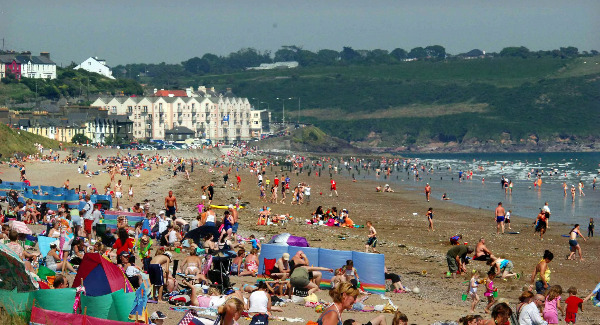
The state-owned company, which manages and operates the country’s transmission grid, said it now needs to survey the corridor routes which lead to two popular beaches near Youghal, to determine whether the 600km Celtic Interconnector cable could be brought ashore there.
These new surveys, which follow similar work on other nearby route and landfall options, are necessary to provide additional options for the cable and to avoid what the company described as “areas of challenging geology” identified on the approach to the coast. The additional options include:
- A route to new landfall points at Redbarn and Claycastle beaches to the south of Youghal;
- A route following a slightly different approach to a previously identified landfall point at Ballinwilling, in Ballycotton Bay, which was surveyed in 2014 and 2015.
EirGrid has submitted an application for a foreshore licence to the Department of Housing, Planning, and Local Government for permission to carry out a range of surveys on the foreshore, in shallow water, and offshore at the new options, leading to and at Claycastle and Redbarn.
It has also sought permission to survey along the new approach route to the previously identified Ballinwilling landfall point.
All the potential landfall sites are close to special protection areas and special areas of conservation.
Pending a decision on the foreshore licence, the company hopes to start the survey work in May, and it estimates it will take about one month to complete.

The Celtic Interconnector is classed as a major EU Project of Common Interest designed to secure Europe’s power network.
It is among a small group of just 25 EU “electricity highways” designed to prepare Europe’s power system for the future and, along with the development of a liquefied natural gas (LNG) import terminal, it is one of two big Irish energy projects designed to reduce our energy dependence on Britain, post-Brexit.
EirGrid has been working with its French counterpart, Réseau de Transport d’Electricité (RTE), since 2011 on the feasibility of the subsea cable. A series of joint studies has been carried out over the years which suggests that if built, the interconnector would benefit electricity customers in Ireland, France, and the EU.
EirGrid completed a feasibility study of a marine route between Brittany and East Cork in 2016, which included a range of geophysical, geotechnical, and environmental marine surveys, conducted under licence.
In documents submitted with its latest foreshore licence application, the company says it is working to a tight programme, and public consultation is under way.
A spokesman for EirGrid stressed last night that the proposed technical works are designed to inform its decision-making on the project.
However, he said a decision on whether or not to proceed with the actual construction of the cable could be up to two years away. If built, the cable would allow for the import and export of about 700 megawatts of electricity — enough to power around 450,000 homes.

CONNECT WITH US TODAY



Be the first to know the latest news and updates