Show of political maturity by young-gun Taoiseach garners respect
A bad domestic week, which saw the Government teeter on the brink of an election, was followed by an exceptional internationally-focused week, which no doubt will have earned Leo Varadkar increased respect among his EU counterparts.
While British prime minister Theresa May was sweating over words and clauses in a bid to appease the DUP, Mr Varadkar held the Irish line by maintaining a measured force, politely refusing to budge.
The result was a 16-page progress report committing into writing that there will be no return to a hard border on this island, words which Mr Varadkar himself described as “politically bulletproof”.
But the Taoiseach, who since becoming leader has grown fond of taking juvenile pot shots at Sinn Féin in the Dáil, showed signs of political maturity even before things started to go awry on Monday. In fact these signals went back as far as Thursday of last week.
Setting aside internal party rivalries, he appointed Simon Coveney as Tánaiste following the resignation of Frances Fitzgerald over the McCabe email debacle.
The appointment came on the eve of a most crucial period in Brexit talks for this nation and it was evident that installing a safe and experienced pair of hands as second-in-command was a good move.
It may have been a case of love at first sight in the bromance between our Taoiseach and Canadian prime minister Justin Trudeau as the pair giggled over socks and bonded while out on a jog. But the budding relationship between Mr Varadkar and Mr Coveney has been more of a slow burner.
Mr Varadkar failed to make Mr Coveney Tánaiste after both men battled it out for the leadership of Fine Gael last summer and the Cork minister was shunted away to Iveagh House.
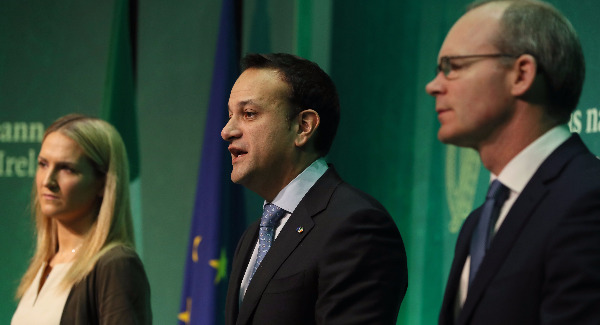
But together this week, the duo appeared as a strong and united force, with Mr Coveney backing the Taoiseach up inside and out of the Dáil chamber.
Mr Varadkar was no doubt able to rely on Mr Coveney’s knowledge of the delicate negotiations which he and his officials in the Department of Foreign Affairs had been slowly picking away at for months.
He also brought a negotiating experience to the table, having hammered out an EU Fisheries deal which secured quotas for Irish fishermen in 2012 as minister for the marine.
While Brexit negotiations have been and will continue to be strictly between the UK and the EU Brexit task force, it is understood that Irish officials had been kept very well in the loop the entire way through the process.
Prevented from actually being present in the room with Ms May and other
British negotiators, Irish officials were often in a room next door and were being constantly and immediately briefed on how talks were progressing behind the wall.
This level of contact had intensified in recent weeks and while the rules of engagement also prevent one-to-one discussions, it is understood contact between Ireland and the UK became frequent at an official level.
On Monday this week, 10 days of tense consultations, meetings, teleconferences, and phone calls culminated in an agreement which all appeared to be satisfied with.
A series of checks and double-checks began before official sign-off, first with confirmation between the Taoiseach and Ms May and then confirmation from officials drawing up the text.
At the request of EU Commission president Jean-Claude Juncker, further confirmation was sought to ensure the Taoiseach was happy with the deal, before it was bounced back to the British prime minister. It was then confirmed with the Brexit task force.
At this stage the logistics of announcing the deal were being arranged and Theresa May went to lunch with Mr Juncker in Brussels. We all know about happened next.
All week while the British side became tangled up in the semantics of it all as they tried to please a disgruntled Arlene Foster, Mr Varadkar held firm that the Irish position remained the same.
But he left the door ajar in stating he would accept suggestions from Ms May on new or extra lines, provided the core meaning remained the same.
This was echoed by the Tánaiste, who told the Dáil on Thursday:
“The Taoiseach and I intend to hold to what we said this week. Of course, we also want to be helpful in terms of trying to move this process on and provide reassurance for people on all sides that what the Government is advocating for is good for everyone living on the island and can also be good for Britain.”
It was these statements that allowed Ms May to allay Unionist fears by inserting an additional paragraph.
While the initial text had agreed that the UK would “propose specific solutions to address the unique circumstances of the island of Ireland”, the new paragraph states that in the
absence of agreed solutions the UK “will ensure that no new regulatory barriers
develop between Northern Ireland and the rest of the United Kingdom,” giving businesses in the North “unfettered” access to the British market.
Many around Government buildings were yesterday selling the additional line as a positive which would in fact “complement” the deal which had been all-but agreed upon on Monday afternoon before the DUP got wind of it.
It has been a win-win situation for Ireland, the UK, and the EU. But what happens now could be even more significant.
While huge progress has been made, Mr Varadkar and his new partner Mr Coveney will have to use the same level-headed approach to what could be even more difficult and testing negotiations around trade, in phase two of Brexit talks.
One initial victory and the continued support of the other EU nations cannot mean we now become complacent.
Yesterday, Mr Varadkar appeared to get that.
“This is not the end but it is the end of the beginning, and we will remain fully engaged,” he said.

CONNECT WITH US TODAY



Be the first to know the latest news and updates