One controversy too many for Nóirín O’Sullivan?
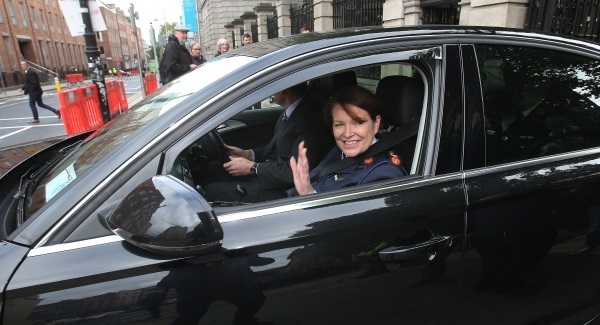
SOMEWHERE in the corridors of Leinster House on Wednesday a knife was produced with the Garda Commissioner’s name on it.
Nóirín O’Sullivan was on a four-day trip in San Diego while ‘Rome was burning’ was the word given to the media.
Cue front-page stories in a number of newspapers — replete with a succession of named Government TDs putting the boot into the Garda boss, including slurs that she was “sunning herself”.
The morning media agenda was set, again with Fine Gael TDs heavily criticising her on radio.
There was no criticism of Tánaiste and Justice Minister Frances Fitzgerald being abroad on a two-day Enterprise Ireland trip — an entirely legitimate gig.
For the record, there’s no criticism of any newspaper running a story of the Garda boss being abroad while a national policing crisis loomed.

The bigger issue is the political one: Why the willingness of numerous Fine Gael TDs to go on the record and hammer the commissioner?
As it turns out, it wasn’t a secret that the commissioner was in San Diego to attend the International Association of Chiefs of Police conference.
The official Garda Twitter account sent a tweet out on Wednesday morning, along with a photograph of her. It wasn’t picked up during the day — until political spin later made it the story it was.
So, what are we to make of the issue?
Garda Commissioner Noirin O Sullivan with Mr. Jurgen Stock, Interpol & D/Chief Superintendent Michael O Sullivan at the IACP Conference pic.twitter.com/Fq0Mq1s14O
— Garda Info (@gardainfo) October 19, 2016
From the commissioner’s point of view, she would argue that this was a scheduled event of international police chiefs — and she was a guest speaker.
She was not getting a tan, or playing golf, while gardaí were metaphorically erecting the barricades.
Secondly, she could argue that her ability to draw up a contingency plan for the strikes could not be accurate until she and her team knew if sergeants and inspectors were also going to take industrial action on the same days as frontline gardaí.
The Association of Garda Sergeants & Inspectors (AGSI), representing 2,000 front-line supervisors, only made that call at 4pm last Monday.
In making their decision, they joined the Garda Representative Association (GRA), representing about 10,500 frontline gardaí, for strike action on four Fridays next month – November 4, 11, 18, and 25.
Thirdly, her people would argue that she is not part of talks to resolve the dispute and that the meetings between the Department of Justice and both associations were not being held until the end of the week.

They wanted to see the outcome of those meetings — with AGSI yesterday and the GRA today — and whether or not there were any signs that progress could be made and the strikes averted.
The commissioner was back at Garda HQ yesterday. One thing she and her team didn’t anticipate was that the AGSI would announce a type of work-to-rule action today and the following Friday.
This involves the non-use of the Garda Pulse computer system today.
“That was a bolt out of the blue and caught us off guard,” said a source.
The commissioner could also argue that the associations, the AGSI in particular, has not spelled out who they are going to allow to be available on the strike days, so she could devise her contingency plan. The GRA has exempted three units from the strikes.
Those critical of the commissioner’s decision to persist with her trip also have a case. She knew that the AGSI decision would be known on the day she was going out.
She knew that if delegates at the AGSI special conference in Athlone decided to go out on the same day — which was a distinct possibility — she would have a “nightmare scenario” (as Garda sources have described it) on her hands.
She would know there would be massive concern in senior ranks of her organisation — among superintendents and chief superintendents in particular — who would also be looking to her for leadership and communication.
She would have known that this would be a major political issue, and that maybe the Tánaiste would want her, at the least, to be in the country. But, as we know, Ms Fitzgerald was also gone for two days.
The issue of waiting for yesterday’s and today’s meetings to finish before drawing up her contingency plan is a bit weaker.
The Irish Examiner understands she has not yet contacted the associations with requests in terms of emergency cover for her contingency plans.
It is also understood that superintendents and chief superintendents were only asked for their emergency staffing requirements to feed into her plan earlier this week.
As of yesterday, there is still no news of where the contingency plan is at or when it would be finished.
One experienced Garda source, who would not be in the commissioner’s camp in any way, said this: “It’s bad optically, that’s for sure. But she has no power to negotiate [with the associations]. It’s not an issue for her — it’s for the department and the Tánaiste.”
And on the contingency plans: “In reality, she has an awful lot of people to do this job. She’s not sitting down herself and doing the plan. She’ll sign off on it when it’s done.
“She has a team under her, chiefs and superintendents and staff in HQ doing the work. And I don’t doubt she’s in constant contact, by phone, email, video conference if need be. But yeah, it still doesn’t look good.”
Outside observers have commented on what appears to be a lack of urgency in the drafting of the contingency plans.
As reported in yesterday’s Irish Examiner, the dedicated gangland units — the Drugs and Organised Crime Bureau and the Special Crime Task Force (numbering 140 to 150 staff) — will not be operational on the strike dates.
There are signs that this story of the “commissioner being abroad at a time of need” may be more than just a distraction from the main story — the strikes — and that there is a bigger development unfolding.
The current concern over the strikes comes within a context for Commissioner O’Sullivan — a bit like her predecessor Martin Callinan.

She has a battle on multiple fronts in relation to Garda whistleblowers, and, at best, is barely holding her own.
These issues follow the controversy over her advice to her legal team at the O’Higgins inquiry, which sought to challenge Sgt McCabe’s motivation and credibility.
Are we seeing signs that people in Government, especially within Fine Gael, are preparing the groundwork of a context within which Ms O’Sullivan could be sacrificed if she is embroiled in what could be portrayed as “one controversy too many”?
That happened to her predecessor: Forced, in reality, to resign by the last government — not on the immediate issue, but because it was the final straw.
CONNECT WITH US TODAY



Be the first to know the latest news and updates