Former taoiseach Brian Cowen appraises his role in tackling economic crisis
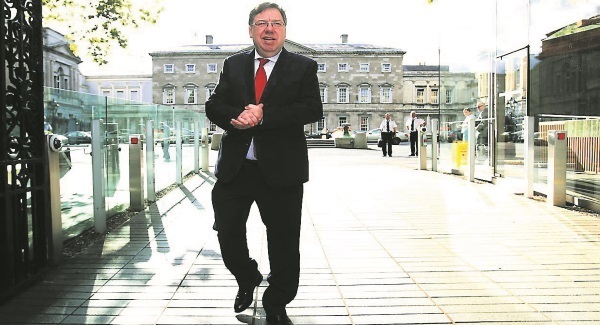
A defiant Brian Cowen insists being Taoiseach was “very difficult” for him, but claims his actions saved the country.
Former taoiseach Brian Cowen appraises his role in tackling economic crisis

Speaking for the first time in detail about his time in office, the controversial former Fianna Fáil leader’s comments are contained in a new book — Hell At The Gates — by Irish Examiner political editor Daniel McConnell and John Lee. Extracts of the book are published in today’s newspaper.

Mr Cowen also reveals how he felt about the personal attacks on him which led to his daughters receiving some verbal abuse at the time.

“The public debate was getting very personal and things were being said that I didn’t like being said. But the family are very resilient, strong and very supportive,” he added.

Despite the trauma inflicted on the country during his four years in power, Mr Cowen has insisted the deeply unpopular steps he had to take ultimately saved Ireland from economic ruin.

“Yes, my taoiseach term was a difficult time but I think over time people are maybe realising that we did get through that period, that what we did was part of the necessary recovery.

“Certainly, I would have hoped that it was not as hard as it was, but there was no political capital to be gained in doing what we had to do. There is no doubt that for the State to continue, for us to have some prospects of recovery, I’m absolutely convinced that we were on the right track,” he said.

However, a number of senior government figures at the time of the crash criticise Mr Cowen, with former minister Mary O’Rourke saying the decision not to hold an early election in October 2010 cost Fianna Fáil “20 or 30 seats”.

Then minister Dara Calleary revealed his anger over the manner in which the universal social charge (USC) was introduced, saying it cost Fianna Fáil as many as 15 seats in the general election.

“I actually believe the USC cleaned us: the USC cleaned us in Dublin. I think the USC cost us between 10 and 15 seats,” he said.

Mr Cowen said his family also had challenging times during his time in office.

“One of my kids was in college, she was well able to look after herself. One was at home [in school in Offaly]. Of course, it was challenging. They may have gotten a bit [of verbal abuse] but nothing they couldn’t handle. They have to stand up for themselves, it wasn’t a systemic thing, it was in the background,” he said.

However, he said the media treatment of him was not easy for his family.

“They would have been reading what was being written, pretty negative stuff,” said Mr Cowen.

The book also reveals the late Brian Lenihan approached Micheál Martin and other senior ministers seeking their support for him to replace Mr Cowen as leader, despite his terminal cancer diagnosis.

Mr Martin, however, rejected his advances.“I think that Brian did have an idea that he could maybe be a bridge within the party in the pre-election — I just didn’t think it was a runner,” he added.

Mr Cowen also said that despite Mr Lenihan having terminal pancreatic cancer, he never considered asking him to step aside. “He told me what the story was and that was it.

“I have heard people say, ‘why didn’t you consider changing the position?’ That didn’t occur to me at all,” Mr Cowen said.

x

More in this section

Lunchtime News

Newsletter

Get a lunch briefing straight to your inbox at noon daily. Also be the first to know with our occasional Breaking News emails.

Cookie Policy Privacy Policy Brand Safety FAQ Help Contact Us Terms and Conditions

© Examiner Echo Group Limited