Garda industrial action: Frances Fitzgerald ‘absolutely open’ to holding talks with force
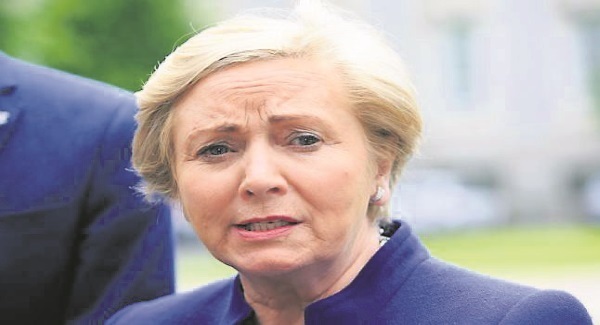
The Tánaiste outlined her position as she was urged by the opposition to avoid a damaging “Mexican stand-off” that will put the safety of communities in jeopardy.
Speaking during leaders’ questions in the Dáil, Ms Fitzgerald faced repeated criticism from Fianna Fáil and Sinn Féin that the Government has failed to take Garda pay concerns seriously until now.
However, responding to the claims, she said the Coalition was fully aware of the problems and was doing everything possible to avert strike action.
While acknowledging the difficulties facing gardaí, some of whom she was told are being forced to sleep in cars as they cannot afford accommodation, she said the only way to resolve the dispute is to hear “directly” for Garda officials through urgent talks.
“I want to hear directly from them. It would be most unfortunate if, rather than engaging, further action would be contemplated that would not be in the best interests of our communities and An Garda Siochána.
“I am in no doubt whatsoever about the seriousness of this issue. I am absolutely open to meeting to resolve the outstanding issues.”
She also said she was willing to seek the establishment of a public service pay commission “shortly” to address long-term pay problems among State employs.
However, despite the comments, she faced significant criticism over her and Government’s handling of the Garda dispute until now.
Fianna Fáil justice spokesman Jim O’Callaghan warned that Ireland is facing an “unprecedented” situation which could “threaten the safety of the State”, a situation which risks being exacerbated by a “Mexican stand-off” between Government and gardaí.
Hitting out at an alleged Government reluctance to tackle the issue in the five months since the coalition was formed, he said it has ignored a “rampant demoralisation in the force”.
Mr O’Callaghan said that in recent years gardaí have suffered pay cuts; staff reductions; the closure of more than 100 Garda stations; and a belief their “grievances” have not been acknowledged by Government.
The remark was repeated by Sinn Féin justice spokesman, Jonathan O’Brien, who said there must not be any “grandstanding” and that it would be “naive” and a “huge mistake” to believe gardaí will not proceed with strike action.
Possible strikes on the horizon
Upcoming strikes by Dublin Bus staff have been suspended after a breakthrough in talks at the Workplace Relations Commission.
Following marathon talks, staff are to be balloted again on a document negotiated by management and unions over the last number of days.
It is understood the deal offers workers a 3.75% increase on pay each year for the next three years — amounting to an 11.25% increase. Unions had looked for a 15% pay increase — nearly double the 8.25% recommended by the Labour Court.
The suspension of industrial actions means that buses will now be running in the capital for this weekend’s All-Ireland final replay between Dublin and Mayo.
The Association of Secondary Teachers Ireland is balloting its 18,000 members for industrial action, up to and including strikes, over the pay of those who have entered the profession in the last five years.
The Department of Education reached agreement with the Irish National Teachers’ Organisation and Teachers’ Union of Ireland on salary increases for recent entrants to reflect the amounts lost when qualifications allowances were lost from 2012. But the ASTI remains outside the Lansdowne Road Agreement and is insisting that full pay equality is restored, including reversal of the 10% cut to salary scales of all those who started teaching since 2011.
A separate ASTI ballot, the result of which is also due in mid-October, could see hundreds of secondary schools close as members are being asked to stop doing substitution work.
The possibility of power cuts coming into the winter months has also increased as 1,300 staff at the ESB are set to be balloted for industrial action up to strike.
Members of the Technical Engineering and Electrical Union (TEEU), who represent the staff at the utility, have twice rejected a proposed agreement which would see pay increases of 5.5% over two years as well as a lump sum payment of €2,750. That is in addition to a 2% increase paid last year.
The rejection is in spite of the fact that the other unions which, together with the TEEU, make up the ESB group of unions, have all accepted the agreement.