Leader's Debate: Fine Gael to blame for its own woes
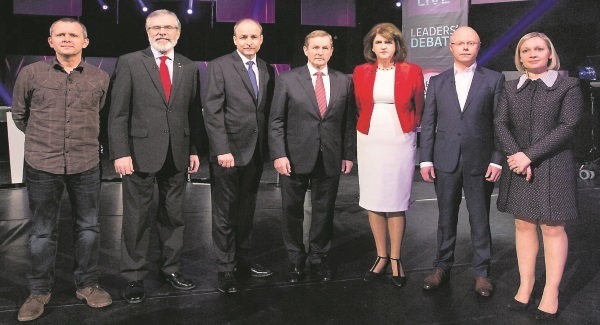
As they say in Enda Kenny’s household — lights, camera, delay needlessly on simple yes or no answer questions for days on end, damaging your party’s chances in the process.
While the second live TV debate of the campaign had the spotlight last night as the seven leaders of Ireland’s largest political parties took centre stage, in reality there is a far more pressing discussion that needs to be heard over the unruly shouting.
Since calling the election two weeks ago tomorrow, Fine Gael’s campaign has gone from assured confidence, bordering on arrogance, that the party would waltz back into power (even hushed talk of an overall majority), to one where a hung Dáil is now staring them in the face.
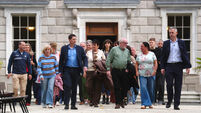
While Mr Kenny attempted to look nonplussed by growing problems last night by draping his suit top over his shoulder as he strolled into the University of Limerick RTÉ debate studio in the freezing cold, the clear PR strategy instead had the opposite effect of making him appear under pressure.
And after days of delays over whether he will rule out cutting a deal with Fianna Fáil; a similar stuttering delay over the same issue with Independent TD Michael Lowry; concerns over the law and order party’s record on crime; the fiscal space miscalculation; and dropping poll support, under pressure is exactly what he is.
After the break on @RTEOne #GE16 #leadersdebate @ClaireByrneLive ... All in position. pic.twitter.com/spZPEYpc0A
— RTÉ (@rte) February 15, 2016
For more election news, analysis and general banter join us HERE
Despite Mr Kenny and Labour leader Joan Burton effectively tag-teaming Fianna Fáil’s Micheál Martin throughout last night’s debate, with Ms Burton admitting “it might come up” when asked before the event began about the rival party’s economic crash legacy, Fine Gael’s fight for re-election appears to be floundering when all pre-election indications were that it would surge.
And the party only has its own self-inflicted wounds, and its leader’s stalling on simple questions, to blame.
By not being definitive on ruling out a potential deal with Fianna Fáil for five days until yesterday’s clear confirmation that no deal will be struck, Mr Kenny simply allowed Fianna Fáil leader Micheál Martin and his party to gain some small momentum, resulting in a perception — not reflected in the poll, where it continues to hover on 18% — the lead opposition party are gaining ground.

It also shows that despite the Government focussing its entire campaign strategy on how it has helped to rescue the economy after the disastrous situation it was handed by Fianna Fáil in 2011, the message is not getting through.
The same faltering delay by Mr Kenny which caused the brief furore over whether a deal would be considered with Independent TD Michael Lowry has also led to a perception, fair or not, that Fine Gael is about gaining power regardless of whose help it needs.
The Taoiseach could easily have killed the story on day one by laughing off questions from reporters about the controversial Tipperary TD.
But instead, he side-stepped, leading to a week-long controversy which was completely avoidable.
While the party was handed almost its dream situation at the start of the election — international advice to stick with stability in an uncertain world economy, law and order front and centre, and the Sinn Féin shadow of ‘Slab’ Murphy sauntering back into view — even these issues have hurt rather than helped.
Due to the fiscal space miscalculation by Finance Minister Michael Noonan in the first days of the campaign, Fine Gael’s financial credibility has been undermined — ironically at the same time as the world economy’s credibility has taken the same hit.

While law and order has rightly been the focus of much of the campaign due to the brutal murder of David Byrne, the fact the justice minister has insisted there was no intelligence to suggest the attack was likely meant more rear-guard fighting had to occur.
And despite the fast response to the murder of Eddie Hutch last week in setting up a new €5m Garda group to tackle the issue, in the polls at least — where Fine Gael is down 3 points to 28%, Labour down 2 points to 8%, far below the threshold to enter government by itself — confidence in the Coalition appears to be wobbling.
In last night’s debate, Mr Kenny immediately attacked Fianna Fáil’s economic track record in a return to his warning that complacency is the big issue in terms of the economy and that Fine Gael must be returned, before Ms Burton accused Fianna Fáil’s economic credibility as being laughable and Mr Martin being “the emperor who has no clothes”.
Enda Kenny: 'The Fianna Fáil party ... are not credit worthy in terms of being in government ...' #GE16 #cblivehttps://t.co/24QWEyKona
— RTÉ News (@rtenews) February 15, 2016
Mr Martin poked and prodded at the Coalition’s economic record, and Sinn Féin leader Gerry Adams alleged IRA links.
The Anti-Austerity Alliance-People before Profit’s Richard Boyd Barrett said the Government is fooling people and that fiscal space is guesswork.
The Social Democrats’ Stephen Donnelly suggested they could be election king-makers, Renua’s Lucinda Creighton defended her party’s tax plans, and Mr Adams hit out at a “cosy consensus” against his party and pointed to Mr Kenny, Ms Burton, and Mr Martin by saying: “Here they are, the three amigos.”
All landed punches and appealed, successfully, to their demographics as a live audience looked on.
But the big issue this morning should be why Fine Gael and Labour is not yet pulling away from the pack.
After a fortnight of campaigning and two live debates dominated by the economy, its faltering start means that — just like the rainbow coalition of the mid-nineties, which lost a race it should have easily won — the Coalition now has a battle on its hands.