What we know about the Paris attacks terror suspects
Suicide bombers and gunmen linked to the Islamic State group “were behind how the terrorist acts unfolded”, Francois Molins said in a televised press conference.
One of the suicide bombers in the attacks has been identified as Ismael Omar Mostefai, who lived in a Paris suburb and probably spent a few months in Syria during 2013 and 2014, Le Monde reported, citing Chartres Mayor Jean-Pierre Gorges, a member of parliament, and another unidentified source.
International manhunt underway for Paris terror suspect Salah Abdeslam, one of three broth… https://t.co/LL1Lj4ipdo pic.twitter.com/0DDAdc1pc6
— Irish Examiner (@irishexaminer) November 15, 2015
In Belgium at least three people have been arrested in connection with the deadly attacks, local prosecutors said.
“Faced with the atrocity that was committed, we are more determined than ever in our struggle against terrorism,” Molins said.
“Quite probably there were three terrorist groups, who were co-ordinated, who originated these barbaric acts.”

In Belgium, the raids followed French requests related to a Belgian-plated rental car found near the Bataclan concert hall, Belgium’s Federal Prosecutor’s office told reporters.
Police and intelligence agencies across Europe and beyond are racing to determine who was responsible for Friday’s assaults, which French President François Hollande called an “act of war”.
The slaughter compounds one of the deepest crises facing European leaders since the Second World War as they struggle to accommodate a stream of refugees from war-torn Syria while also facing jihadist retribution for air strikes on Islamic State.
According to Molins, one of the three teams operating on Friday consisted of a trio of suicide bombers at the Stade de France, who wore identical explosive vests. A second drove to multiple locations in east-central Paris, firing hundreds of rounds from Kalashnikov rifles.
And a third went to the Bataclan, where 89 people were slain before police stormed the theater, killing one gunman. The other two killed themselves with explosive vests, Molins said.

Molins said information was still preliminary, and that police are working on the basis of witness statements and surveillance-camera footage. It’s unclear whether additional suspects are still being pursued.
In a statement posted on Twitter claiming responsibility, Islamic State said the violence was in retaliation for French air strikes on what it calls its “caliphate” in parts of Iraq and Syria. The attacks are “the first drop in the rain, and should serve as a warning”, it said.
For the extremist group, the killings signal “a structural shift in its modus operandi, representing a prelude to additional attacks in the West”, political consultancy Eurasia Group said.
Islamic State’s leadership “is committing to a strategy of pursuing retaliatory attacks against any country conducting airstrikes on its bases in Iraq and Syria”, the note said.
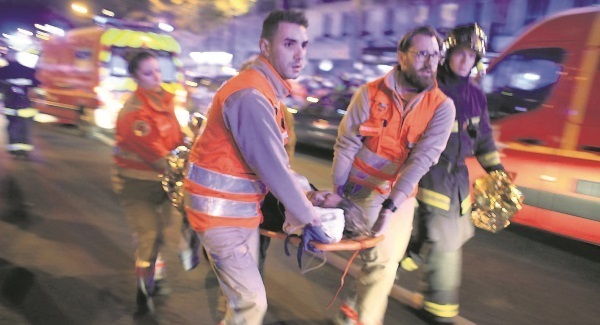
Ninety-nine people remain in critical condition, among a total of 352 injured, according to Molins. The death toll, which he warned could still rise due to the number of seriously wounded victims, is the largest for a terror attack in Europe since the 2004 train bombings in Madrid.
Panic in Paris as 'loud bang' causes alert https://t.co/r0hTlvSoJv pic.twitter.com/cxT2ZhZ9wR
— Irish Examiner (@irishexaminer) November 15, 2015
Among the rapid developments in the aftermath of the assault:
- Marine Le Pen, leader of the hard-right National Front political party, said the attacks were evidence of the need for France to “take back definitive control of its borders” and strip French terrorists of their nationality;
- Laurent Fabius, France’s foreign minister, said the United Nations’ COP21 climate talks scheduled for late November and early December in Paris would go ahead as planned, with reinforced security. Over 120 world leaders are expected to attend the conference;
- The Paris stock exchange operator said it would open trading as normal today . Schools will also be open nationwide;
- France’s main Muslim groups issued a joint statement condemning the attacks and calling on Muslims to donate blood;
- Spurred by the Paris attacks, 17 nations in Vienna overcame policy differences over Syria and adopted a timeline to elect a new government by 2017.
The killings are certain to intensify debate about accepting migrants fleeing Syria and Iraq for the European Union, where hundreds of thousands have sought shelter this year. Politicians in some countries argue the open-door policy advocated by German Chancellor Angela Merkel will let more jihadists into the 28-nation bloc. The attacks are also likely to reopen the issue of how to better integrate France’s Muslim population, the largest in Europe.
Woman shares horrific account of pretending to be dead during Paris attacks https://t.co/Fm7NCcmoKJ pic.twitter.com/Y2migxzSBf
— Irish Examiner (@irishexaminer) November 15, 2015
The co-ordinated assaults began around 9.20 pm on Friday local time with three suicide bombings near the Stade de France.
Almost simultaneously, gunmen with automatic rifles jumped from cars outside various bars and restaurants in the vibrant 10th and 11th arrondissements of the capital, shooting at Parisians who moments earlier had been enjoying a normal start to the weekend.
Theresa Cede, a 39-year-old who works in the telecommunications sector, was at the Bataclan when the gunmen burst in.
“I hid underneath the body of a man who was shot in the head” Cede said. Another woman lying next to her was severely wounded, though Cede escaped unharmed. “I don’t know how many guardian angels I had looking out for me,” she said.