Cork students get a science lesson in the physical side of soccer
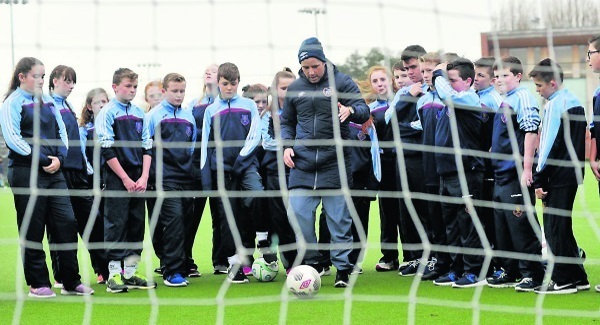
The Tyndall National Institute took a class of Blarney science students to both the classroom and the pitch at Cork’s Mardyke Arena yesterday to show them how soccer’s top players use physics to make them the stars of the game.

Firstly to the classroom, where the Scoil Mhuire Gan Smál first-year class met John Barton, a senior staff researcher at Tyndall’s microsystems centre and — it quickly became clear — something of a football buff. He talked the class through the physics of, among other things, passing, shooting and accelerating past the opposing players.
For example they learned that if a keeper wants to get the longest possible length in their goal-kick, 45 degrees is the best trajectory for distance. A greater angle will mean the ball will gain more height at the expense of length. Lower and, not only might it be intercepted, but it will not go as far.

Mr Barton also gave the class a theoretical masterclass on the art of passing: how the wind or even a wet pitch surface can greatly affect the force with which the ball must be struck in order to successfully get it to a teammate.
When it came to the penalties, it became clear the goalkeeper has an almost impossible job if the penalty-taker is accurate.

Firstly Mr Barton was able to display that a penalty into a top corner is nigh-on impossible to save even for the tallest of shot-stoppers. Secondly, he revealed it takes the ball approximately 0.4 seconds to get from penalty spot to the back of the goal — too fast for the keeper to assess the direction and move. That means the keeper must research the kicker’s habits in advance and essentially fling himself in a direction he hopes the ball will go.
After the science of the classroom, the pupils got to put the theory into practice on the Mardyke’s all-weather pitch under the tutelage of UCC/FAI soccer co-ordinator Greg Yelverton. In the pouring rain, they certainly got to experience the physics of drag as the ball stuck, velcro-like, to the ground by the wet surface.

“Physics often has the most negative reputation of all the branches of sciences. People feel that its textbook-based and exam learning,” said Karen McCarthy, Tyndall’s outreach officer.
“If we can get students to associate physics with an enjoyable activity and see how the theory can be applied, that would be a good way to make them interested.”

While there were more boys than girls at yesterday’s event, the intention was as much to get girls thinking about physics as an option. Ms McCarthy pointed out that a quarter of secondary schools do not offer physics for Leaving Certificate and, of those, most are female-only schools.