Naval service gets smart to continue vital work
The force is turning to smart technology and recruiting new personnel to help patrol our territorial waters, writes Sean O’Riordan

Naval service gets smart to continue vital work

The navy is turning to smart technology to help patrol the 1m sq km of seas for which it is responsible — an enormous area for the eight-ship fleet to cover.

The use of drones, which are relatively small and covert in nature, would help the naval service keep a much closer ‘eye in the sky’ on what’s going on and can be used for several purposes, most notably drug interception and fisheries protection.

The navy is hoping technology such as drones, pictured, will help in the surveillance and tracking of vessels in the future.

The service has played an important part in intercepting hundreds of millions of euros worth of drugs into this country and the EU in recent years.

Last September, the navy seized the yacht Makayabella off the south-west coast. She was carrying 41 bales of cocaine. Initially it was though the consignment was worth approximately €80m, but such was its purity that the street value was revised upwards to €350m.

Navy officers stand behind around a tonne of cocaine seized from the yacht Makayabella last year. The haul was valued at €350m.

In November 2008, the navy launched Operation Seabight to track and eventually seize the 18m yacht Dances With Waves 211km off Mizen Head.

Its cargo of €600m of cocaine had been loaded in Venezuela, as had the cocaine on the Makayabella.

Drones could also be used in fishery surveillance and would be important to detect discards of fish from factory trawlers hoovering up shoals in our waters.

Discards of certain fish are already illegal and more species are likely to follow as the EU tightens up controls.

At present the navy, in co-operation with the Sea Fisheries Protection Authority, is going after such ships, but surveillance, boarding and proving discards are difficult. Such technology would aid the fight against this, importantly enabling stocks to recover and aid the global fight against starvation in the years to come.

“We are also helping to develop a wifi at sea system in association with the company Seatech,” says head of the Naval Service Commodore Hugh Tully. “We are helping them to test this VHF-type technology. It has positive implications for [yachting] tourists coming into harbours and commercially for people employed by companies who want to survey harbours and download the information immediately to their companies.”

Together with a company called G Energy, the Naval Service is testing a pen-like device which can test for the presence of microbes in fuel. The dip-in type device can test the fuel’s purity, which is important because too many microbes can clog up fuel pipes which can lead to costly engine problems.

Meanwhile, working with Seftec,the Naval Service is helping to develop systems to monitor firefighters operating in extremely dangerous conditions, especially in confined spaces.

Cdre Tulley points out that having fire suits fitted with sensors was vitally important for the navy, especially as a fire in any ship’s engine room is a potentially very serious event.

“With this wearable technology, we can immediately detect where a firefighter is at any moment and tell us how much air is left in their oxygen tank,” he says. “It certainly has major benefits for us. This has huge benefits for the maritime industry as a whole and it also has important applications on shore.”

The Naval Service is also helping to develop ‘data loggers’ on ships to computer monitor their engines’ performances and the outside environment at any specific time.

Together with NUI Galway, the navy has fitted wave motion monitoring equipment to some vessels.

Cdre Tulley explains that this collaboration provided vital data which will enable ship designers to come up with improved streamlined ships’ hulls, which will make them glide through the water more efficiently and thus cut down on fuel costs.

Again this technology has huge cost-saving implications, which could be sold on to commercial and military organisations.

In the meantime, the navy is about to convert to electronic navigation systems next year and is also developing kites that will be hoisted on decks and equipped with sensors which can improve its radar-length capabilities. The kites can also be used to save fuel.

“We’re at the high end of technology now,” says Cdre Tulley. “We have a vision to become the smartest, most innovative and responsive navy in the world.

“It means we will be able to produce, rather than suck-up resources. This fits in well with the government’s transformation and innovation agenda.”

Cdre Tully points out that collaboration with organisations such as the National Maritime College of Ireland and Halpin Centre are the way forward, because such enterprise clusters are more likely to attract EU grant aid.

The Naval Service has never in its history had as many highly trained personnel who are experts in a number of fields and who are sought for their know-how.

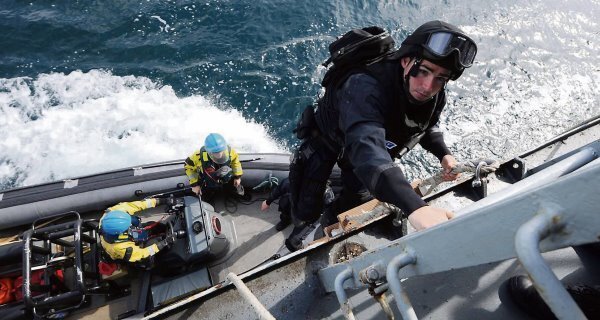
A winch operation takes place on the LÉ Eithne, part of the rigorous ongoing training for naval personnel.

This is why the collaboration with private companies is working on the ground.

“We will help to create jobs with the expertise and collaboration we now have,” says Cdre Tulley. “We want to be a producer of resources. More than 50% of our people are technically trained to the highest ability. We have experts in electrical and marine engineering, IT and communications experts. The navy has been in existence for 70 years and we have the benefit of sea-going experience. We know what will and will not work.

“I joined in 1975. There have been massive changes since. When I joined we got no [professional] qualifications. Now we’re educating our personnel for the good of the navy and when they leave for the good of the country. This is the most educated navy ever, there are even guys in their 50s getting degrees. The maritime college and IMERC [Irish Maritime Energy Research Cluster] have made it easy to get access to education for them and it costs very little. It would be remiss of us not to educate them.”

The navy is looking for 80 recruits, and is highly likely to be oversubscribed for the jobs, which will come on stream in two training class phases before the year is out.

However, Cdre Tully says the service is short of engineering and operations officers and said he hoped the Department of Defence would give the green light soon to allow them to recruit more such men and women.

Typically, those successful have to serve up to 10 years on a contract, during which time their opportunities for furthering their education are second to none.

Cdre Tully says it was no wonder that after completing their stint in the navy that officer engineers in particular were being head-hunted by the cruise line companies — where they can make very good money.

A life on the ocean wave has never presented a better opportunities.

Read more of today’s news here

x

More in this section

Lunchtime News

Newsletter

Keep up with stories of the day with our lunchtime news wrap and important breaking news alerts.

Cookie Policy Privacy Policy Brand Safety FAQ Help Contact Us Terms and Conditions

© Examiner Echo Group Limited