The highs and lows of Albert Reynolds’ career.
THE HIGHS
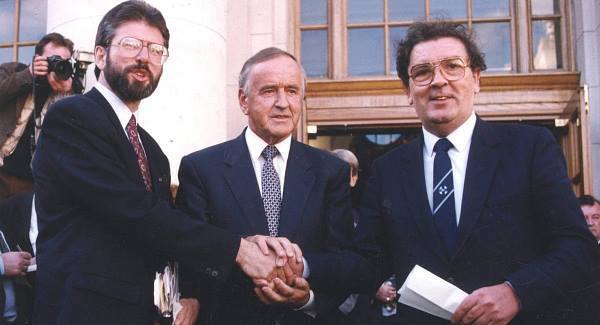
Reynolds as a showband promoter in his early career had worked on both sides of the border and when he came to power set about solving the Northern Irish troubles.
He dispensed with ordinary protocol, travelled to secret meetings, forged a very close friendship with British prime minister John Major and opened dialogue with both sides of the sectarian divide.
His ability to bring both sides to book without losing their trust laid the foundations for the Downing Street Declaration. And, unusually, he continued to play a role in the peace talks even after his coalition fell.
Reynolds had come to the Oireachtas in the surge of support that gathered behind Jack Lynch in his 1997 giveaway election.
But there was no room for sentiment in 1979 when he joined Charlie Haughey’s Gang of Five, who ousted Lynch as party leader.
Haughey became taoiseach and Reynolds was appointed minister for post and telegraphs.
During the 1980s, Reynolds was one of the most ardent supporters of Haughey and was rewarded with successive ministerial appointments, including the finance portfolio.
Like Micheál Martin learned in 2011, losing the first battle is often more of a blessing than winning it. Martin was the first mover in the internal coup against Brian Cowen: he had to leave Cabinet but returned a short time later as leader.
He followed a template set by Reynolds in 1991 when he stood up against his old ally and offered himself as an alternative to Charlie Haughey.
This coup was unsuccessful, but Haughey was in steady decline as the revelations regarding the party’s links with beef baron Larry Goodman angered their partners in Government, the Progressive Democrats.
The nail in the coffin came when former justice minister Sean Doherty revealed Haughey had ordered him to get the gardaí to tap journalists’ phones.
Haughey was gone, and in February 1992 Reynolds was elected taoiseach. His first action was to clear out Haughey loyalists and to promote a new generation of Fianna Fáil politicians who were to dominate politics for the next 15 years.
Long before libel actions and the Beef Tribunal, Reynolds was remembered for his first stint in Cabinet when he was given responsibility for post and telegraphs.
He set about modernising the antiquated switch board system and delivered an electronic exchange.
This had a dramatic impact on a growing and increasingly interconnected economy in the 1980s.
Reynolds was characterised as a country yahoo, but he was shrewder than many of those around him.
He became a highly successful showband promoter after organising events in support of the local church. When the charitable work was done, he had the contacts and the bands to support his own enterprise.
He opened 14 dancehalls across the country making contacts that he continued to nurture throughout his political life.
He sold on his business in 1966 at its peak and went on to invest in newspapers, and in 1971 the C&D pet food business.
THE LOWS
In October 1994, UTV’s Counterpoint aired a documentary on the handling of the extradition application for Fr Brendan Smyth.
It exposed the failures of attorney general Harry Whelehan in dealing with the case. Reynolds had been pressing to appoint Whelehan as president of the High Court against the wishes of his coalition partners in Labour.
Reynolds initially fought to defend Whelehan’s reputation but, as he later recalled, the Labour Party felt “the priest changes everything”.
When Whelehan was sworn in as president of the High Court, it pushed Labour towards the exit. The government fell.
In December 1992, citizenship was granted to a wealthy Arab investor in exchange for a £1m loan he gave to Reynolds’ C&D pet food business.
The passports for sale legislation was above board, but the Masris did not meet the criteria required to obtain the passports.
Reynolds argued that he had resigned his position as chairman of the business when he became taoiseach. He said the Masris, a mother and son, also had invested £1.5m in a separate forestry project.
He was publicly criticised but remained politically intact when Labour were won over by the argument that the deal was done at arm’s length.
Des O’Malley, the leader of his coalition partners in 1992, became the thorn in Reynolds’ side as he kept pressing the issues raised in the 1991 World in Action documentary into the beef industry.
Reynolds had been responsible for providing export credit insurance to Larry Goodman to sell beef into Iraq, which left a massive liability following the first Gulf War.
When he left the Progressive Democrat coalition and entered a post-election deal with the Labour Party, the Beef Tribunal was in progress and threatened to ruin him.
Reynolds had the Beef Tribunal report before anybody else and rushed to the presses to declare that it had vindicated him.
When others got to read the same document they did not reach the same conclusion, but accepted it did not find evidence to support the damning allegations that had been made.
In later years, another tribunal report, by Judge Alan Mahon, criticised the way he used his office to solicit party donations from developer Owen O’Callaghan.
The fall of the Fianna Fáil/Labour Party coalition led to a report in the Sunday Times that labelled Reynolds a “Gombeen Man” for his handling of Whelehan’s appointment.
The information used in the report was incorrect and Reynolds sued for libel in the English courts. He won.
But in one of the most famous libel cases of its times, he was awarded £0 and this was later upgraded to a single penny.
This left him with a moral victory but, because the matter was in the public interest, he was left with a legal bill of £800,000.
In 1997, buoyed by the success of the Northern Irish peace talks, Reynolds was encouraged to run for the Fianna Fáil presidential nomination. His successor, Bertie Ahern, had asked him to remain as a TD after the 1997 election with a view to running for the Áras.
Reynolds topped the first round of voting in the selection convention. But on the second round he was defeated by Mary McAleese who later became President.