Origami inspires creation of real-life Transformers
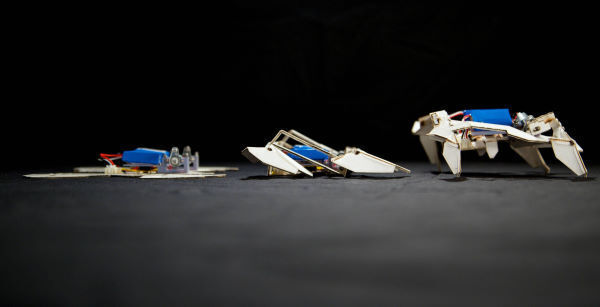
A real-life Transformer has been created by scientists inspired by the Japanese paper-folding art of origami.

Origami inspires creation of real-life Transformers

In tests, the small shape- changing robot folded itself into a functional machine that could walk and turn without human help.

But unlike Transformers toys — robots that disguise themselves as cars and trucks — the device is not aimed at children. Experts believe the assembly system could provide a cheap way to mass-produce robots with multiple applications.

They may be especially useful for accessing confined spaces, for instance when searching for survivors in collapsed buildings. A “flat pack” robot could be posted through a narrow gap or tunnel before expanding itself to full-size.

Origami is a Japanese art that involves folding sheets of paper in cunning ways to form 3D shapes resembling flowers, animals, or decorative figures.

Drawing on the same principles, US scientists built a self-assembling four-legged robot from sheets of shape-memory plastic containing embedded electronics.

Once connected to a battery power supply, the flat composite heated up, folded, and transformed into a mobile robot in about four minutes. The 5in-long device crawled away at a speed of more than 2in per second and was also able to turn without assistance.

Professor Rob Wood, who led the Harvard University team, said: “Folding allows you to avoid the ‘nuts and bolts’ assembly approaches typically used for robots or other complex electromechanical devices and it allows you to integrate components.”

Colleague Sam Felton pointed out that traditional manufacturing required costly machinery and 3D printing was too slow for mass production.

But the components of folding robots could be produced rapidly and cheaply using standard tools such as laser cutters and printed circuit etching technology.

A software programme called “Origamizer” was used to generate the crease patterns at the heart of the automated folding process, the researchers reported in the journal Science.

More in this section

Lunchtime News

Newsletter

Keep up with stories of the day with our lunchtime news wrap and important breaking news alerts.

Cookie Policy Privacy Policy Brand Safety FAQ Help Contact Us Terms and Conditions

© Examiner Echo Group Limited