Behind the door at the Cork Simon Community Day Centre
The first is that most of the men don’t look like what we dub “down and outs”. The second is that many of the men seem quite young.
You could say the absence of a woman in the queue is also surprising, but maybe not, when you consider the statistics: The number of homeless men outweighs the number of women by about five to one.
The doors open at about 7pm and the men file in to cheery greetings from Theresa McCarthy from Clonakilty and Yvonne Murphy from Fairhill, both of whom began their Simon careers as volunteers and both of whom are now staff. The women screen the men via security camera in case anybody’s overloaded with drink or drugs. Tonight, just one person is turned away.
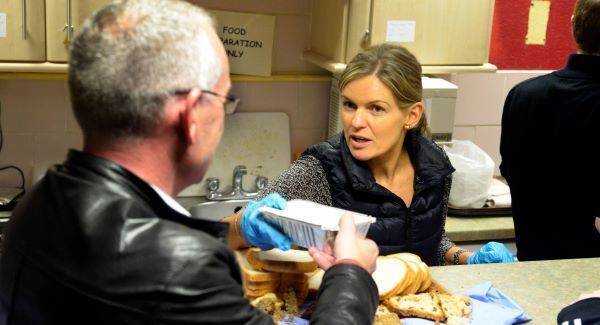
Inside, the day centre is warm and welcoming and glowing with Christmas decorations. The men head towards the food counter where a couple of volunteers serve up the dish of the day: Mashed potato, chicken kiev, and a mix of veg. For the hungrier, there are fine doorsteps of bread and the customers tuck in with relish. There’s banter among those in the mood.
William (Billy) Kenneally, from East Cork, now living in Mayfield, is being slagged for his Santa beard. He dresses up as Santa three days a year to help with fundraising for the homeless.
He enjoys the “craic” in the Simon centre, but doesn’t come every night. Drink is his demon and he’s off it at the moment but admits he “breaks out now and then”. When he was younger he could hold court all day and all night in a pub, until it began to damage his health. He used to like road running and fishing and can name all the beaches of East Cork. He’ll spend Christmas Day with his best mate.
Others will come to the centre for Christmas dinner and the menu will offer the full works: Turkey and ham, stuffing, plum pudding. A Christmas tree is already in situ. A band will churn out festive tunes. The soup run will also take place and people living in Simon-supported housing will receive visits because poverty and loneliness are not just for Christmas.
Suzanne Dennison is part of the Thursday night soup run team (44 volunteers make up rotating teams) so she won’t be on Christmas Day. She says the demand for Simon’s services is growing all the time.
“It’s got busier. And the demographic has shifted. We have a lot of people coming in in their 30s and 40s. Before it was a lot older,” she says.
Paul Sheehan, campaigns manager with Cork Simon, says the number availing of the soup run averages 30 per night. Six months ago the figure was closer to 20.
The number of people sleeping rough in the city averaged eight per night in November, compared to six last April. The total sleeping rough in November was 33, compared to 22 in April. The target of the previous administration was to end homelessness by 2010. The current Government has pushed that out to 2016.
When I express surprise that the men coming in to Simon tonight are all sober, Suzanne says “everyone assumes everyone in Simon is on drink and drugs” but in fact “there is no stereotype”.
For instance there’s a man in the night I visit who can pay his rent but has no money left for food after he pays back the loan shark.
Paul says half of the people who use the soup run are living in private rented accommodation but after paying the rent, have nothing left for food. About a quarter live with friends. A Polish chap, Miroslw, 39, is one of them. He came to Ireland about seven years ago and lived in various Cork suburbs until his relationship with his wife broke down. He has two young kids. His wife kicked him out because “I am not a nice person”, he says.
He was a teacher in Poland but works as a part-time cleaner here. He earns €180 a week, less than he would earn on the dole. He discovered Simon when he was dropped there by gardaí after his wife kicked him out. That was February. There is nothing like Simon in Poland he says. Any similar services are run by the Church and controlled by the state, which he says works to keep people down. He likes Ireland.
Tonight, he has met two other men from Poland at the day centre. They are Adam Kowalski, a tiler by trade, who says his parents also live in Ireland.
However relations are not good and his wife has also kicked him out because she thinks he drinks too much, he says.
His foot is in cast, he caught it in the banisters, he says. He isn’t working at the moment. He is staying at the St Vincent de Paul hostel on Anglesea St which provides short-term supported accommodation for single men. His friend Marscz Tarnoplski is staying there as well.
Relationship breakdown is a theme among the men. Paul says many have addictions to drink, drugs, gambling. Mental health problems are rife. Eleanor Kiely, head of homeless emergency services, says they try to get people from the shelter to supported housing “because they need a bit of a stepping stone before they go to private rented accommodation”.
“Our problem is that we don’t have enough supported houses at the moment,” she says, (they have 27 flats) “and the step from the shelter to independent living is huge.”
Simon has a strong focus on trying to look after the health of people who come in contact with the service, Eleanor says. They have a GP during the day upstairs. Men who wouldn’t otherwise visit the GP are encouraged to do so when they visit the day centre. They have the opportunity to shower. They can access a psychiatric nurse, a public health nurse, a psychologist, a psychiatrist, an addiction counsellor. The medical team services are shared with St Vincent de Paul.
“When they come in we try to get them up to speed, sort out medical cards, get them on a housing list. Sometimes, when you’ve had a decent meal and a shower, it’s easier to engage,” says Eleanor.
Paul says they also encourage those who stay in the shelter — and there are currently 48 — to engage in training and education opportunities.
They offer courses in everything from literacy, to cooking to IT. There’s a poster on the notice board advertising the “Great Simon Bake Off”.
“We work towards harm reduction, we are not about trying to get people to stop but to reduce their intake of drink or drugs. By doing things like cooking and arts and crafts they can start off the day in a positive frame of mind,” says Paul.
This evening, the vibe in the centre is pretty positive, not least because of the efforts of staff. A volunteer, Colette, brings Billy “Santa” Kenneally a cup of tea and a slice of cake after we finish our chat. Baskets of cake are handed out to the men as well as a basket of fruit. Eleanor says there’s a good chance it’s the only piece of fruit the men get because they wouldn’t waste their money on it themselves. Teabags and bananas are handed out to those who ask for something to take home. Musgraves are great for donations, as are many local businesses, Eleanor says. Suzanne, who lives in Rochestown, arrives in with two bags of new shoes, left over from the shoe shop her father used to have in Nenagh. I ask what drew her to be a volunteer.
“I wanted to give something back,” she says. “I get a lot of satisfaction from coming in here. People can get carried away at this time of year and it’s important to remember those what have very little.
“Sometimes life lets people down and they don’t know who to trust. Everyone here is very isolated. Many have no family to turn to, they pushed relationships too far.
“At least they can come in here and have other people to talk to and it offers them a bit of security. Simon is like a security blanket for them.”
In the hallway of the Cork Simon Community emergency shelter, a man with a wide smile and a warm handshake greets me with the words: “Hi, I’m Michael. I’m homeless, but I’m not hopeless”.
Half beaten from a long-standing battle with booze, he is in to collect his anti-seizure medication. He says he would like us to chat “one-to-one”.
Paul Sheehan, campaigns manager with Cork Simon, is happy to facilitate this. He leads us through the brightly-lit shelter kitchen where a group of homeless women sit in dressing gowns shooting the breeze. We walk through glass doors into an adjoining courtyard where light from the kitchen and a nearby TV room pierces the dark.
Inside men are watching a Europa League match, others are playing pool. Outside, sitting beside me on a wooden bench, Michael whispers that he’s been coming to the shelter for longer than he cares to remember.
“I’ve been coming and going here for years and that’s not a proud thing for me to say. But that’s the way it is. I’ve spent a lot of time on the streets and a lot of time in prison. I’m not drinking all of the time, but most of the time.”
Personally, he doesn’t like coming to the shelter on Anderson’s Quay, next to the River Lee. He doesn’t like the way some people behave. “There are always fights, inside the building and out.”
It makes him feel depressed. A number of years ago, two people died in the shelter, one night after the next, he says. It was of natural causes, but workers do room checks now to make sure everybody is safe. “People walk out of here and into the river,” he says.
He has thought of doing as much himself. It’s not that he doesn’t appreciate the roof over his head. He’s happy when he knows his two brothers, also homeless, are staying in the shelter at night.
“They’ve no safe haven and I know they’re safe when they’re in here. It would be worse if they were dead.” But the shelter reinforces the tragedy of his own life.
I met him last Thursday. He had slept out the night before. There was some kind of “serious incident” he says, a fight or an assault on the street, and some people were turned away as a result. Staff have to assess each night who it’s safe to let in.
“The next morning I was sitting on the street and a girl walked by. I asked if she could spare €10. She passed me as if I didn’t exist,” Michael says.
“Then a chap came along and bought coffee for me and a friend and one for himself. It was the first full cup of coffee I ever drank. I enjoyed it so much because I knew it was given from the heart.”
Asked what reduced him to homelessness, he replies, “poverty”. He came from a family of eight boys and four girls and there was never enough. He worked hard when he was young, he says. He went to school but left after first year.
It’s clear he has a good brain but it’s bit muddled by decades of drink. He recites a poem he wrote in prison, Fade Away, about a girl he once loved. He has a smattering of Gaeilge. He has a 19-year-old son that he hasn’t seen in seven years. Relationships were ruined by drink. His health is poor. He almost forgets to take his anti-seizure meds, but Paul reminds him.
He stands to go. He doesn’t like being on his own in the shelter. There’s too much time for thinking, he says. Drink kills the pain.
“It’s a good break away from physical and mental pain, but when it wears off, the pain comes back.”
His problem comes in a bottle, he says, not in a needle, but there are others for whom needles offer solace. He cries when he’s alone. “I don’t do it in front of people even though I know what’s inside shows on my face. I feel like fucking crying now.”
Cork Simon’s budget has been cut year-on-year since 2008. In 2008, 70% of funding came from government. That figure now stands at 56%, and will reduce to 54% for 2014. As well as providing emergency shelter and supported housing, Simon provides medical services, outreach work, a youth homeless drugs prevention project for 18 to 26-year-olds, training and employment programmes, and an activity programme.
For information on donating to Simon, visit www.corksimon.ie
or phone 021-4321166.
CONNECT WITH US TODAY



Be the first to know the latest news and updates