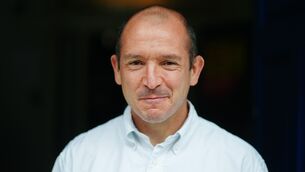
Aiming to beat the banks
Ultimately, it appears prepared to use legal arguments dating back to the reign of King James I of England to separate hundreds of millions of euro worth of debts from the distressed properties to which they are linked.
The trust’s language has chimed with those who have sought Freeman of the Land status as a mechanism for claiming to be ‘individuals under God’ rather than citizens of a nation state.
This is supported by the trust’s deed documents and an aspiration statement given to those entering the trust. It refers to people living under the guiding principals of natural law, which is set out in the treaty of the universal community trust.
This community trust is a loose international movement which has, unsuccessfully, used Freeman of the Land strategies to take on states and courts.
Throughout the summer, even those who have placed properties into its trust have expressed major reservations about its prospects.
People were still willing to risk €350 as a last-ditch attempt to thwart receivers and forced auctions. The trust, run by Kilkenny man Charles Allen, has so far remained an enigma.
It has courted controversy since it thwarted an auction early this summer and, in its most public act, seized the Kennyscourt Stud Farm in Kildare from two receivers who work for Savills.
The property had been in receivership for some time and belongs to Eugene McDermott, who owes a combined €8m to Bank of Scotland and the remnants of Anglo Irish Bank.
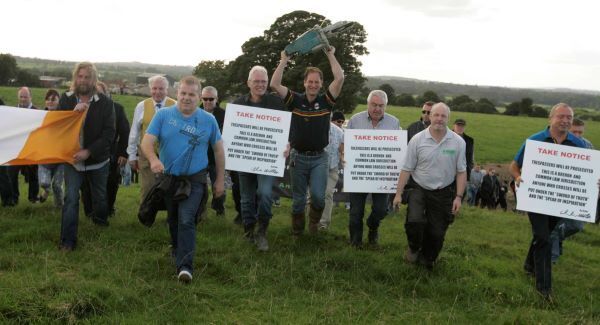
When the receivers retook the property from the trust late last month, Mr Allen returned with a consaw and more than 250 supporters to occupy it once more.
He said he expected this would trigger a court challenge but, so far, the receivers have remained silent.
Prior to the Kennyscourt tussle, Mr Allen had kept a low profile and postponed interview requests. He said the trust was a private entity and had to remain so.
He had at least four people working for him yesterday and has told people barristers are ready to fight his corner when this inevitably reaches court.
According to company filings, Mr Allen is a landscape gardener in Inistioge, Kilkenny.
He has not had much of a public profile. A routine search shows that his local credit union registered a judgment against him for €11,000 in 2008.
When he spoke to the Irish Examiner last week, at the site of the stand-off at Kennyscourt Stud, he said he was fighting for middle Ireland.
Those who have entered the trust have found it reassuring that he has not sought large up-front fees and has not charged people for deals involving their family home.
During the summer, people could enter the trust for €250 and pay €100 a year to lease back their properties. This rose to €425 to enter the trust at yesterday’s signing-in session plus the €100 annual lease.
For commercial portfolios, the trust has asked for at least 10% of the properties to be signed over.
The idea is that the trust will oust the receivers and can then begin to claim the rent these sites earn.
There is no evidence that the Rodolphus Allen Private Family Trust has laid claim to any of this rent yet.
In all likelihood, the trust will only start to make money on these arrangements if it succeeds in court.
Doubting debtors have felt that, if it was a scam, as has been suggested in the Seanad by senator Thomas Byrne, Mr Allen would have asked for a larger up-front fee and not rely on future earnings.
If 50 people paid €425 yesterday, the trust still stood to earn more than €20,000 for a day’s work.
There have been many other people offering fix-all solutions to debt problems, who have charged a lot more for consultation fees.
The trust has also benefited because people who attended signing-in sessions were able to identify well-known businessmen and some solicitors who were willing to give the trust a chance. They did not publicly endorse the trust but, as the signing-in sessions were relatively public, the fact they entered was evident.
The Irish Examiner has established that a number of people with multimillion-euro debts signed their properties in to the trust — this has included the businessman Bill Cullen.
Lower-profile people from across the country have also committed their assets.
Those entering the trust have not been told the action will make them debt free. The debts will remain but the properties they are secured against will, if the plan works, be removed from the reaches of the bank.
A person could then file for bankruptcy to clean their debts. Then, when they emerge, the unencumbered properties could be available to them again.
In the early stages, there was a particular interest in the south of the country because most of the signing-in sessions were held in Cork.
Cork was the preferred venue because of the availability of Dermot Conway, a notary public in the county who cut his ties with the trust this week.
Previously, Alan Millard, a notary public, was available in Carlow, but he only provided his services for one session.
It is not clear why a notary public was required but their functions have been to record transactions and to verify that people signing over properties are not doing so under duress.
People at yesterday’s event were told that pressure had been applied on notaries by the Law Society to distance themselves from the trust and, without their co-operation, there would be no more signing-in sessions.
The first Cork meeting was held in June at the Clarion Hotel.
There have been other events in Youghal and Mitchelstown. These have facilitated people travelling from different parts of the country.
Yesterday’s event was held at Ashford, Co Wicklow, because Mr Conway was no longer available to the trust.
A meeting that had been scheduled for Mitchelstown was cancelled.
The trust has not explained the formula it believes will defeat lenders when it is challenged. Even those with large portfolios in the scheme are still in the dark as to the fine print.
Its operator, Mr Allen, has said that those who need to know already know and it will become evident when required.
As of yet, the trust has not been challenged in court so Mr Allen has not had to show his hand.
The Rodolphus Allen Trust explained. Note: This summary is based on third-hand information and distilled through people who are not lawyers or experts in land law.
During last week’s seizure of a stud farm in Kildare, the group cited Brehon and common law. Common law, which is based on precedent, only applies if no new law has been written down to overrule it.
The trust seems to feel it can show that, under common law, there can only be one owner of a property at any one time.
In effect, a mortgage gives a lender a right to own a property, but this is put on hold as long as a borrower meets a repayment schedule.
It is suspected that the trust will argue this is not a legitimate encumbrance because, regardless of any mortgage arrangement, the buyer of a property is the registered owner.
This tactic has been underscored by the single requirement people have had to meet in order to place a property into the trust.
They must get one specific type of document from either the Land Registry or the Registry of Deeds and make it available at the signing-in session.
This is a certified copy of the original instrument or memorial which recorded their purchase of the property.
The object is to show the person turning up at the signing-in session, with proper identification, is the rightful owner.
The scheme only relates to freehold property — this is critical to the potential success of the trust’s case because it is expected to argue that there can be only one owner of land. A long leasehold, even if it is for 999 years, is not ownership.
Trusts, in various forms, are not new.
They date back to the middle ages as a means of ensuring property is kept in use for a specific purpose.
But although putting assets into a trust is not a new argument, there is no evidence that this type of approach has worked in cases where there is a debt already secured on the land.
In England, there are cases going back to 1997 where a person can only put a property into a trust if they truly intend for it to be held in trust.
So, precedent would suggest you cannot put a property into a trust just to temporarily keep it away from creditors.
The parties entering the trust will also have signed a deed which says the property is free of any encumbrance.
But in all of the cases there is a loan attached to it and a claim registered against the title.