‘No other devices’ complicates police probe
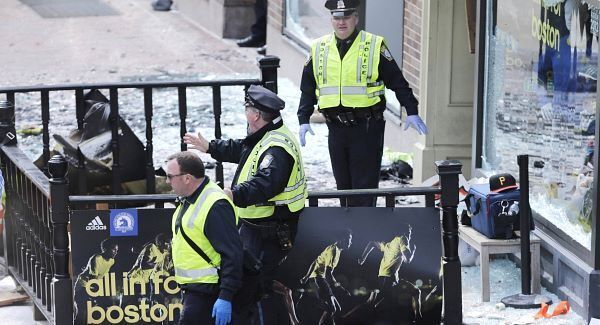
At this point, no one is in custody in connection with the Monday attack that left three dead and sent 176 to area hospitals, Boston Police commissioner Ed Davis said at a press conference. Of the injured, 17 remain in critical condition.
Late on Monday, police searched a Boston area apartment of a Saudi Arabian student who was injured in the blast, law enforcement sources said.
Law enforcement sources briefed on the case said that the evidence was indicating that the Saudi student, who had been temporarily considered a “person of interest” in the investigation, would be cleared of suspicion and was unlikely to shed any light on the attack.
Numerous other theories and leads in the investigation are being looked at, the sources said, but there is no particularly strong lead being pursued.
Richard Deslauriers, FBI special agent in charge of the investigation, declined to name any people being interviewed in the case.
White House officials said it was too early to say whether the attacks were carried out by a foreign or homegrown group.
Dispelling earlier reports of as many as seven devices being found around Boston, Gene Marquez, assistant special agent in charge for the US Bureau of Alcohol, Tobacco and Firearms, said authorities had determined that the only bombs deployed in the attack were the two that detonated.
Any unexploded device might have provided a clearer picture of what materials were used and how the bomb was assembled, furnishing leads in the case.
Meanwhile, a stretch of Boylston St near the race’s finish line, where the blasts occurred, and the blocks around it were closed to traffic as police searched for evidence of the identity of who placed the bombs, which were packed with ball bearings and nails.
The White House said the bombings would be treated as “an act of terror” and President Barack Obama vowed those responsible would “feel the full weight of justice”.
It was the worst terror attack on US soil since security was tightened after the attacks of Sep 11, 2001.
Hospitals in the Boston area were planning surgeries for some of the victims, many of whom sustained lower leg injuries in the blasts, said Peter Fagenholz, a trauma surgeon at Massachusetts General Hospital.
“We’re seeing a lot of shrapnel injuries” from small metal debris, Fagenholz told reporters outside the hospital. Doctors treated 29 people, of whom eight were in a critical condition.
A 2-year-old was being treated at Boston Children’s Hospital for a head wound, the hospital said.
The blasts put police on alert in major cities across the US, including Washington and New York City, the sites of the Sep 11 attacks.
Officials in Britain and Spain said the London and Madrid marathons would go ahead on Sunday, but security plans for both races were under review.
Police may still have few answers but that hasn’t quieted the speculation.
There are three groups that are the focus of early finger-pointing in the Boston attack:
*Islamist jihadists were inevitable since the Sep 11, 2001 attacks. The construction of the bombs — gunpowder with ball bearings and other shrapnel to maximise the damage — is similar to a bomb recipe shared by al Qaeda “on its internet manuals for terrorist attacks”.
*Right-wing militia types are also being looked at. Most proponents point to the date — Patriots Day — as a clue. Residents of Massachusetts and Maine celebrate by re-enacting the first battles of the American Revolution, says Sommer Mathis at The Atlantic Cities.
*Investigators may also be looking for a lone wolf.
The photograph and video of a 78-year-old Washington man who was seen knocked down by one of two bomb blasts during the Boston Marathon only to finish the race quickly went viral.
Bill Iffrig was running his third Boston Marathon and was near the finish line when the first explosion took place. He said he heard a noise and then found himself on the ground.
“It was only 5 feet (1.5m) away from me,” he said.
“It was really loud.”
Iffrig said he was fortunate to end up with only a scraped knee.
A race official then quickly helped him to his feet.
He walked across the finish line and another half- mile to his hotel. Iffrig called his experience a said the experience seriously “scared” him.
The runner’s son, Mark, from Seattle, said he was tracking his father’s race progress online and didn’t realise what had happened.
He later became aware of the news through a post on Facebook and quickly turned on the TV before trying to call his father.
He said he recognised his father from a widely distributed Boston Globe photo showing him on the ground, surrounded by police and race officials.
CONNECT WITH US TODAY



Be the first to know the latest news and updates