Expectations high for Pope Francis ahead of inauguration
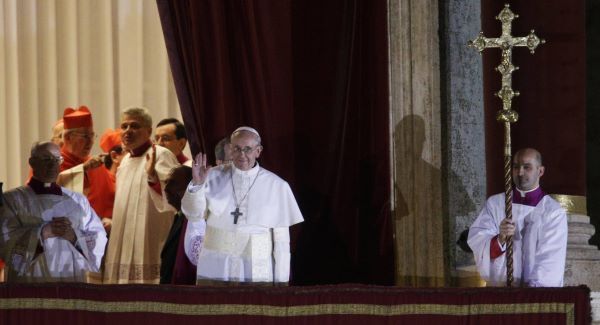
Fr Paul Smyth, whose parents are from Co Longford, is vicar general with the Claretian Missionaries and is based in Rome. He believes the decision by the previous pope, Benedict, to resign, was his final gift to the Church.
This photo of the crowd waiting for #PopeFrancis to emerge is insane! #Pope pic.twitter.com/YULczQWEkW
— Keen Eye (@MartinBerthelot) March 14, 2013
“One of the good things about Benedict’s resignation is that it avoids creating the kind of environment that essentially allows the curia to fill the vacuum,” Paul says.
Paul met Benedict’s predecessor, John Paul 11, about 16 years ago, and even then, signs of the illness that eventually took him were evident. Yet, he continued to be wheeled out by the curia, who Paul feels were happy to maintain the status quo.
It meant they had a front man, while, essentially, the curia was pulling all the strings. Paul believes Benedict was determined not to allow a similar situation develop in his own case.
“He had great courage to say “enough is enough”. That, I believe, was his gift to the Church, even though some of the older clergy feel he should have carried on, that what he did breaks with tradition,” Paul says.
In relation to the new pope, Francis, Paul sees him as a man of contradictions: on the one hand a man of the poor and also, as cardinal, a prince of the Church.
God bless our new Pope, Francis the first! #PopeFrancis #conclave
— + Fintan Monahan (@BishopFintan) March 14, 2013
“He chose to do his own washing and ironing and walk among the people in the metro when he lived in Buenos Aires, but he’s also done the job of being a manager within the Church.”
“Part of that involved discouraging priests from political activism and it was as a result of this that the new pope has seen old allegations come back to haunt him. During his time as Jesuit provincal in Argentina, two of his priests were kidnapped by the military regime. One of the priests later blamed the pope, then Jorge Mario Bergoglio, for betraying them.”
In relation to these accusations, Paul says the allegations relate to a time of “tremendous upheaval in Latin America”, when Bergoglio was a relatively young age. They relate to a time when liberation theology (that the Church should derive its legitimacy from allying itself with the poor) was shunned. Bergoglio, Paul says, has since embraced the fact that the Church is for the poor.
“The fact that he chose the name Francis, from Francis of Assisi, the symbolism of that name resonates, he’s not saying “redecorate my Church, he’s saying rebuild it,” Paul says.
“Personally, I find myself feeling more hopeful about the Church than I have done in a long time. I think this pope has the charisma and the gifts necessary to move the Church in the direction in which it needs to be moved.”
Rome-based Sr Liz Hartigan, from Co Leitrim, is a member of Our Lady of the Missions religious congregation. She is hoping for better relations between the Vatican and women’s congregations under the new pontificate.
“I know it’s early days, but I get the impression he may initiate change and interact more with the hopes and dreams of the people,” Liz says.
“He gives the impression of being a simple, humble man, but I think he is a strong character as well.
“I hope, somehow, that he will encompass all sections of the Church,including women and lay people.” Liz feels the Vatican could do more to embrace the role of women in the Church. Her own congregation works principally with women.
The previous pope was an intellectual, she says, he didn’t meet general chapter members (representatives of the women’s religious congregations). And the curia didn’t seem overly interested in involving the women’s congregations in the life of the Church.
“At the last gathering of general superiors of the women’s congregations in Rome, there was no real acknowledgement by the curia that it was even taking place. I mean you are talking about the leadership of all the women’s congregations, and no real acknowledgement,” Liz says.
Women in the Church were also hurt at a decision by the Vatican in 2009 to begin a doctrinal investigation of the largest US women’s religious leadership organisation, the Leadership Conference of Women Religious (LCWR).
This investigation was initiated by the Vatican’s Congregation for the Doctrine of the Faith (CDF) after initial Vatican doctrinal concerns were expressed in 2001 following a meeting between the CDF and the LCWR. It was focused on LCWR activities and initiatives in three areas: namely, that Catholic ordination to the priesthood is reserved for men alone; that non-Catholic Christian communities suffer “defects” and that homosexuality must be seen as an objective disorder.
“Some of the meetings of leaders of the women’s congregations raised points that the Church didn’t approve of. Things were presented in a way that had not been responded to by the Vatican. The investigation was initiated but the findings have not been made public to the women.
“One of my hopes would be that with the new pope, who, as a Jesuit, has experience of religious life, that there will be an improvement in relations between the congregations and the Curia,” Liz says.
“In a way, I hope he’ll stir things up with the cardinals in the Vatican and weed out whoever needs to be weeded out. I hope he’ll have the courage to do that.”

CONNECT WITH US TODAY



Be the first to know the latest news and updates