‘They want to turn off the oxygen in our lives’
Her most recent play, Mainstream, is being staged at the Dublin Theatre Festival. She is a graduate from Trinity College. She has run for public office and has worked extensively with people who don’t possess her gifts or drive to succeed.
She happens to suffer from cerebral palsy, a condition that has left her unable to use her legs, along with other disabilities. Her spirit is unaffected by the ravages of the body, as is her sense of humour, but she is particularly adamant that her citizenship is also intact, despite a perception in wider society that disability renders her a victim, and the perception in government that victims are a soft touch when it comes to making cuts.
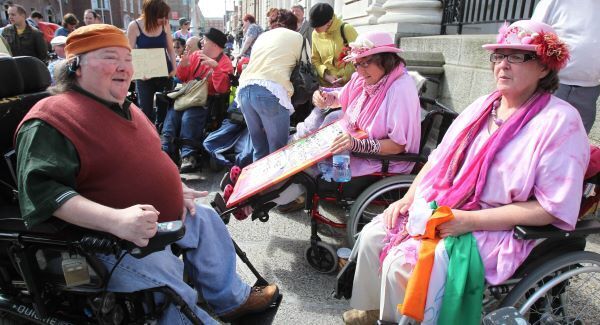
Yesterday, she was at the gates of Government Buildings when about 100 people with whom she has something in common gathered to pose some questions that are screaming out for answers.
“We are seen as people for benevolence. Not just by the Government but by wider society. We’re not seen in terms of citizenship, as part of a diverse Ireland. The only time that people with disabilities are in the news is when it comes to sport or cutbacks,” she said.
The gathering of citizens was organised in response to the announcement last week that €10m was to be cut from the budget for home help and home care packages. Outside the gates of the seat of government, they came together under an unseasonably warm September sun. Many were confined to wheelchairs, some accompanied by carers.
Inside the gates, preparations were being made for the first meeting of the Cabinet after the summer recess.
“We’re tired of defending our rights,” said Ms McDonagh. “We are not asking for anything unreasonable. But the way these things are being dealt with it, it’s as if we are an easy touch. We are not — what’s that awful phrase they use? — low-hanging fruit.”
The protest was first mooted last week in the hours after the announcement by the HSE of €130m in cuts.
Somebody, somewhere in the HSE ran the rule over various sectoral budgets, and came to the conclusion that people with disabilities would have to take another hit for the national good.
This hit would come in the form of an hour of their lives here and there in which their help or care would be suspended.
“We began phoning and texting each other, just some of us who had something in common,” said Ms McDonagh.
“Nobody could believe it. “What you have to understand is that people with disabilities have already been subjected to a lot of indirect cuts, particularly through social welfare. The fuel allowance has been cut, and others, and then there is the SNAs. That has a massive effect on children and their parents. And now they’re talking about direct cuts, taking away home help or personal assistants. They want to turn off the oxygen in our lives.”
The protest was attended by a number of opposition politicians, including Fianna Fáil’s Billy Kelleher, Clare Daly, formerly of the Socialist Party, and Richard Boyd Barrett. All made known their disgust at the proposed cuts, which is what politicians do in opposition.
There was no sign of any ministers, en route to deliberate on who exactly was this week’s selection for that much patronised constituency, “the most vulnerable”.
One public figure of note did pass by without making any comment. Judge Peter Kelly was in his civvies as he walked down Merrion St, casting a quick eye at the gathering before moving on. Down in the Four Courts, he presides daily over the fallout from the recession as it affects those who bestrode an economy that was out of control.
He has made some scathing comments on the attitudes and behaviours of those who were at the forefront of blowing the living daylights out of the bubble. And yesterday, in his private capacity, he could observe the other side of the fallout, where those who had no hand, act or part in the madness were being forced to carry the heaviest load.
The protest was a rare enough event. Unlike those who occupy the various power centres in society, people with disabilities, their carers and families tend not to engage in high- profile or mass protests. Making the trek to the seat of government, particularly from outside the capital, can be a major ordeal.
A cynic might conclude this handicap makes it easier for the powers-that-be to target this section of society. Name-checking “the most vulnerable” is all very well and good, but nothing concentrates the minds of politicians like the sound and fury.
Other factors also impinge on the perception in official circles of people with disabilities. The role of families is taken for granted, and even exploited. Where the State is unwilling to discharge its duty to a citizen, officialdom consoles itself that families can be called on to cover for the state’s failing.
“We don’t all have families who can take up the slack,” said Ms McDonagh. “And even those who do, they’re the same as any other adult. After a certain age you just don’t want your parents to be looking after you. That’s natural for anybody.”
With that, she moved on her chair back among her fellows to resume bearing witness to a system that seems to be shorn of even basic republican values.
She turned briefly to emphasise once more her central point. “I’m not a victim. I’m a citizen.”