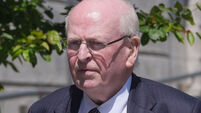
Many will celebrate his demise but unlikely we’ve heard last of O’Shea
The 68-year-old former sports reporter founded the charity in 1977 and, over the years, it has transformed into a global organisation which has spent more than €720m on humanitarian programmes.
Over more than three decades O’Shea, the irascible but engaging frontman, was the central figure in Goal but since boardroom cracks began to appear in the past year, his position as CEO appeared increasingly tenuous.
There were accusations of bullying within the organisation and disclosures over the dysfunctional relationship with some board members. Last year seven members of the board resigned, among them former FAI chief executive Fran Rooney. The new chairman, Ken Fogarty, resigned three months into the job.
O’Shea firmly rejected any claims of bullying, insisting they were false. He launched a legal action against the Goal board and secured an interim order restraining the organisation from suspending him, claiming there was a “concerted action” to remove him. The case has pinged around the High Court in recent weeks; at one point it seemed a détente had been reached only for it to fall through.
Then, on Thursday, came the news a mutually acceptable agreement had been reached and O’Shea would be stepping down at the end of August. His daughter Lisa, who currently works as the charity’s head of fundraising and marketing, is understood to be interested in succeeding her father, but she will have to compete with others when the position is publicly advertised.
In the interests of fairness, it should be said that this reporter has done some work with Goal. In the immediate aftermath of the Asian tsunami of Christmas 2004, O’Shea rang me and had me on a plane within days. The destination was Matara in southern Sri Lanka where I worked for the charity on publicising its work in the stricken coastal region while also filing for this newspaper.
My opinion of him then, as now, was of a man entirely, almost obsessively, driven by the business of Goal. Brusque, boiling over with opinions and unafraid to voice them, it was easy to see how he could have operated in a newsroom, which seemed a more natural environment for him than, say, glad-handing with politicians and diplomats.
He did some effing and blinding but it always seemed to be focused on the job in hand. While he had an abrasive way of showing it, he did genuinely seem to care that the projects on the ground were having a tangible and swift effect — something in marked contrast to the “talks about talks” approach of other NGOs, some of which appeared more interested in having their branding on view than actually getting down to the nuts and bolts of responding to the needs of communities that had lost everything.
But then, I have over the years met plenty of other people — some of them ex-Goalies — who have a different view of O’Shea. Some people were downright condemnatory, others sounded hurt as though they had some of their illusions shattered while working under him.
You could contend that, in 35 years of working to try and provide for the poorest communities in the world, some egos are going to take a pounding, yet you could also argue his management style was increasingly out of step with modern methods.
The kidnapping of Goal staff Sharon Commins and Hilda Kawuki in Sudan in summer 2009 highlighted issues within the organisation. The two women had been staying in a compound in the dangerous Kutum region of Sudan after staff at other NGOs had pulled out of the area.
They endured a 107-day ordeal at the hands of their captors before they were eventually released. Afterwards, an RTÉ documentary outlined the serious questions being asked of Goal and specifically how two female staff had been left in such a vulnerable position in such a hostile environment.
Ms Commins was unavailable for interview for this piece but, earlier this year, spoke at an event in the University of Limerick where she stood by her earlier criticisms of Goal’s security measures at the time of her kidnap, stating: “Ultimately, the buck stops with the aid agency.”
During the RTÉ documentary, O’Shea, for once, looked and sounded uncertain. He said he had staff in countries all over the world and it would have been impossible for him to have known everything about a particular situation in one corner of Sudan.
Yet Ms Commins’s comments, coming from someone who had lived through the ordeal of being held captive, carried greater weight. “I am glad that I publicly criticised them because I think that security practices in Ireland and further afield have changed,” she said.
The Irish Government, the UN, numerous foreign leaders, sundry diplomats, and even other NGOs have all felt the lash of O’Shea’s tongue over the decades.
Many may now breathe a sigh of relief that he is stepping down from the frontline, the boot boy now entering the era of pipe and slippers. But it’s unlikely we have heard the last of him.