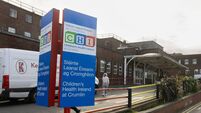
Farmer loses action against health board
Dermot Finn’s wife Noreen, aged 58, of Faha, Killarney, Co Kerry, died over two months after undergoing brain surgery at the hospital in 1997.
Rejecting Mr Finn’s claim against the Southern Health Board, Mr Justice Éamon de Valera said he accepted the evidence of a hospital pathology technician that he had returned the brain in a casket to Mr Finn a few weeks after the autopsy.
“I don’t know why Mr Finn does not remember this,” the judge said.
The pathology technician, Dan Collins, he said, was adamant he returned the brain remains. The judge said he had seldom been more impressed with the truthfulness and accuracy of a witness such as Mr Collins.
Mr Justice de Valera said he that also accepted the evidence of the then deputy chief executive of Cork University Hospital, Gerry O’Dwyer, and noted that Mr Finn admitted in cross-examination he could not confirm he had told his solicitor about alleged phone calls to Mr O’Dwyer about his wife’s brain.
This week Mr Finn settled his action against neurosurgeons Timothy Buckley and Charles Marks of Cork University Hospital, and Killarney GP Dr Miriam McCarthy, for damages surrounding his wife’s death after an open offer in the region of €300,000 plus costs was made with a partial concession of liability in relation to the medics.
In his evidence to the court yesterday, Mr Finn said it was “completely incorrect” of the Southern Health Board to say he got the brain back in an urn a month after his wife died.
“Let’s put it strongly. That is a lie. It was not given back.
“It is a disgrace. It has been horrifying, indescribable, the effect on me and my family.”
Mr Finn also claimed that four years after his wife’s death and autopsy, the then deputy chief executive of CUH, Mr O’Dwyer, rang him out of the blue. He said Mr O’Dwyer told him Mrs Finn’s brain was ready for collection in an urn and he could collect it at his convenience.
“I said I needed to have it DNA-tested to ensure I am getting back what I am supposed to get back,” he said, and left it at that.
A couple of days later, he alleged, Mr O’Dwyer rang him to say they could not find the brain.
He said he wanted his wife’s brain to bury it with a ceremony.
Mr O’Dwyer said he had rung Mr Finn on several occasions to offer him counselling and answer his questions, but he was clear he did not make the phonecalls alleged by Mr Finn.
Mr Collins told the court that he returned the brain to Mr Finn in person in a white casket. “As far as I am concerned, I gave him the brain. I have no axe to grind with this man. I am there to serve him and I thought I had,” he said.
Mr Collins said he would not agree with counsel for Mr Finn that he was mistaken on the matter.
Mr Finn brought an action for damages against the Southern Health Board in relation to the alleged retention of his wife’s brain after an autopsy following her death in the hospital in Apr 1997.
It was claimed that Mr Finn, his daughter, Breda, and his son, Sean, suffered emotional trauma, anguish, and distress.
It was claimed the Southern Health Board wrongfully retained the brain matter and failed to return it to Mrs Finn’s husband for proper burial despite repeated requests to do so. Mr Finn, it was claimed, suffered a prolonged grief reaction and this has been aggravated by the alleged retention.
Mr Finn said when he and his family arrived at the hospital on Apr 23, 1997, his wife, who had undergone brain surgery over two months previously, had died. He said it came as a shock. He did not know how she had died and an autopsy would solve the problem.
“I gave permission on the clear undertaking that no parts, nothing of her body, would be kept back. I would not have consented without a guarantee.”
Mr Finn said the guarantee meant everything to him.
“She was my wife and the mother of my family,” he said, breaking down in tears in the witness box.
Mr Finn said that after the autopsy, he asked a man in a white coat what was the cause of his wife’s death, and he said they put the brain in a substance for six weeks and examined it then to establish the cause of death.
“Sixteen years later, we still do not know the cause of death. I ask this court to tell me why my wife died. I am entitled to that.”
Mr Finn said that in the mortuary, he wondered should he ask the staff to put his wife’s brain back, but “I said ‘we had three months of hell’, and decided to get out of there.”
A month after the funeral, he told the court he asked a priest to contact the hospital as he wanted to get his wife’s brain back to bury it.
Mr Justice de Valera will today decide on the costs.