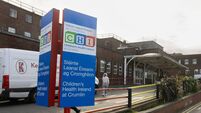
'More children could die, warns heart expert
Mr Freddie Wood, a cardio-thoracic surgeon at Our Lady’s Hospital for Sick Children at Crumlin, said it appeared that as long as the problem was out of the limelight the authorities responsible were doing little to address it.
“It is nearly three years since the problem has been identified and yet it does not seem to be any better.
“The nursing authorities have had ample time to come up with answers and they have not done so,” Mr Wood said.
He said on the day he was due to operate on two-year-old Róisín Ruddle, the theatre and all the necessary medical expertise and equipment was available.
What was missing in the vital link was a nurse to nurse the bed space for the child to go to,” he said.
He said everybody at the hospital had been devastated by the unexpected death of the little girl.
In fairness, he said, money had been provided to recruit the nurses in both 2000 and 2001.
So the question had to be asked if the recruitment process was adequate and would it stand up to scrutiny, Mr Wood said.
Because the recruitment programme was unsuccessful the hospital found itself short 45 nurses, compared to 2001 when they were short 30 out of a total of 115.
There was a further attempt to recruit intensive care nurses this year but there is a now a cap on nursing staff employed by the hospital at 1,034.
So, the hospital would have to let nurses go from other areas in order to successfully recruit.
Mr Wood said the little girl was scheduled for elective cardiac surgery on Monday.
Because of the lack of intensive care beds he and the consultant anaesthetist had to make a choice between what child should or should not be operated on.
It was the only operation cancelled on the day. Mr Wood said he had to cancel about six cases out of 50 in the last six months.
One-third of children are denied admission to intensive care on a daily basis at Crumlin, mainly because of a lack of intensive care nurses to nurse the bed space.
The hospital has 21 intensive care spaces that are fully equipped since 2000 but on a daily basis only 13 to 14 of these spaces are functional, depending on the skilled nursing staff available to manage them.
“It has to be realised that we only ask for patient to go to intensive care where we consider their condition or surgery treatment has a significant threat to life so it is not asked for lightly,” Mr Wood said.
He added that children needing cardiac surgery are prioritised when it came to designating intensive care spaces.
As a consequence, in the last year and a half there had been few cancellations than there had been in other specialist areas.