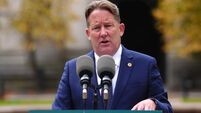
Roche bursts gum tax plan bubble
Mr Roche also said the Government will not go ahead with proposals to tax fast food, litter and bank machine receipts.
However, the Government will seek a phasing out of polystyrene in fast-food packaging.
Former minister Martin Cullen initially championed a new tax for ATM receipts and chewing gum to defray their clean-up costs.
But in a reversal of policy, Mr Roche asked companies to come up with proposals to minimise their products' litter impact.
The chewing gum industry lobbied against the tax, with Wrigley's getting US Ambassador to Ireland James Kenny to make their position known to the Government. Opposition parties attacked the U-turn last night, calling it a concession to commercial interests.
Labour Party environment spokesman Eamon Gilmore said Mr Roche had capitulated to lobbying.
"Mr Roche has capitulated to direct and indirect lobbying conducted by the large chewing gum manufacturers by merely making them pay levies to local authorities. This solution was the preferred option of the companies, yet totally ignores the recommendations of independent consultants who conducted research on the matter," he said.
Mr Gilmore said the ambassador's involvement demonstrated "the lengths to which companies were prepared to go to protect their economic well-being, as opposed to protecting the Irish environment".
Fine Gael spokesperson Fergus O'Dowd accused Mr Roche of making policy "on the hoof".
"If there was proper investment in litter wardens to catch and punish the significant minority of litterbugs who throw their gum on the ground, perhaps there would be a saving in the long run," he said.
Mr O'Dowd also called for a ban for ATM receipts.
He said: "These receipts are an environmental nightmare and should be banned immediately."
In a statement released yesterday, Mr Roche said he would begin negotiations with the relevant sectors.
"This will give these sectors in effect, the producers of the items concerned, which end up as litter an opportunity to propose positive and meaningful measures to minimise the impact of the items they produce in causing nuisance litter."
However, Mr Roche warned that a failure to come up with workable proposals would see a return to a mandatory levy.
"Our ultimate objective must be to tackle the litter problem and associated negative environmental impacts.
"To this end, I am anxious to see a considerable reduction in the incidence of these items as nuisance litter as quickly as possible," he said.