Nissan Leaf review: Can the electric pioneer compete with today’s SUV rivals?
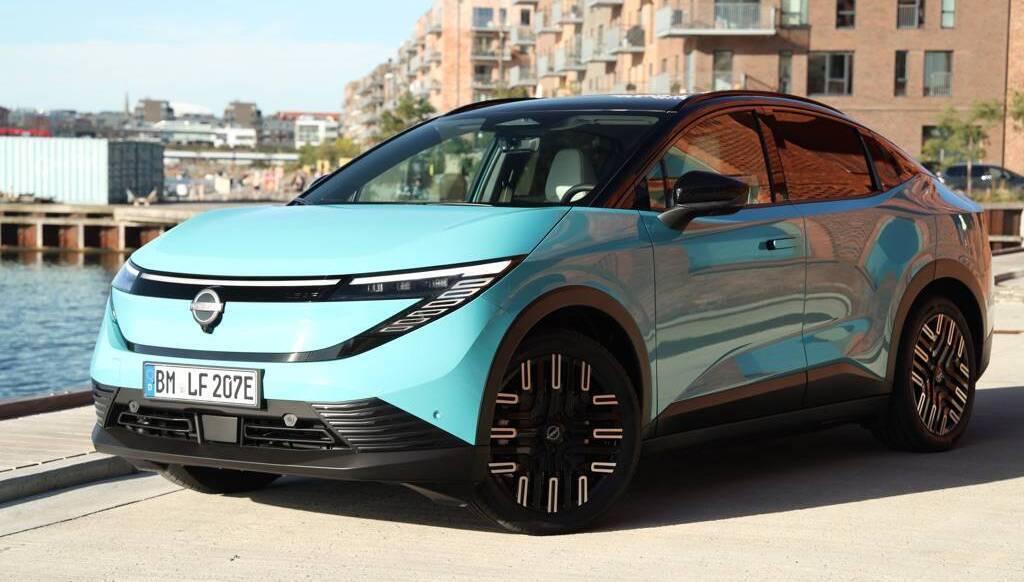
The new Nissan Leaf gets an SUV makeover, up to 604km of claimed range and improved technology. Our review examines its performance, comfort and real-world efficiency.
|
NISSAN LEAF |
|
|---|---|
|
|
★★★★☆ |
|
|
From €36,095 |
|
|
Fully electric and a good one at that |
|
|
Claimed to be 480km, but 420 to 450km should be easily achievable |
|
|
Although we only tested the version with the smaller battery, it comes pretty well loaded |
|
|
A definite return to form from Nissan |
It might be a fact lost in the mists of time, but Nissan were responsible for the first genuinely capable electric vehicle we had seen in the modern era. Its innovation and boldness were rewarded by being voted in 2011.
Originally launched in 2010, the first-generation Nissan Leaf was the predecessor of all those small/medium EVs we see currently flooding the market and was endowed with genuine capabilities in terms of both performance and range.
Although initially only capable of 117km of motoring on a single charge, that was steadily improved to 364km as bigger batteries and other improvements edged up its capabilities.
Certainly, it had its flaws, but it was the precursor to the many capable and affordable electrics that now exist. The only shameful thing about it was that Nissan did not exploit it in any real positive manner, and it was largely left to wallow in a pit of customer ignorance.
It should have sold really well to that vanguard of early adopting eco-motorists – and did to a small degree – but as far as the general buying public was concerned it got mired in all those ancient arguments about range anxiety and EV capability, and they basically ignored it.
Those that did buy one were notable for their smug, self-satisfied countenances – and rightly so; sadly, they were but a tiny fraction of the audience that Nissan required.
Read More
The Leaf, dare I say it, therefore withered on the branch, and even a second generation of the car failed to spark any real and substantive backing from the broader global customer base, despite the fact it was among the best electrics we had seen to that point.
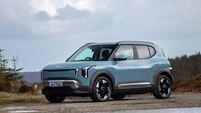
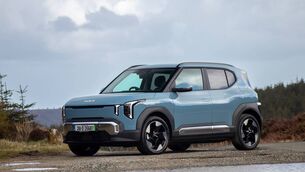
Now, however, Nissan has breathed new life into the Leaf and transformed it from being a stumpy hatchback into an SUV/crossover with a long sloping roof which gives it something of coupe demeanour.
In fact, it is a super-slippery design with a 0.25 CD figure and features design details such as active aero flaps on the front grille, a flat underbody and a ducktail rear spoiler. It also boasts permanent magnet electric motors, a liquid-cooled battery and various thermal management solutions which boost both range and performance.
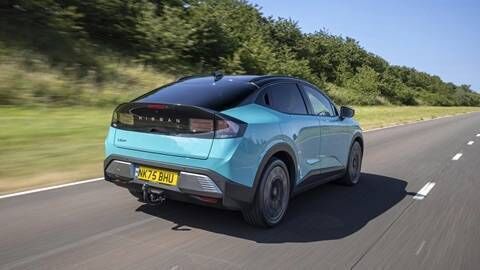
Based on the same platform upon which the Nissan Ariya and the current Renault Megane are also built, it now has many more rivals than when we saw it originally, but Nissan’s aim is to make it as efficient and competitive as possible against a crowded field of rivals.
Largely, the Japanese company has achieved its lofty aims. There are two battery choices – of 52 kWh and 75 kWh – providing claimed respective ranges of 488 and 604km. The smaller version has a 0-100 km/h time of 8.3 seconds, while the bigger one does it in 7.6 seconds. Both top speeds max out at 160 km/h.
The tester we had was the one with the smaller battery, and while it is not – by any stretch – a sporty car, it does nevertheless ride and handle well, corners with aplomb and has reasonable accelerative powers without the light-switch delivery which characterised so many of the early EVs.
Like most electrics these days, it offers drivers a choice of driving modes – ‘Sport,’ ‘Eco,’ ‘Comfort’ and so forth and, like so many others, there is a negligible difference between them. Certainly, the steering weights up noticeably when engaging ‘Sport,’ although it doesn’t actually do much else by way of making the driving experience any more involving.
In terms of the range, the Leaf is an honest broker, and that’s not something every EV can boast. The claimed range is not madly inaccurate, like so many, and you can honestly expect to get somewhere in the region of 420km from it in cross-country driving and with your shoe heavy.
Around town it will do better – about 450km – and as that’s probably where most will spend their lives, it’s reasonable.
The fact that Nissan has given the car a MacPherson strut front and multilink rear suspension set-up has helped enormously on the handling and ride front. Many others could take note here, rather than simply adopting the cheaper solutions.
They have made the Leaf a rather nicer car to drive than a lot of rivals, simply by going down this path and offering an element of sophistication that others lack. Ride comfort might be somewhat compromised by the rather firm damping, but the other side of that coin is the top-drawer handling.
Nissan has also got a jump on many rivals with its intuitive and easy-to-live-with tech. The twin 14.3” screens are melded into one, and it dominates the dashboard. The infotainment end of things is intuitive and nothing as convoluted as so many Chinese rivals, in that you don’t need a doctorate in computer science to navigate it.
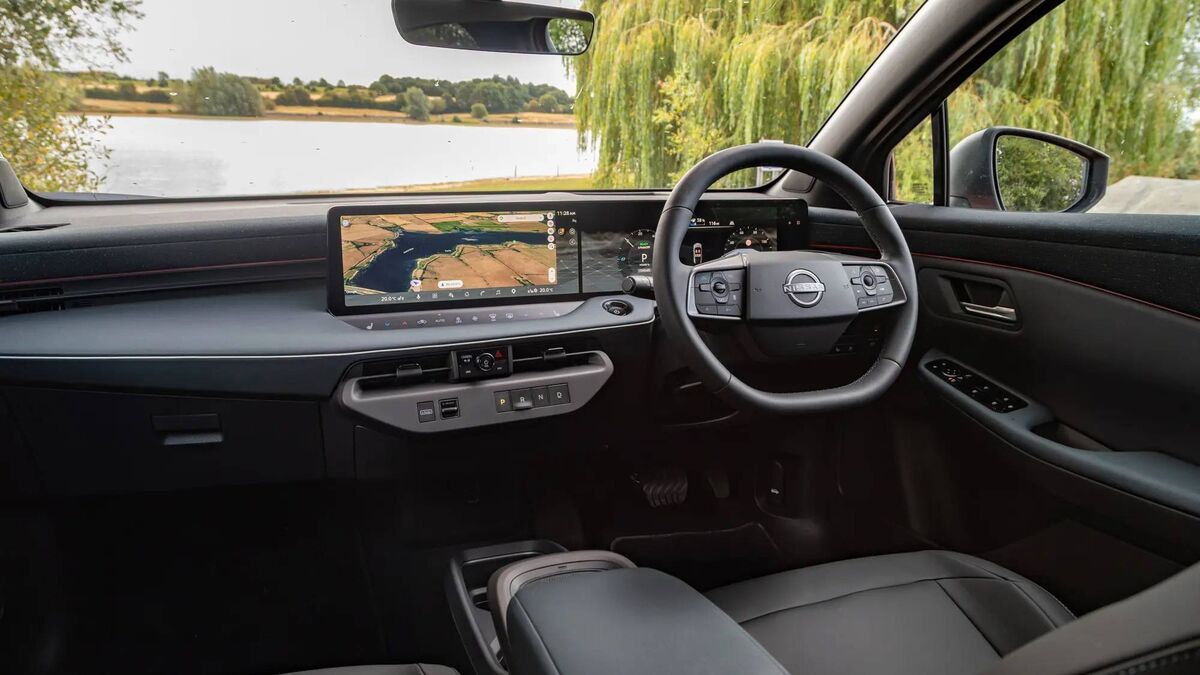
It struck me as being more driver-friendly than anything I’ve seen in a Nissan heretofore, and the company has obviously spent a good deal of time on this end of things in order to make it as good as it is.
Hung underneath the dash and the central ventilation ducts is a faux aluminium panel with touch controls for the climate – which sounds good, but it's actually a bit of a handful to operate and takes more attention away from the road than should be necessary. It was a good idea, but has flawed execution.
Other than that, though, the interior is well-built, decked out with pleasing materials and quite spacious, although the boot is not as big as some of the class leaders. The coupe roof also compromises headroom in the rear, as well as making the car look slightly prattish.
All versions of the car have a V2L (vehicle to load) capacity, and Nissan says that, in due course, it will introduce a V2G (vehicle to grid) capability, so you can get the thing to power your home if you so wish.
Even with the coupe roofline – something of a bugbear in these quarters, as many readers will know – it’s a relatively handsome car, and the pastel shades Nissan presents it with are very pleasing on the eye.
Along with the excellent new Micra, the Leaf is something of a turning point for Nissan globally right now and, believe me, that’s no bad thing because while the Qashqai and Juke models still sell well, they are groaning towards a sell-by date. By comparison, the Leaf and the Micra represent a company looking forward to the future, and that’s not something we’ve truly seen from the company in a while.