VOLKSWAGEN CARAVELLE Rating ★★★☆☆ Price €69,495 in Style specification
Power
An EV unit with 286bhp Range Claimed range of 380km but realistically a pretty poor 265km The Spec A lot on offer here Verdict Ridiculously versatile vehicle hampered by a poor range
THIS motoring craic — like life itself, in fact — can sometimes throw a mysterious curveball at you that leaves you scratching your head and wondering how the hell it ever came to pass.
So, making sense of life, or even decisions made by faceless men in conference rooms, can often be a rum deal whereby you question the thought processes that went into the concept, design and building of anything new, be it a car or a dishwasher. In the end, sometimes, you begin to question your own sanity.
Car companies, very occasionally, come up with something so left-field and seemingly bereft of any cohesive thought processes that you’re left wondering if it’s you that’s losing the plot, or is it simply that the people behind it are as mad as a box of frogs.
You can slap your thigh and laugh vacantly at machines which challenged engineering conventions and were conceived by engineering rebels and while some failed spectacularly, others forced the industry to question its innate conservatism.
Read More
Giggle at such as the Tesla Cybertruck which was probably designed to offend people anyway, or the Nissan Murano CrossCabriolet, a never-seen-here SUV Coupe, or the Aston Martin Cygnet which gave rise to the phrase ‘brand dilution’. Then you’ve stuff such as the Reliant Robin three-wheeler which was dumb and bad, or the Toyota Mirai which brought Hydrogen power to the masses and was an awesome thing, but you couldn’t go anywhere in it because there was nowhere to refuel it.
This week we are testing another vehicle which may yet be consigned to the auto industry’s great bin of unwanted, unloved, and unbecoming failures. Or maybe not.
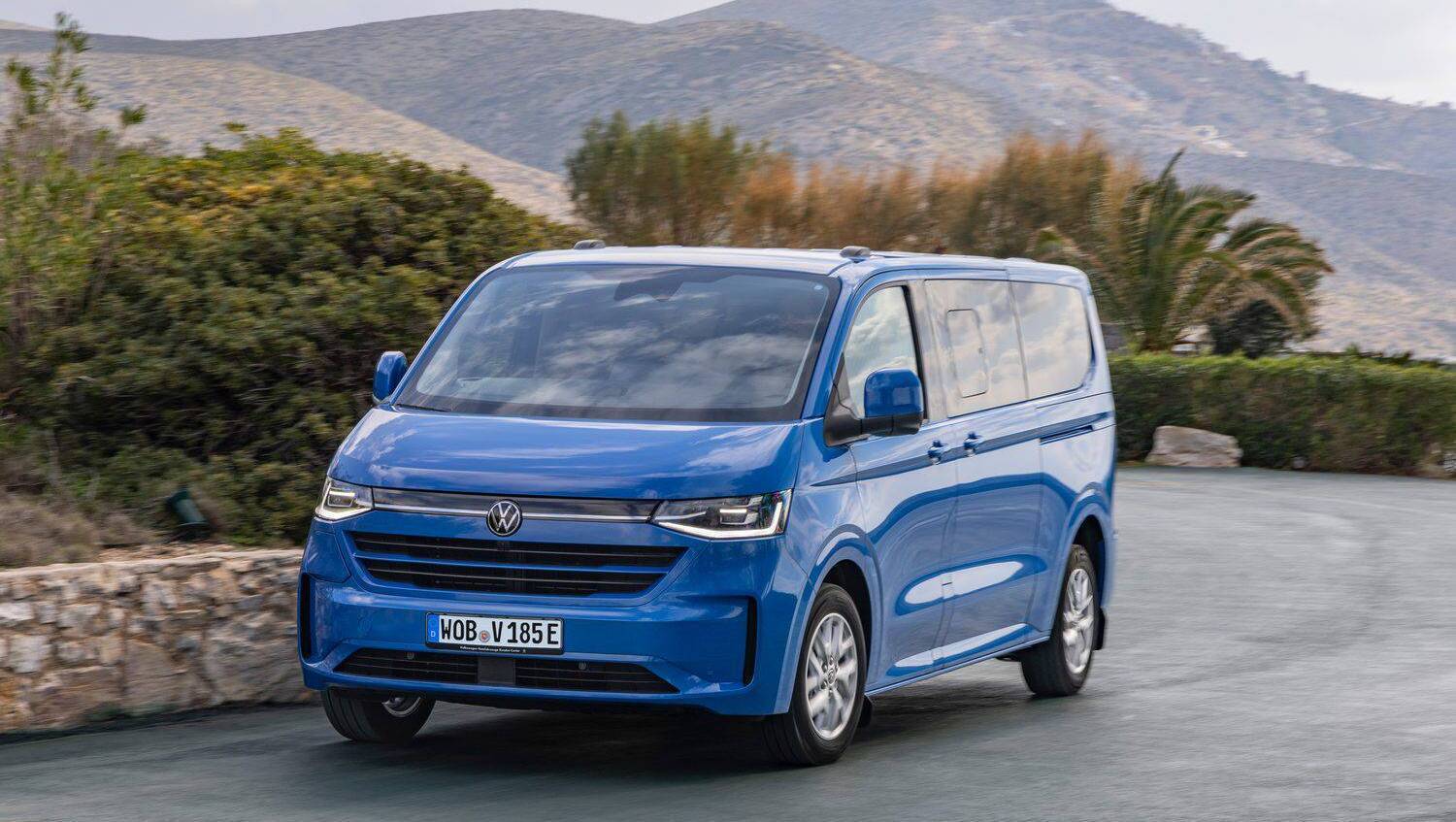
The car in question is a version of Volkswagen’s hugely successful Caravelle range, the passenger carrying take on the company’s Transporter van series. We’ve driven many of them down the years in both petrol and diesel configuration and they are wonderful things.
A people carrier of some note — six, seven, or eight seats, depending on your preference — it was a practical addition to the driveway of people with large numbers of children, a clever addition to the fleet of many taxi companies and also a favourite of such as hotels and golf clubs for ferrying guests around the place.
VW added another string to that particular bow a few years back by introducing the electric ID.Buzz, one of the cutest things you’ll ever see on four wheels.
But it is a Caravelle we have this week — an electric Caravelle. Even to our limited intellectual capacity this is a car which makes little if any sense. Certainly it’s huge and an unbelievably practical eight-seater, but it’s missing one crucial element for any vehicle — not only EVs — and that’s range.

Range, has we well know has become the defining characteristic of all vehicles in the EV sphere and the single factor which stalled electric sales from the get-go. Now the industry is making cars (and vans) that will actually allow people to move with the same freedom as ICE-powered ones, the phrase ‘range anxiety’ is fast disappearing from our daily lexicon.
The general rule of thumb was ‘less range, less buyers’ and cars with limitations in how far they could go were pretty much shunned by the buying public. This could be another that fits into that category.
This Caravelle, you see, has a claimed range of 380km. By modern standards it’s not a lot and the reality, sad to say, is much worse. When I got the car, it was, it informed me, 77% charged and good to go for 234km.
I reached my destination — 125km away from where I picked the Caravelle up — with just 20km left. I then filled it thanks to my home charger and when it was 100% full, it boasted of a range of just 265km.
Now I know most car companies exaggerate the range capabilities of their EVs, very much in the same way they did about the potential of their petrol or diesel engines. But this was something different; this was taking the mickey.
I know too that when you come to EVs, you largely have to relearn the way you drive them, as each has its own quirks and foibles. Indeed, getting them to create regeneration while on the move has become an art form which I’m getting really good at.
With some you only have to feather the throttle, or a mild stab of occasional brakes will create the desired effect. With the Caravelle it was a whole other ball game. I found you had to be an excessive braker to get any regeneration going — in the parlance of the trade, you had to ‘ride’ them.
This was not only counter-intuitive for me but ran against every rule I’ve ever known about driving a car — any car. But, needs must, and you do whatever you have to do to achieve the best possible results.
Practical and all as it is for ferrying people around, be it the family, tourists, or whatever, the sad truth is that you won’t be going very far with them. It may be that certain businesses or families will be able to successfully work their way around this issue and still make the electric Caravelle work for them, but I’m struggling to make that compute.
Even taking in the fact that this is as plush an MPV as you find about the place and can be configured with all manner of luxuries from captain’s chair seats to Persian carpets — slight exaggeration there — the Caravelle is a fine thing indeed, but when it comes with a range that’ll barely get you from Cork City to West Cork, it gets a bit, well, meh.
There are other downsides in that as what is essentially a van, it doesn’t come with car-like ride or handling characteristics. As such it will buck-leap across rutted surfaces — try the first 4km of the Dunmanway to Copeen road, for example — and won’t impress tourists, or anyone else for that matter.
That there is 286bhp on tap and the 0-100 km/h time is a sprightly 7.4 seconds, which is not at all bad for something weighing in at over 2,500kgs, will please some drivers, but in truth this is far from being a speedster.
That said, on a smooth surface, it is almost noiseless and most extraneous intrusions — wind, tyres, etc — are terribly well damped.
There are also two body lengths offered — we had the bigger one — and dual sliding back doors are part of the deal with the Style spec version we had, adding to versatility.

VOLKSWAGEN also got into bed with Ford on this one and the Caravelle was designed in tandem with the Ford Transit Custom Combi, although the Germans have given their version a very much in-house appearance.
The interior layout is very accommodating in that the middle and rear seats can be moved about depending on need and the third row can be ditched altogether if more cargo space is needed — making it one of the better MPVs in this regard.
There is a huge amount of room between each row of seats and, on the tester, the front ones were heated. There are also numerous USB charging points dotted around the cabin. The infotainment system works well and even the climate control system — such a bug bear on other VW electrics — is pretty manageable.
On the one hand this is very much a superior thing than most seven-seat SUVs, but on the other, it’s not going to get you very far. You could call it compelling in one regard and very much not in another.
All told, something of a mystery.