Seat Ibiza review: why this classic supermini still holds its own in the age of SUVs and EVs
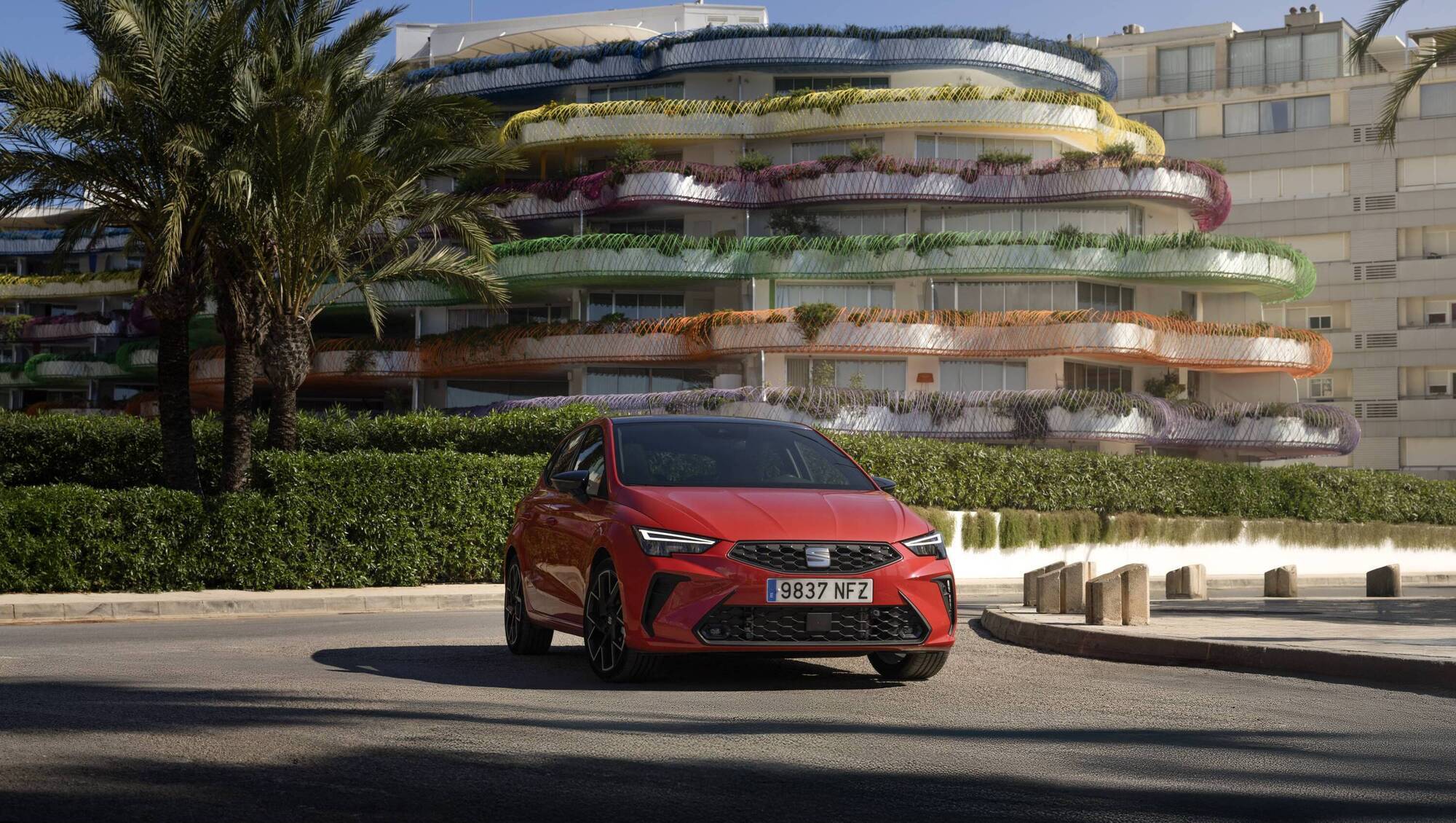
This Seat Ibiza is a turbocharged three-cylinder and, despite its size, is a zesty and feisty number.
|
SEAT IBIZA |
|
|---|---|
|
Rating |
★★★★☆ |
|
Price |
from €23,925 - €33,836 as tested |
|
Engine |
Two 1ltr options with 93bhp and 113bhp |
|
The Spec |
Pretty impressive for such a small car |
|
Verdict |
Not a lot has changed here, but then it didn’t need to |
The actual term ‘Supermini’ was coined around 1985 by the influential Consumer’s Association in its Car Buyer’s Guide which defined the genre as being one which was ‘larger than a Mini (which had not had its second incarnation back then), yet smaller than a typical car.’
Of course, the category can actually be traced back to the 1940s when Citroen came up with the 2CV in 1948 and it continued into the 1950s and 1960s with such monster successes as the (original) Mini and the Fiat 500, both designed as automotive antidotes to post-war financial austerity.
By the 1970s, small cars were getting bigger but the fuel crisis (sound familiar?) of ’73 changed all that, forcing buyers to seek out smaller, less powerful, economic and practical models than had been on offer up to then.
Read More
Stuff like the Fiat 127, the VW Polo, the Renault 5, the Opel Kadett City and the Peugeot 104, typified what came next, with manufacturers quickly climbing aboard the bandwagon in order to fulfil growing consumer demand.
Subsequent offerings like the hugely successful Ford Fiesta, the MG Metro, the Opel Corsa, the Nissan Micra, the Toyota Starlet all followed on and the Supermini market became an absolute necessity both for producers and punters alike.
We here at Examiner Motoring have always – to the scorn of those who always felt such cars beneath them – sung the praises of these little cars not only as benchmarks of style, build quality, practicality and personality, but also, in some cases, as performing animals without the three-ringed circus.
VW were always to the fore in this market and in the early noughties, having revitalised the once scorned Skoda brand with the Fabia in 2000, it used the platform for that well-built, comfortable and economical little car as the basis for their own Polo and also the SEAT Ibiza, which is where we land this week with the latest iteration of the diminutive Spanish contender.
Having spent years trying to shed its reputation as the manufacturer of cheap Fiat knock offs, SEAT came under the ownership of the Wolfsburg giant in 1986 and by 1993, when its new Martorell manufacturing facility came online, the first cars off the production line were the Mk2 Ibiza and its saloon version, the Mk1 Cordoba.
Initial versions were far from being sophisticated, but they were well made, practical and, critically, cheap. SEAT has since moved the Ibiza along considerably and by the time the fifth-generation version arrived in 2017, the car was being lauded as being one of the best in the B-Segment, which is the official designation for the Supermini class.
Alarmingly – time really does fly past faster the older you get – the Ibiza now spans five generations. The first one was designed and built completely in-house (albeit with help from such as Porsche, Karmann and Italdesign), but everything since has been made with bit from the VW parts bin - platforms, engines, gearboxes, etc.
Twice it has debuted a new VW platform – the second and fourth generations, if you must know – and it has, over its lifetime, consistently been SEAT’s best performer in sales terms.
The fourth generation arrived in 2008 and, really, was the first Ibiza to show a serious bit of intent and originality on the design front. The next one came in 2017 and with it a slew of awards for its design and overall excellence.
It was also the first time that SEAT truly caused some mild embarrassment at VW Group HQ in Wolfsburg, largely because it was so far ahead of the VW Polo with which it shared so much. Indeed, it was around this time that both SEAT and Skoda were starting to show their German owners exactly what they were capable of – and triggering a lot of red faces back there.
In any event, that model was face-lifted in 2021 and again late last year for the MY 2006 Ibiza. And, even in the face of much change and a whole raft of small EV contenders and small SUVs, it remained resolutely true to its origins – ie a five-door hatch with a choice of internal combustion engine motors.
To be truthful, the re-design has not really altered much; they’ve dickied up the lights, reshaped the bumpers slightly and added a new ‘corporate’ grille with hexagonal elements in it. The specs have been upgraded and the amount of kit it now comes with is a million miles from the original, where the ashtray (they had such things back then) was nearly an optional extra.
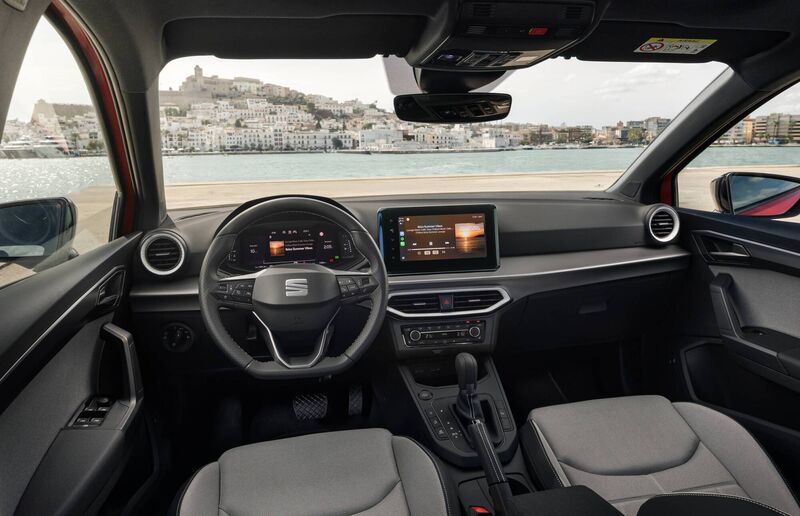
Our tester came with a tasty ‘Oniric Grey’ paint job in ‘FR’ trim; it boasted 18” alloys, bucket front seats with some form of recycled textile upholstery, an 8.25” infotainment screen and an 8” digital instrumentation screen, front and rear LED lights, rear camera, and a leather steering wheel (with a load of built-in functions).
Options on the tester included adaptive cruise control, automatic lights, a wireless phone charger and heated front seats.
We had the more powerful of the two one-litre engine options; there is a bog-standard 93 bhp version with a six-speed manual ‘box, while we tried the 113 bhp version which was mated with a seven-speed auto DSG transmission.
The diminutive petrol powerplant is a turbocharged three-cylinder and, despite its size, is a zesty and feisty number which fairly clamours for work. The gearbox does have a sporty demeanour and tends to kick down a little too readily when you give it toe, but in general changes are snappy and it tends not to hold on to individual cogs for too long.
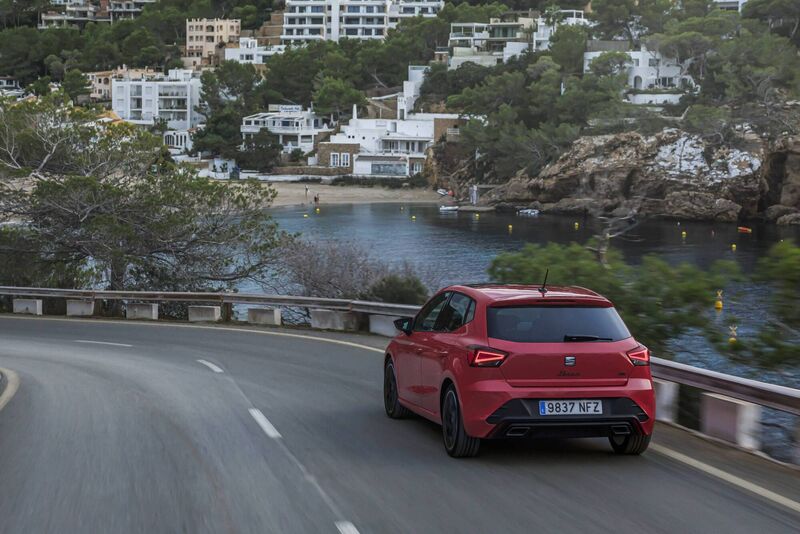
On the road the car is very well balanced and while the handling is sporty, the ride comfort is not compromised by those large alloys, which can sometimes be the case. It deals with bad road surfaces well and those inside don’t get thrashed around when the going gets tough.
In some ways the interior is something of a throw-back because everything is largely controlled by buttons and switches rather than being funnelled through the infotainment screen. Everything is well put together and there’s a lot less scratchy plastics on show than you might have imagined.
The front bucket seats are quite comfy and there’s just about enough room in the back for your plus-sized buddies. The boot is commodious enough for the class.
It might well be that the SEAT lacks some of the tech pizzaz of such as the new Renault 5 (to keep the young ‘uns happy), but it is all very workable and just good, to be honest.
This is a car we’ve pretty much always liked – well, since the fourth generation anyway – and there is nothing here that has changed our view of it. It might be a tad old school, but in its own way that is charming too.
In the modern supermini era, it is a sensible and straightforward contender and one of the best out there.