Fiesta feelgood factor edges Mini marvel
We here at Examiner Motoring don’t do comparison tests often, largely because many of them are meaningless exercises between cars which don’t actually directly compete against each other, or they present an unreasonable choice between cars largely unaffordable to the masses and are therefore only mere titillation.
On this occasion, however, we got to try — in very short order — the brand new Ford Fiesta ST and the new Mini John Cooper Works (JCW). The two cars are essentially of the genus “hot hatch” and are quite closely matched in many regards — except for one very crucial aspect, as we shall see.
The new Fiesta ST is, literally, hot off the presses and comes to us dripping with equal measures of expectation and dread.
The expectation stems from the fact the previous iteration of the ST was most certainly one of the best machines of its type ever made — and I can assure you that assertion is not hyperbole. While on the other hand, the dread emanates from the possibility it might not live up to the expectation.
The Mini JCW, meanwhile, has established itself as the daddy of all sporting Minis and whatever sort of Mini the name is attached to (Cooper, Clubman, Countryman), it signifies to buyers, and anyone with a hint of interest, that it is the hottest of hot.
This is the third generation of the JCW hatch and boasts a series of revisions and updates which makes it the hottest thus far.
Two worthy opponents then to go head to head, although the Mini might have the edge in terms of class — ie, it is very much of the upper class variety, while the ST would be more, let’s say, “Essex”, if you get my drift. Nevertheless there is a lot they have in common — they’re both sensationally quick, fantastic handlers, and absolutely smashing to drive.
Last year’s revamp of the JCW saw changes to both engine and chassis. On the engine front, the two-litre turbo was given new induction and exhaust systems, pistons, and turbo, all of which boosts power output to 227 bhp (a 10% improvement) and increases torque to 320 Nm (a 23% increase).
Top speed is now 250/km/h and the 0-100 time is just 6.1 seconds. A six-speed automatic gearbox was fitted to the tester, but adds over two-and-a-half grand to the bottom line.
Elsewhere, the front suspension boasts uprated springs and dampers as well as lightened and strengthened supports and wishbones. The rear multi-link suspension has also been beefed up and lightened at the same time, while a torque vectoring system is adopted instead of a mechanical limited slip diff.
Over at Ford there has been something of a more radical approach, especially on the engine front. The last ST utilised a traditional four-pot 1.6 turbo which put out 178bhp, but with an over-boost facility which gave you as much as 197 bhp in short bursts.
It was a fantastic thing and towards the end of its lifecycle (in ST200 guise) was further enhanced to produce 197 bhp with nearly 230 bhp on hand via the over-boost. Many expressed doubts that what they were about to do involved huge risks.
What they were about to do — and indeed have done — is replace that gem with a three-cylinder, 1.5-litre turbocharged unit, an engine based on the ingenious one-litre EcoBoost triple with which Ford has made so much capital.
In expanding capacity to 1.5 litres and turbocharging the unit, Ford has squeezed an output of 197 bhp (funny that) from it and rendered it into a fizzing, effervescent, and joyous thing which has a top speed just shy of 230km/h with a 0-100 time of 6.5 seconds.
The six-speed manual gearbox is a joy to live with — slick, smooth, short — and anyone who is not taken by the truly unique burbling and blatting exhaust needs an automotive heart transplant.
The ST tester (actually designated ST3) was fitted with the ‘Performance Pack’ essential — a Quaife limited slip diff — and I would encourage anyone buying this car to ensure they pay the nine hundred quid or so extra for this because it finishes off the car as a true great, adding a level of handling sure-footedness that is truly a joy to explore.
Both these cars come from a heritage of greatness and both are at the very top end of the handling scale when it comes to the hot hatch department. The Mini is as karty as you might expect, given its lineage and as exuberant a ‘point and squirt’ merchant as you will find out there.
It is also more sophisticated than the Fiesta in its general demeanour and interior quality.
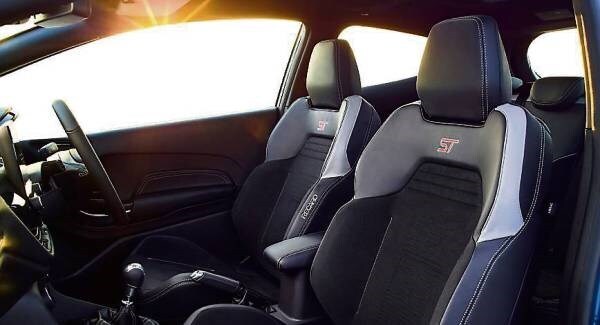
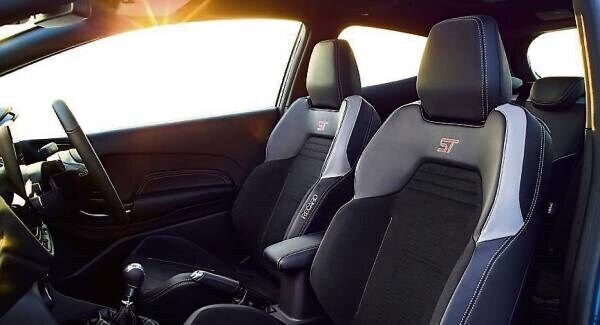
That’s not to say the ST is a pleb by comparison — far from it, what with its Recaros and Bang and Olufsen sound system — but it is not the aesthete the Mini is. That’s probably why it costs so much less. But, when you get it out on the road all that stuff is forgotten as you luxuriate in and appreciate just what it has to offer.
It is a car of astonishing ability and — even if the launch control facility is a little OTT — can put a smile on your face even more than the Mini, which actually out-performs it in almost every sector: Acceleration, top speed, output, and torque. But the Mini somehow cannot match the feelgood factor of the ST.
These are two serious performance cars and talking about their merits and demerits is a subjective thing — one person’s meat being another’s murder — but I have to say I came down on the Fiesta side not only because of its astonishing pace and handling competency, not to mention it is a five-door and that there was a price differential of 15 grand between the respective testers.
Mini does indeed make brilliant cars — largely for well-appointed people, it has to be said — whereas the Blue Oval has always had more blue-collar appeal and the Fiesta ST is no different in that regard, but the manner which the
German company piles on the extras with gay abandon (over €1,100 for the admittedly beautiful “rebel green” overcoat) is a bit much, in fairness.
There’s not much between these two on paper — or even on the road, for that matter — but to my thinking the Fiesta ST shaded the verdict on value and day-to-day practicality.





