Latest generation of vehicles revealed
Check out some of the latest options available.
Transit transformation
A strongly revised Transit Custom van due in Ireland in March will reinforce Ford’s strong position in the one-tonne van class.

With significant improvements outside, inside and under the hood, the latest iteration of the Custom builds on the elements which have made the vehicle a go-to for those who favour the blue oval brand in the medium van space.
As befits the company whose founder is often credited with the ‘if it ain’t broke, don’t fix it’ advice, the basic sound build and practical design of the Custom hasn’t been tinkered with. Indeed, nothing has been ‘tinkered’ with, any changes are substantial.
Starting with the look. The face of the Transit Custom is now more strongly styled, and has been brought fully into line with the company’s passenger cars design. This includes the one-piece trapezoidal grille, much more stylish lights, and a redesigned lower air intake. Apart from engineering reasons, it all makes the van look more purposeful. There are also reshaped bits to the bodywork.
Inside the cabin, there’s been a complete reworking along the lines of the interior of the new Ford Fiesta, which very much modernises the dashboard and instruments layout. There are more storage spaces too, and the whole aesthetic has been upgraded with more premium materials. Harder wearing seating material too, which apparently has been seriously tortured by Ford’s accelerated wear test equipment.
The powertrains are the new 2.0 diesels that were introduced by Ford last year, replacing the 2.2 units that had underpinned Transits up to then. A selection of drives this week in Germany showed they’re efficient, quiet, and pull well depending on the version chosen and the application. Specifically, the engine is available in 105/130/170hp versions, with six-speed manual and automatic choices.
An EcoNetic option is aimed at the operator for whom fuel economy is particularly important. With stop-start, an accelerator system which actively aids an efficient driving style, a limiter to 100km/h, and low rolling resistance tyres, this version offers a 6% improvement in fuel economy over the most efficient Transit Custom up to now.
The revised van will also be available with all the safety technologies which have been developed for Ford’s passenger cars.

Some are adapted and enhanced to better suit the needs of commercial vehicles, especially the radar-operated approaching vehicle monitoring system used when reversing out of a nose-in parking space. It will even warn of approaching cyclists. The pre-collision warning system is now improved to respond to imminent situations even in darkness by the illumination of the van’s lights.
The revision of the Transit Custom is the first step in a complete upgrade of Ford’s commercial vehicles over the next 18 months. But there’s big movement planned for the commercials power options too. Some 20 customer companies are taking delivery of plug-in hybrid variants of the Transit Custom before the end of this year, for evaluation before the version is put fully on sale.
This electrified powertrain will have its electric motor as the primary motive element, from a battery that can be charged while the vehicle is not being used, and can also operated for long distances through a 1.0 petrol engine used as a generator of electricity. On electric power alone, the version will offer a 50km range, and up to 500km from the petrol-hybrid combination.
Collectors edition Landy

Land Rover is producing a limited edition of its now-finished production icon, the Defender, powered by a 5.0 V8 petrol engine.
The collectors edition will be limited to just 150 units, and with 405hp on tap it will be the most powerful version ever produced of the Defender by Land Rover themselves.
A 3.5 V8 version was produced in series from 1979, and along with 50th Anniversary copies of the Defender is already a sought-after collectors item.
The latest one, based on the 7th series Defender, will be called the Defender Works V8 and will offer acceleration as fast as 5.6s to 60mph. It will celebrate the 70th Anniversary of Land Rover.
The vehicle will be available only by personal import and will not be sold through JLR dealership networks.
Harris Group appointment
The appointment of John McEvoy as the new Chief Operating Officer for the Harris Group is an important part of the Group’s strategy for growth.
Mr McEvoy has more than 30 years’ experience in the commercial vehicle and fleet sectors and he will oversee the company’s expansion plans. His previous position was Supply Chain & Fleet Manager at the Kerry Group, where he worked for more than a decade.
A new HQ for the Group on its Naas Road site in Dublin will house its full commercial vehicle range including LDV, Sinotruk, Higer, Hino and Isuzu, but also a new parts distribution centre and Sinotruk assembly plant.
Founded in 1961 by the late Pino Harris, the Group won the exclusive franchise for the Hino truck brand in the UK and Ireland in 1968.
Revamped Berlingo
Citroen has revealed a new style for its Berlingo van, in the form it will debut as a passenger vehicle at the upcoming Geneva Motor Show.
The styling is more in your face and reflects the distinctive grille and lights treatment of recent Citroens, including the new C3 and the upcoming next generation C4 Cactus.
The new Berlingo will be on sale in the second half of the year.
Mercedes-Benz uses drones

In what is claimed as a global first, Mercedes-Benz has used a combination of vans and drones to deliver packages to homes in a trial in Zurich, Switzerland.
The deliveries, which took place between September 25 and October 13 of last year, were a test for on-demand delivery of e-commerce orders.
A total of around 100 flights were made without incident over the city of Zurich. The project made use of two drones and two Mercedes-Benz Vito vans with integrated landing platforms. Technology installed in the vehicle roofs ensured that landings were accurate and safe.
The results of the tests are currently being analysed.
New generation Sprinter

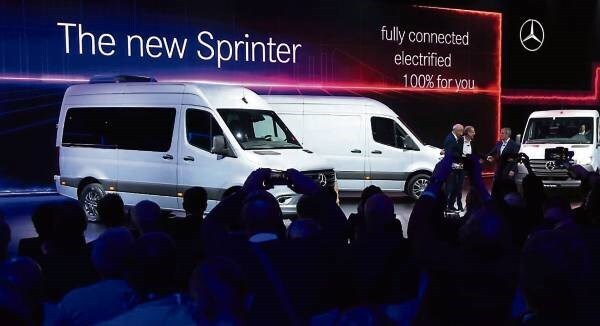
The new generation Mercedes-Benz Sprinter van was revealed this month at a special event in Duisburg in Germany.
The reveal was attended by commercial vehicle journalists from around the world, who heard that the company is aiming at becoming more than a vehicle manufacturer, expanding into a total service logistics systems provider.
Four of the biggest customers of Mercedes-Benz commercials were also invited to the reveal, representing parcels delivery, retail grocery, the service division of a power supply company, and a bus hire group. They collectively outlined a comprehensive ‘wish list’ of features they’d like to see in the new Sprinter.
These included alternative and sustainable powertrains, autonomous driving elements, the ability to order bespoke variants to suit directly their own needs, a reduction in carbon footprints, connectivity all the way to
the customer, and safety technologies levels similar to those available in passenger cars for the bus versions.
Breakout sessions on five major areas where variants of the Sprinter van are important outlined the relevant technologies which will be available in the new van or are in development for implementation in coming months and years.
Among these were parcel delivery, craft and construction, passenger transport and recreational vehicles — that last a sector which grew by 17% across Europe between 2016 and 2017.
The use of a Mercedes-PRO Connect app to manage the functions and technologies related to each will be a major part of the new van’s place ‘as a node in the Internet of Things’.
The new Sprinter will be permanently connected to the internet, Volker Mornhinweg, head of the Mercedes-Benz vans division, says. A WiFi hotspot will also be available within the connectivity options.
An electric version will be produced, joining the eCanter and eVito which are already in production from Daimler.
More than 3.4m Sprinters have been sold, and last year the outgoing version established another record with more than 200,000 units sold.
There will be more than 1,700 possible variants of the new Sprinter. It will also come with a FWD version for the first time, in addition to the RWD and AWD which are the options of the outgoing model. A chassis cab version will be available for use by conversion companies including RV builders.
The full range of driver assistance systems that are part of the Mercedes-Benz passenger cars environment will also be available in the new Sprinter, in addition to specific ones for LCVs such as the side wind assistance.
The new Sprinter will be available in Ireland from the middle of the year.




