Honda revs up for crossover comeback
HONDA has long been regarded as one of the most innovative and ingenious of all the motor manufacturers in the world and thus, when the company announced a return to the pinnacle of motor sport with a new hybrid Formula One engine, it was expected that the Japanese company would make an immediate and sustained impact, writes Declan Colley

Honda revs up for crossover comeback

Indeed, Honda’s relationship with the world of Grand Prix racing has been long and fruitful one, beginning in 1964 when it switched its on-track activities from those solely of a two wheel variety to car racing and entered Formula One as an engine and chassis manufacturer which was most unusual at the time, with Ferrari and BRM being the only other such entrants back then.

The rest of the field was made up of what Enzo Ferrari somewhat unkindly labelled “garagistas” such as Cooper, Lotus, and Brabham, who made their own chassis, but got their engines from outside suppliers.


The diminutive American Richie Ginther won Honda’s first ever Grande Epreuve in Mexico in 1965, shocking the rest of the field with the competitiveness of the Honda so quickly into its F1 career and the great John Surtees followed that up two years later when he pipped Jack Brabham to win the Italian Grand Prix at Monza. However, following the tragic and fiery death of Jo Schlesser during the French Grand Prix at Rouen, Honda withdrew.

It took no further part in grand prix racing until 1983 when it re-emerged as solely an engine supplier, initially to the tiny Spirit team which it funded, and in 1984 it began a fruitful relationship with the Williams team which used Honda’s astonishing 1.5-litre RA167-E V6 turbo engine to propel it to two constructors’ championships and a drivers’ championship between 1986 and ‘88.

So powerful was this engine that Williams designer Patrick Head later admitted they had no actual clue as to how much horsepower it really produced. “Honda told us that it was outputting some 1,000bhp at 9,000rpm. Their dyno only measured up to 9,000rpm, but in race trim we were revving it to 13,000rpm or more, so God only knows how much it was actually producing,” he later recalled.

At the end of the turbo era in F1, Honda reverted to manufacturing a normally aspirated V12 which was used by new partner McLaren to good effect, propelling their cars to four consecutive constructors’ championships and four driver’s titles, three for Ayrton Senna and one for Alain Prost, before the Japanese outfit withdrew once more in 1992. Between ‘83 and ‘92 Honda scored a remarkable 69 GP victories.

They came back for more in 2000 and powered cars made by BAR and Jordan, before buying BAR out and having a fully fledged Honda team once more in 2006.

But, just one win for Jenson Button at the ‘06 Hungarian GP was the net result of three hard seasons and Honda pulled the plug once more, selling the team to Ross Brawn whose eponymous team promptly won the title the following year — but with Mercedes engines powering them.

Despite the later disappointments, Honda’s glory years in the 1980s and 1990s left the world with an image of a company for whom achievement was second nature and, when it announced it would be returning in 2015 as engine supplier to McLaren, the expectations were very high. To say that those expectations fell short is to understate matters somewhat.

Despite having drivers of the calibre of Fernando Alonso and Jenson Button the McLaren-Honda team had a terrible year, usually qualifying at the rear end of the grid and rarely scoring points. It was an unmitigated disaster.

Everyone expected the Honda to be immediately competitive, but it turned out to be underpowered, unreliable and inefficient. Just days ago engine chief, Yasuhisa Arai fell on his sword and will be replaced for the coming season. This was not what people expected from the Japanese automotive giant.

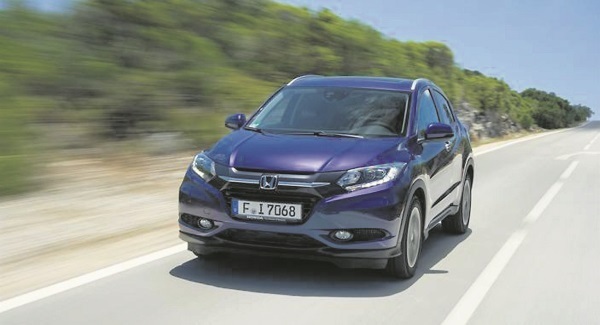
I’ve given you this history lesson by way of an introduction to one of Honda’s latest road cars, the HR-V which itself has had something of a chequered career and is a car which, since the HR-V nameplate has just been re-introduced, has not necessarily set the world alight.

The original version was a square slab-sided crossover contender which actually preceded the current craze for compact SUVs, but completely missed the boat and was canned unceremoniously.

Now, some 10 years later, Honda has revived the HR-V and it is now an animal of a completely different colour to the original.

Based on the platform which also supports the Jazz supermini, the HR-V is now classed as a compact crossover and Honda wants this car to give it a real presence in a very lucrative market segment — a segment it effectively invented but never properly exploited.

The new car is very good looking, and visual styling cues common to the rest of the company’s current line-up. Aimed at such as the Mazda CX-3 and the Renault Captur, among others, it is a very cleverly packaged and practical machine which actually boasts more cargo capacity than bigger cars like the Nissan Qashqai. Honda’s very clever “magic seats” fold up, down and all around, and are also a class leading feature.

These elements will make it hugely appealing to many buyers, as will the spectacular levels of kit on offer and the excellent turbodiesel engine, but deficiencies on the handling front will rob it of a sizeable chunk of potential owners.

Although grip levels are good and the ride is not bad, the HR-V struggles with vague steering on the open road and while this is not a problem in an urban environment, it does nothing for driver confidence when it needs most to do so.

This makes the performance of the 1.6 turbodiesel — 10 second 0-100 kph, 192km/h top speed and 3.8 l/100 km (70mpg) economy — seem almost inconsequential. That should not be the case, but it is, which is a pity.

The HR-V, much like the company’s current F1 effort, harks back to past glories but has yet to actually match them. It is a fine effort in many regards, but one or two aspects of its’ character need attention for it to really shake up the segment. No doubt, McLaren supremo Ron Dennis feels the same way about the company’s current Grand Prix engine.

COLLEY'S VERDICT

The Cost: From €25,995 - €28,595 as tested.

The Engine: A truly excellent diesel powerplant which is both perky and economic.

The Specification: Some surprisingly nice things as standard in the ES model tested.

The Overall Verdict: A good car let down by dynamics in some very important areas.

More in this section

Revoiced

Newsletter

Sign up to the best reads of the week from irishexaminer.com selected just for you.

Cookie Policy Privacy Policy Brand Safety FAQ Help Contact Us Terms and Conditions

© Examiner Echo Group Limited

