The Ferrari 458 is rather Speciale
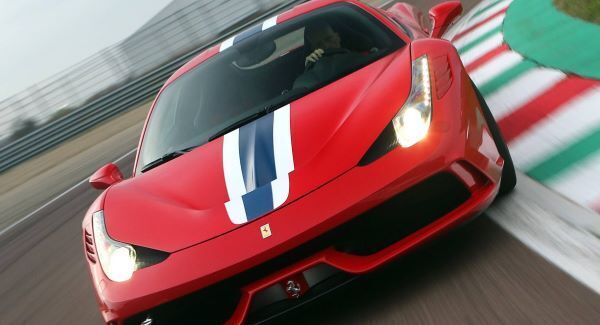
The 458 Speciale I’m testing is painted a vigorous red. It’s also got racing stripes, basically doubling down on the attention factor. I’m quite sure, for instance, the police will take notice. After all, would you pull over a Honda Civic or this €300,000 supercar?
Hence, two miles under the speed limit. No problem. I’ve been looking forward to the Speciale since it was announced last year at the Frankfurt motor show. Better, I’m headed to the racetrack, the speed-appropriate place to let its 597 horses roam free.
Exotic-car manufacturers love to say their models are race cars for the street, but this Speciale from Maranello, comes perilously close. It’s a faster, leaner and more focused model of an already fast and lean supercar, the 458 Italia. In other words, how about an extra dose of extreme with your excess?

Ferrari historically has made two types of cars: those with 12-cylinder engines placed under the front hood, and those with V-8s in the centre, behind the driver.
The former are grand-touring cars, ideal for zinging across Italy on the Autostrada, while the latter are best on the racetrack.
The mid-engine placement affords ideal balance, allowing deft changes in direction. It also sounds fabulous keening at 8,000 revolutions per minute just behind your head. Since the early 2000s, the Fiat SpA unit has produced hard-core versions of these mid-engine V-8 models, including the Challenge Stradale based on the 360 Modena and the 430 Scuderia from the F430. Still, after first driving the “conventional” Italia several years ago, I couldn’t imagine how Ferrari was going to one-up itself.
Then, hubris, they called it the Speciale.
So, yes, I’ll be needing a racetrack to squeeze all the juice from this car.
A couple of hours later I arrive at the Monticello Motor Club in upstate New York. There is a small commotion among members. Look, multimillionaires are taking mobile-phone pictures of my car.
Owners won’t race the Speciale. Instead, many will drive it up to a private racetrack like Monticello, spend the afternoon slinging it around at phenomenal speeds, then amble slowly back home.
The Speciale’s €260,000 starting price is before petrol guzzler taxes or destination charges. My test model was north of €300,000. The obvious question is, what makes it that much more special than the €260,000 Italia?
More power, clearly, as sure an ingredient as cream and butter in any French dish. The Speciale gets 597 horsepower and 398 pound-feet of torque from its 4.5-litre V-8, which is truly significant for an engine without the aid of turbochargers or superchargers.
It also looks more intense than the Italia, with a big scoop in the sexy hood, dartlike fins hanging off the side that help channel air, and a flipped-up trunk/spoiler. Ferrari is knee-deep in aerodynamic R&D, and like an airplane, the Speciale employs a series of flaps that variously open, close or deploy to keep the car better planted on the asphalt at high velocity or make it easier to turn at lower speeds.

But the car has no carpeting, no radio and no navigation system. There’s no leather, bolt heads are exposed, and most things you touch are made of carbon fibre. Your feet rest on a sheath of aluminum.
The Speciale is almost 200 pounds (90 kilogrammes) lighter than the Italia thanks to criteria like the minimalist interior. Yet, unlike its predecessor, the track-oriented 430 Scuderia, the Speciale still feels luxurious and precious.
But ultimately, this is a car to drive hard, to pummel, to fall in love with at 150 mph.
Yes, it’s fast. Yes, the carbon-ceramic brakes are great. But it’s a technical uphill corner when the Speciale suddenly comes alive underneath me. I’ve taken this turn in real race cars and in McLarens and Porsches and Corvettes. You always have to let off the gas here and be patient.
In the Ferrari I’m still on the accelerator, left wheels riding the curbing, gaining speed instead of shedding it. What manner of physics is this?
Call it Maranello magic. The brains of cars are becoming ever more like artificial intelligence, using electronic stability and traction control to keep drivers out of trouble. This usually means cutting power at key moments.
Yet Ferrari has specifically tuned the electronics to allow the car to slide, to wag its tail out, to let the driver have more fun, while still keeping the car in check — and from spinning off the track.

After I’ve done a number of efficient, fast laps, I start to play — a little extra welly at the exit of a corner here, a quick waggle of the steering wheel there. The car gets a little sideways, drifts through corners.
I expected the car to be fast and hard-core. I just didn’t expect it to be so playful, so much silly fun. Plenty special enough to earn its name.
4.5-liter V-8 with 597 horsepower and 398 pound- feet of torque
Seven-speed double-clutch automated manual
13 city, 17 motorway
from €260,000
Massive fun to drive on the track
Worst features: Trying to find a legal road worthy of its potential



