Fiat 500 Trekking review (06/02/2014)
On a worldwide basis the group last week reported trading profits of some 3.4 billion and the January completion of its take-over of Chrysler appears to have added further impetus to the continuing rude health of the organisation.
Yet, the Fiat and Alfa brands have all but vanished off the radar in Ireland in recent years as a drastic lack of product — the 500 and a few van derived cars as well as Alfa’s Mito and Giulietta — have barely kept the Italian ‘Tricolore’ fluttering Sales levels have plummeted to hitherto unprecedented lows. Even the addition of Chrysler (nee Lancia) and Jeep products did little to boost momentum.
Fiat Group Automobiles has moved to address this situation in recent months and the arrival of a batch of new cars and an overhaul of its dealer network points to a new era for Fiat, Alfa, Chrysler and Jeep in this country. And, with worldwide performance on a very solid footing it would appear to many observers, myself included, that the company has just got a lot more serious about rebuilding brand image and sales volume in smaller markets like ours, where it once
enjoyed a very substantial presence.
With regard to Fiat itself, it was never going to be the case that the brilliant 500 could solely support a viable dealer network which, after the failure of the Bravo to make any real inroads in the vital small family car segment, was left with little or no product to sell. Now, however, the arrival of the new 500 L, the 500 L MPW and the 500 Trekking, has given the brand a much needed shot in the arm.
But where have these cars come from? From any reasonable point of view they bear no design or ideological connection with the range whose name they share. The 500 is a hugely successful concept in which the supermini is taken to a logical conclusion and customers can personalise their car completely so that practically each and every 500 that comes off the production line is different from the next.
This idea found massive support among a young and trendy audience whose thirst for individuality in their automotive transport found life in cars like the Fiat, the Mini and the Opel Adam, among others.
But — life being what it is — these people do not stay young forever and their needs in many things evolve — not least in motoring terms.
That is all very good and predictable. However, in Fiat’s case, the company had nothing to offer that in any way mirrors their experiences with the 500.
So, what to do? Well, the most obvious thing was to develop a line of cars which not only imitated the 500 experience in terms of cutesy looks, wild colour choices and a stand-out design — but continued the buyer’s ability to personalise each machine.
But how to achieve such an ambitious plan? Well, one easy way of doing so was to keep the 500 name up in lights. And that’s what Fiat has done. Despite the fact that none of the new machines — the aforementioned 500 L, the 500 L MPW and the 500 Trekking — bear any relationship with the modern day 500s (in fact they are based on a tweaked version of the old Punto platform), Fiat has nevertheless achieved a continuity of association between these two otherwise unconnected ranges.
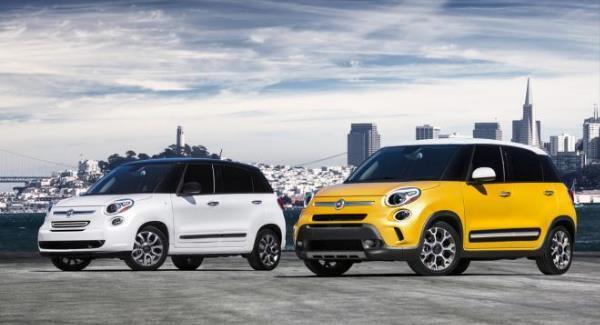
The 500 L is simply a family car, the 500 MPW is a family car with seven seats and the Trekking is a family car aimed at outdoor types. The test car’s vivid ‘Hip-Hop’ yellow body colour with a white roof, attracted more comment during my time with it than anything else about it. People were more struck by the flamboyant personality of the car rather than its rugged looks. It differs from it two siblings thanks to chunky front and rear bumpers with skid plates and additional wheel-arch and rocker-panel mouldings. Rear privacy glass (if you like that sort of thing) and Diamond-Black 17” alloys complete the effect. It also differs from the other ‘family’ 500s by having a sort of a four wheel drive system. Fiat call this system ‘Traction+’ and say that instead of a hefty all-wheel drive that is rarely put to use, the front-wheel drive Trekking uses the car’s ESC hardware to continuously monitor the vehicle’s dynamics in slippery conditions and directs engine torque to whichever wheel has the most grip.
The system is activated by a dashboard switch but does not impact the vehicle’s efficiency or running costs, when not in use. In addition to Traction+, the Trekking is equipped with mud and snow tyres and a suspension configuration with 13mm of additional ground clearance to maximise its all-weather capabilities.
In truth it was hard to judge if any of this was of any use, but it was an OK drive and seemed well sorted on the grip front. It handled well and the ride comfort was pretty good too, but to be honest I’m not so sure if it would be top of the vehicle list for any mountaineering expedition.
So what we have here is a sort of ‘adventure lite’ vehicle which throws in a few sops for those with an outdoor lean, but is merely a family car with a little bit of attitude. People will like the elevated driving position and the punchy but economic 1.6 litre MultiJet turbo-diesel and the comprehensive specification. But, will people like it enough to put Fiat back on the map in sales terms?
The Trekking alone will almost certainly not, but it certainly gives the company a chance to re-establish itself as something more than a one-trick pony.





