Opel Astra review (03/04/2013)
The company’s travails have been well documented in these columns over a long period, but now that its future appears to be considerably more solid than it might have been if its American paymasters had not taken such a positive attitude towards the Opel brand and its potential contribution to General Motors’ coffers.
With such as the Insignia and the new mini SUV, the Mokka, Opel had been giving us signs there was life left in the oul’ dog yet and it is hoping that with newer products such as the latest Astra range and the new Adam city car, it will convince people it has not stagnated.
When I first started in this gig, I remember the heady days of the original Vectra and the late-lamented Omega coming on stream and the confidence of a company which was, back then, so very secure in its own place in the greater scheme of things. I would love to see Opel return to that sense of well-being, but it would appear that a combination of time, ongoing change in the world in which we live and internal company circumstances are conspiring against it.
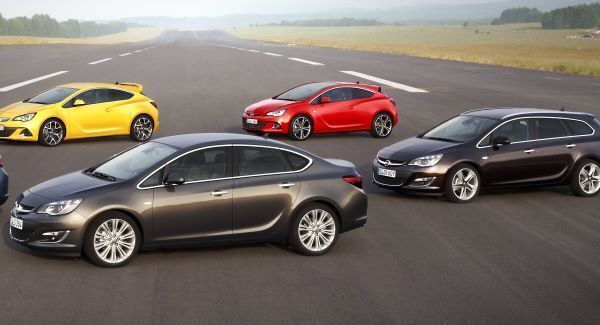
Against that backdrop we tested the new Astra. I have it impressed me in very many ways. I drove the saloon version. As is normal these days in its’ segment, there are three, four and five door versions, as well as estate and hot hatch options — and the first thing that struck me about the new machine was stylish it looked.
The first thought which came to mind is that someone has made a mistake and sent down an Insignia rather than an Astra. But no, the new Astra saloon is like a slightly smaller clone of the Insignia, not a bad thing at all.
Even against the standard bearers in the class, this car is a stand-out and it has much more of a premium look than its predecessor — something which is very definitely reflected in the interior decor — which cannot but help the Astra’s sales potential.
Part of the problem for Astra, however, is that it is lining up against nailed-on class leaders such as the Ford Focus and the VW Golf — not to mention a battery of contenders from Japan and the latter-day legions emanating from Korea. That being so — and framed against a backdrop of European factory closures and general belt-tightening — the incline facing the car steepens by the minute.
And when you throw in the fact that Opel’s engineers appear to have been hamstrung by the fiscal limitations placed on them, a picture begins to emerge that perhaps the Astra never really had a chance of making it to the top table.
To illustrate the point, let me tell you that I’ve been banging on in these columns for some time now about those cars in this segment which are equipped with all-round independent suspension systems — the Golf, the Focus and the Hyundai i30 are three which are universally acclaimed as being among the best in class.
The Astra — along with the Toyota Auris, the Honda Civic and many others — have stuck with variations of the old torsion beam system and few of them can hold a candle to their rivals when it comes to on-road behaviour, handling characteristics and their fun-to-drive quotient.
Sure the people at Opel came up with a novel and inventive solution to this quandary with their Watt’s Linkage addition to the torsion beam which gives their car some degree of an edge over its rivals, but the bottom line is that their cleverness only highlights the fact that those in charge of the purse strings were not willing to allow the engineers design and build a multi-link independent set-up.
That fact, in my view, puts the Astra at an instant disadvantage and compromises its sales potential. It also presupposes that Opel appears to think most of its punters would not appreciate the difference anyway.
The net result is not that this is a terrible handler — far from it in fact — but it does not have the dynamism of its main rivals and nobody will persuade me otherwise. The ecoFLEX diesel engines are very good by comparison with any of its rivals, both in performance and economy terms, and with outputs of 81 kW (110 bhp) and 96 kW (130) and economy of as much as 3.7 l/100 km, these will fit the needs of most drivers.
I really liked the Astra and felt this saloon version to be a really good looking, commodious, practical and economic. However, simply put, the car has been compromised by either the unwillingness or inability of its paymasters to do what was necessary to take it to the top level.
There’s no doubting that this is a serious step up for Opel in this class, but had they stepped up a little further, it might have paid off incrementally.
I liked the Astra a lot — but I wanted to like it a lot more.
From 19,495 — 24,295 as tested.
A decent range of powerplants, but the two 1,7 CDTi turbodiesels will probably be the main sellers.
A very decent amount of standard kit, but a lot of the high-tech kit Opel like to brag about comes at a hefty price.
Citroen C4, Fiat Bravo, Ford Focus, Honda Civic, Hyundai i30, Kia Cee’d, Mazda 3, Peugeot 308, Renault Megane, Seat Leon, Toyota Auris, VW Golf.



