Mitsubishi Outlander review (27/03/2013)
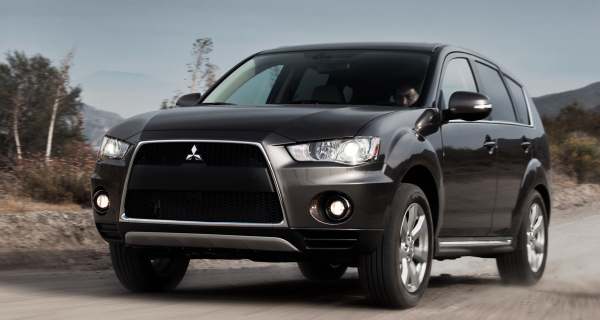
From having been Japan’s third largest manufacturer until 1997 when it was almost crippled as a result of Japan’s financial ‘lost decade’, which was caused by the collapse of the asset price bubble (sounds familiar), through to a new century, when its purchase and subsequent sale by the failed Daimler-Chrysler conglomerate nearly killed it altogether, things have not been rosy for Mitsubishi in recent times.
The company has returned to Japanese ownership and has considerably lessened its massive debts and utilised growing sales in emerging markets to further stabilise its financial situation. But Mitsubishi is still fighting hard for survival and undoubtedly new machines such as the third generation Outlander crossover which we test this week will further help the cause in that regard.
Mitsubishi stalwarts such as the Pajero and the Lancer have been keeping the show on the road for the company, while the iMiEV electric vehicle is something which will potentially come into its own in due course. The newly released Space Star mini MPV will also help sales along. However, in more ways than one, the Outlander has been the standard bearer for the company since we first saw it back in 2001.
The Outlander has been a massive seller in places such as Russia (where Mitsubishi has its biggest dealership in the world) and the fact the Japanese have been building versions of it for the likes of the PSA Group in France — badged respectively as the Citroen C-Crosser and the Peugeot 4007. It has helped see the company return to profit.
Although it killed off European production late last year, Mitsubishi has ambitious plans, particularly in the
hybrid sphere, and we will soon see the fruits of their labours in that
regard. We are told that the arrival of the new Outlander will herald the start of a new generation of global products for Mitsubishi Motors, with the aforementioned Space Star giving it an all-new offering in the B-segment and being followed by a plug-in hybrid version of the Outlander.
However, for the moment we are focusing on the standard new
Outlander which, the company says, is more spacious, more economical, and better equipped than both previous generations.
Available in a five-seater two-wheel drive or seven-seater four-wheel drive (which we tested) and with manual or automatic gearboxes, the Outlander is most certainly going to have a harder time of it second time around, primarily because the ‘crossover’ market has now become so heavily populated.
That very fact is not going to help the car and neither, quite frankly, is the price, which is considerably dearer than rivals such as the newly released RAV 4 from Toyota. So it is not
exactly easy to see considerable
numbers of the car rolling off garage forecourts anytime soon.
Having said that, however, the Outlander does have quite a lot going for it — seven-seat layout, eight-year
warranty, excellent economy, decent performance, and an electronic four-wheel drive system which allows you either to leave it in two-wheel drive, allow it decide for itself whether it needs two- or four-wheel drive, or select permanent all-wheel drive.
The nuts and bolts of the car tell us that 2.2 Di-D turbodiesel outputs some 150bhp and 380Nm of torque, resulting in a 0-100km/h capability of 10.3 seconds and a 200km/h top speed. Allied to that, it will also return some 58.9mpg over the combined cycle.
It offers a composed demeanour on the road and displays plenty of grip levels on whatever surface is thrown at it. I left the car to its own devices — 2/4WD mode where it selects for itself the necessary form of traction — during my time with it and I found it to be a capable handler with few discernible unpleasant habits.
While it is comfortable and stable, it is not particularly engaging and that fact definitely puts it behind the eight-ball by comparison with the Ford Kuga, which is a far more engaging driving proposition.
It is a very comfortable car to drive and sure-footed too, something which is undoubtedly explained by the adoption of a multi-link rear suspension layout. The interior is neatly laid out and well-built, although it would have to be said that in judging some of the material used, Mitsubishi has gone for a longer-lasting utility feel rather than a luxurious one.
That said, the cabin is roomy,
although the rearmost seats are
definitely only for kids.
There is no doubt that the manufacturer has not scrimped in terms of the kit it has thrown at the Outlander as standard; cruise control, centre audio display with reversing camera, hill-start assist, steering wheel mounted stereo, and phone controls, are all part of the deal.
Undoubtedly, however, the Outlander is going to find things tough on the Irish market right now. Not alone is it faced with a raft of competition, but it may simply not have enough to stand it out from the pack as a genuine class leader.
Undoubtedly it will sell well globally and greatly assist Mitsubishi Motors’ recent revitalisation. That said, good and all as the Outlander is — and it is — its snug yet stout character might just not be enough to attract buyers from other brands.
It has serious plus points, but so too have the opposition.
From 34,950 — 36,950 as tested.
A very workmanlike 2.2 turbodiesel which has decent performance and excellent economy.
Standard spec. levels are very high.
Audi Q3, BMW X1, Citroen C-Crosser, Ford Kuga, Hyundai ix35, Kia Sportage, Mazda CX-5, Nissan X-Trail, Opel Mokka, Peugeot 4007, Range Rover Evoque, Skoda Yeti, Toyota RAV 4, VW Tiguan.






