Meet the ski patrollers and their rescue dogs who keep the French Alps safe
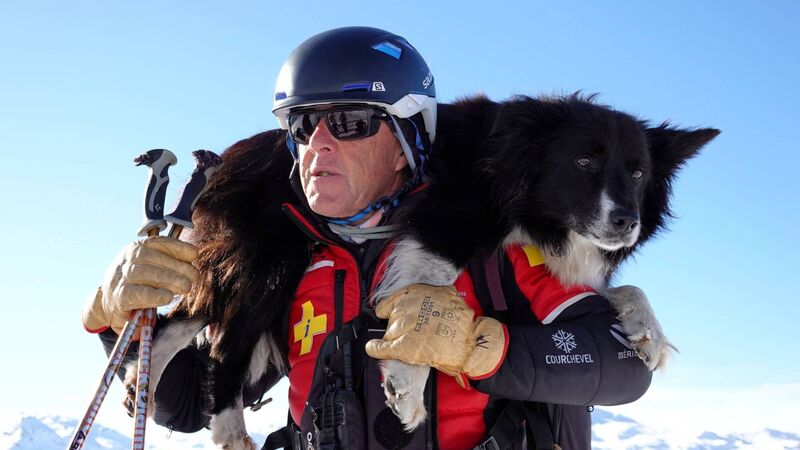
There are several ski patrol stations located at strategic points around Les Menuires, where teams of six patrollers are stationed Picture: Olly Bowman
I’m buried beneath a metre of snow above the ski resort of Les Menuires in the French Alps in a cold, silent, friendless world. Then suddenly there’s a scuffling sound, followed by a pair of black paws frantically excavating the snow, as Split the avalanche dog bursts through to my rescue — more of which later.
This is all part of an exercise by the Les Menuires Ski Patrol, which I’m shadowing for a day that began a few hours earlier at 7.30am on a cold January dawn.
Les Menuires employs 52 ski patrollers along with three avalanche rescue dogs to keep the resort’s 160km of pistes and vast amount of off-piste terrain as safe as possible for the hundreds of thousands of skiers and snowboarders who visit every winter.

Their day officially begins at 8.30am, unless there’s been a snowfall in which case they start between 7-7.30am in order to do avalanche control work. I learn this from the amiable Gilles Roux-Mollard, a 57-year-old ski patroller with 37-years’ experience in the job, as we zoom up the slopes on the high-speed Pointe de la Masse gondola — the fastest in France.
Gilles was born and raised in the Belleville Valley in which Les Menuires is located, and in common with every other ski patroller I meet today, he loves his work — despite the frequently testing weather and snow conditions which are part and parcel of the job.
“I get to work outside in a beautiful environment, to ski every day and to meet all sorts of different people — it certainly doesn’t feel like I’ve been doing this job for so long, as I enjoy it so much,” he says as the ski lift approaches his ‘office’ atop 2,804m Pointe de la Masse.

As I exit the lift to see the early morning sun turning the Mont Blanc massif a fetching shade of lilac, it’s easy to understand the attractions of Gilles’ job — the panorama from the Pointe de la Masse is one of the most spectacular in the French Alps and it’s hard not to envy anyone for whom this is part of the daily commute.
But, of course, there’s a lot more to being a ski patroller than enjoying great views and skiing all day. Gilles goes on to tell me that on average they attend some 4,000 incidents over the course of the ski season, which can vary from a lost child to serious injuries, and in order to do so, extensive training is required.
First-aid skills and an ability to ski any terrain in any snow and weather conditions are clearly a must; but in addition to this, a ski patroller can also, after two-years’ experience, specialise in avalanche control which involves handling explosives, meteorological and snow science (the information they gather is fed back to weather and avalanche forecasters at Meteo France, the national meteorological service), and avalanche dog rescue work.

There are several ski patrol stations located at strategic points around Les Menuires, where teams of six patrollers are stationed. In them, after a morning briefing on weather and snow conditions, the head patroller for one of four sectors will assign maintenance tasks such as ensuring that safety barriers and fences on the pistes are in good order, with one patroller remaining permanently at the station, while others can be sent out or called by radio to attend incidents both on and off the piste.
So far today, things are quiet for Gilles’ team as I join him to ski a red run which will take us almost a thousand vertical metres back down towards LesMenuires, from where we ascend on the Roc 1 gondola to attend various rescue exercises.

On the way down, Gilles stops regularly to check what’s happening on the piste and occasionally chat with a skier or group of skiers who have pulled over for a rest.
He enjoys interacting with visitors to Les Menuires and says it also provides a valuable opportunity to give advice on skiing safely and responsibly, which helps to minimise accidents.
The first of the exercises is the above-mentioned avalanche dog rescue, for which I volunteer to be a ‘buried’ victim — I’m actually in a snow hole excavated by the ski patrol and, unlike in a real avalanche where I’d invariably be crushed and suffocated by packed snow, I have plenty of room to move.
A trained avalanche dog can search one hectare of rough, snowbound terrain and/or avalanche debris in around 30 minutes — it would take 20 humans with avalanche probes around four hours to cover an equivalent area, and speed is absolutely vital in avalanche rescues since around 90% of victims will survive if recovered in the first 15 minutes after burial, provided they haven’t suffered fatal trauma.
This drops to just 30% after half an hour and only 10% after two hours.
The patrollers then practice the use of Recco rescue equipment — this is a system of small, lightweight transponders which are stitched into high-end ski clothing and can be used to locate buried avalanche victims — and the use of avalanche transceivers, shovels, and probes, which all off-piste skiers should carry as a matter of course.
This is particularly pertinent given that the previous weekend six skiers had died in avalanches following heavy snow in the French Alps. I ask Gilles how he feels about this — after all, the ski patrol teams do everything possible to make the terrain around the resort as safe as possible, including issuing warnings about avalanche danger on a daily basis, but still people die every year off-piste skiing.

Gilles replies: “The mountains are free for all to enter and it’s impossible to control them completely, we can only advise and educate and encourage people to act responsibly.”
He then points out an alarming fact — apparently fewer than 20% of off-piste skiers carry avalanche safety equipment with them. On that sobering note, we leave the rescue exercises and head for lunch.
The afternoon sees more patrolling of the pistes before heading to another ski patrol station at the top of the Menuires chairlift where Les Menuires head patroller Raphael Luzy takes me through the various means by which the slopes are kept safe, including explosives and ‘Gazex’ systems that direct hot gases on to slopes to set off controlled avalanches, and — something that could be a game changer for ski patrols — drone surveillance.
Six-years ago, Les Menuires became the first ski resort in the world to use drones; since, as Raphael points out, they can be used to survey not just the on- and off-piste terrain but also to inspect ski lifts, Gazex systems, avalanches, and rockfalls — which might otherwise require the expense of a helicopter. They also make life safer for the patrollers since they can be used to survey hazardous terrain remotely.
The demonstration also includes short videos about the work of the ski patrol, and this is offered free to the public twice a week as yet another means of educating them about mountain safety.
By now, the afternoon is drawing on, so after a couple more runs down to Les Menuires, I hop aboard the Becca chairlift with Raphael and Gilles to the ski patrol station at the top of 2,704m 3 Marches — where it’s possible to ski down into Méribel, which, like Les Menuires, is part of the Three Valleys, the world’s biggest ski area.
Each of the resorts within the Three Valleys has its own ski patrol team, but they work together as and when the need arises.

Half a dozen patrollers are gathered here drinking tea in the cosy ski patrol hut before making the final ‘sweep’ of the day, skiing down the slopes after the lifts close and checking that all skiers and boarders are safely off the mountain.
A few minutes after the last skier departs the top of the Becca chair at 4.25pm, I descend the blue Lac de Combes run with Raphael and Gilles — who usher stragglers down towards Les Menuires as a golden sun sinks below the peaks of the Ecrin National Park to the south-west.
Like their morning journey to work, Gilles’ and Raphael’s evening commute must be among the most scenic in the world, and as I say goodbye to them in the centre of Les Menuires they ski away with smilea on their faces, men happy in their work.
Alf Alderson was a guest of Les Menuires, ( lesmenuires.comtarget="_blank" rel="noopener noreferrer">) and Helly Hansen, who supply more than 200 ski resorts around the world, outfitting more than 55,000 ski professionals. hellyhansen.com
CONNECT WITH US TODAY



Be the first to know the latest news and updates