A decade after Star Wars, what is the lasting impact on Skellig Michael?
It's 10 years since Star Wars put Skellig Michael on the international map. A decade on, Gemma Tipton visits to see the lasting impact
A decade after Star Wars, what is the lasting impact on Skellig Michael?

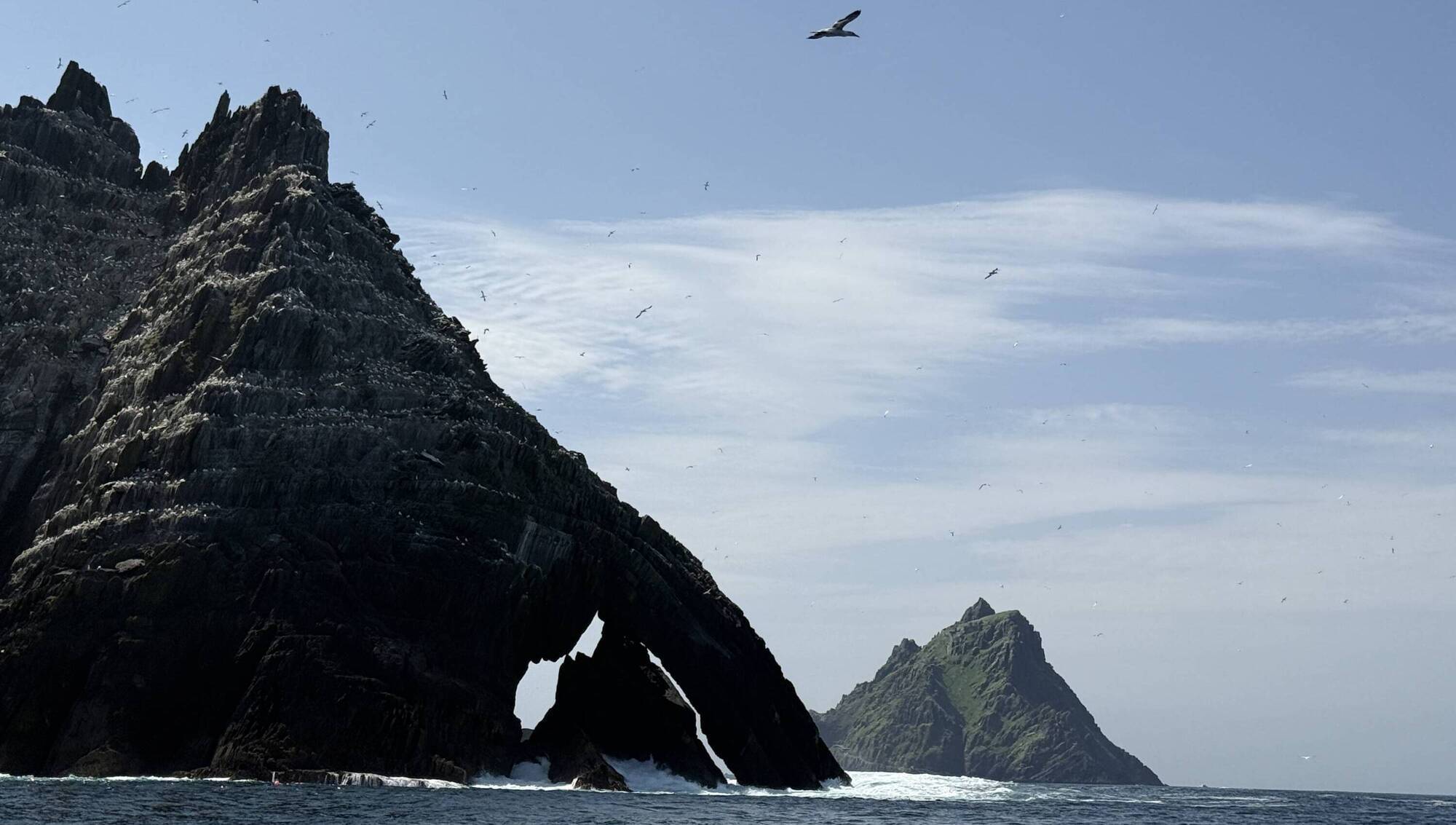
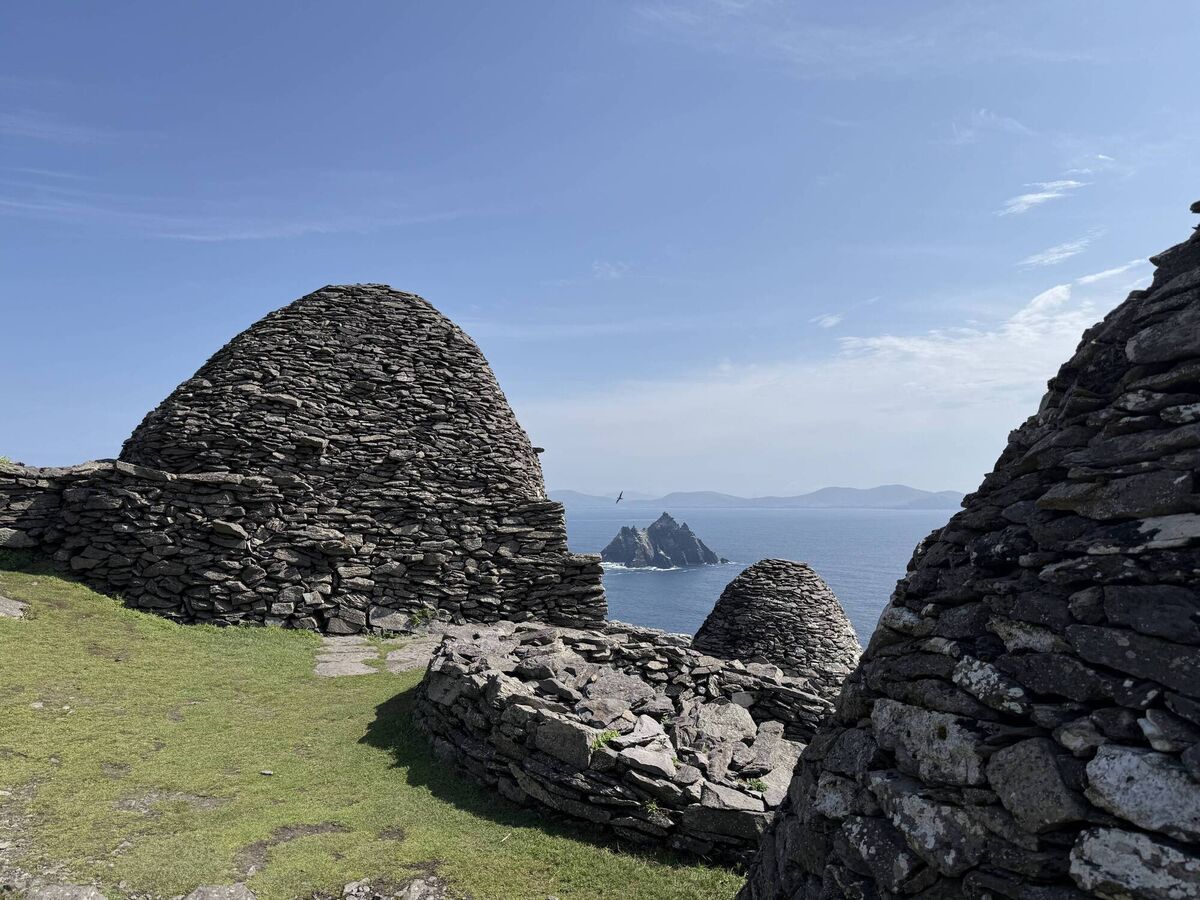
Little Skellig with Skellig Michael in distance. Picture: Gemma Tipton
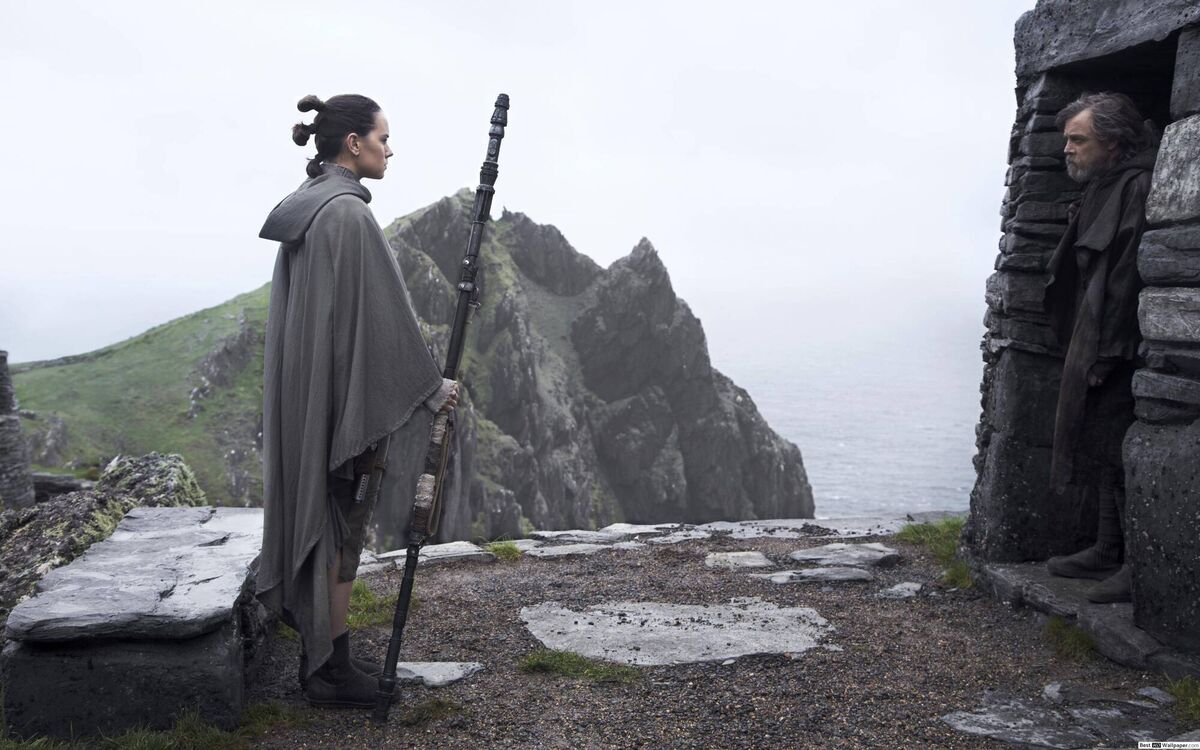
Ten years ago, the force awakened on Skellig Michael/Sceilg Mhichíl, when the seventh instalment of Star Wars premiered in Hollywood, and fans discovered that the astonishing rock at the edge of the Atlantic, previously famed for monks and puffins, was the hideout of a certain Luke Skywalker. They came in their droves from around the world, raising the profile of west Kerry.

Daisy Ridley as Rey and Mark Hamill as Luke Skywalker in a scene from the movie “Star Wars: The Last Jedi,” filmed on Skellig Michael, Ireland.(Jonathan Olley / Jonathan Olley / Lucasfilm Ltd.)

At the same time, however, grave concerns were raised about the Unesco World Heritage site’s fragile archaeology and ecosystems. Visiting a decade later, the cosplay characters are absent, and those who have been lucky enough to make it out to the island when I go are conspicuously lacking in lightsabers.

The luck involved in getting to Skellig Michael is significant. Spots on licensed boats are limited, and the weather frequently prevents landings. On our relatively calm August morning, the crew timed our boat’s lurching pitches to the second, ushering us one by one onto the narrow wave scudded steps.

Does that add to the feeling of being somewhere special? Quite probably: a dramatic arrival does tend to inflect feelings, but Skellig Michael has no need for amplification. It is, in a word, extraordinary.

For those who don’t already know — sometime between the sixth and eighth centuries (the date is disputed), monks established a monastery on this seemingly inhospitable spot. We know they were there by the ninth century, because the island was raided by the Vikings in 823. The monks built beehive-shaped huts, an oratory, and a small graveyard: the island is certainly not short of stone. And they lived, it seems, on fish, and the meat and eggs of the abundant nesting birds. The monastery lasted for four or five hundred years, before the community moved to Ballinskelligs, across the choppy waters.

The famous beehive-shaped huts found on Skellig Michael. Picture: Gemma Tipton

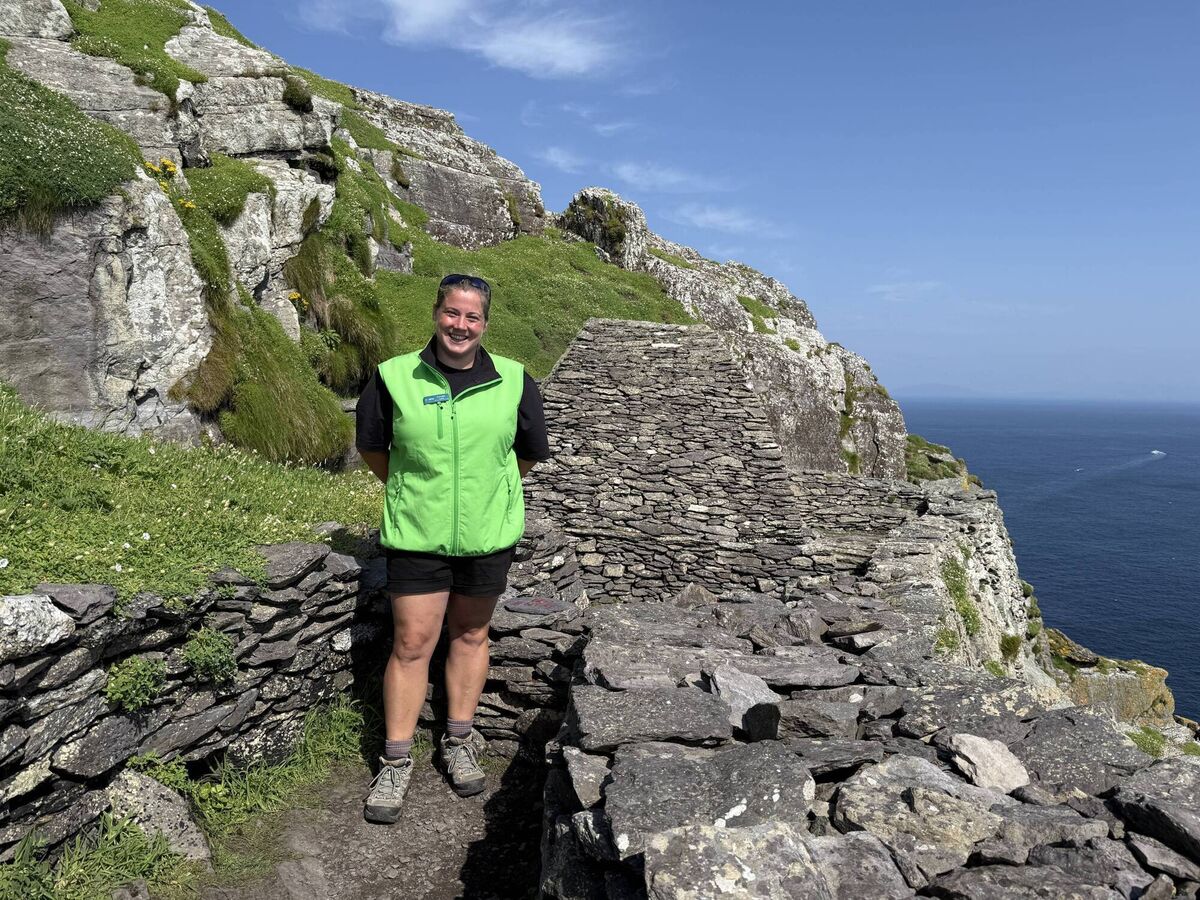
Pilgrims of different types make the trip these days, and some might argue that the force, if such a thing exists, has never truly slept. “There are fewer costume incidents,” says OPW guide Claire O’Halloran, who has worked on Skellig Michael since long before Star Wars.

She describes a time when fully-furred Chewbaccas would make the 618 step climb, and people might emerge from the beehive huts, suddenly
costumed and waving lightsabers. There is no regret in her voice for their passing, and instead she directs me to think, feel, and listen differently.

The whole island is alive under our feet.

“There are thousands of protected North Atlantic sea birds. Everyone comes with their own perspective. The fact it’s closed for most of the year is its biggest protection.”

Alongside her work on Skellig Michael, O’Halloran is also an artist, and her fine drawings, paintings, and stained glass artworks are directly
influenced by the environment.

“I am still working on ways to respond to everything that we are immersed in here,” she says. “All the light and life and colour. Nothing stops moving for long, except the rock itself.”

The birdlife O’Halloran refers to is astonishing. There are falcons, fulmars, Manx shearwaters, storm petrels, kittiwakes, guillemots, and gannets. Sister island, Little Skellig/Sceilig Beag, has the second largest gannet colony in the world.

There are puffins too and, according to locals, when the Star Wars crew first came out to set up filming, mindful of secrecy and security, they said they were working on a puffin documentary. Ultimately, the puffins were to have an accidental starring role in The Force Awakens as they frequently wandered into the middle of key scenes. Being a protected species, they couldn’t be shooed off, and so with a little dash of CGI, the Porg was born. Now, the adorable Porgs, beakless birds native to Skywalker’s planet-in-exile, Ahch-To, have their own fanbase in the Star Wars universe.

O’Halloran’s fellow guide Cornelia Lyne points out the oratory restored by her father, Cornelius. “Yes, I was named for him,” she smiles. She tells me of Meletiy, a Bulgarian monk who travels each year to pray at the site, and who says he has felt the presence of Saint Michael there. Arriving one year with an apprentice, he met a solo traveller, “a complete Star Wars fan, who also turned out to be deeply spiritual. They let him sit in on their prayers. When they were going back on the boat, I asked him how he and his apprentice had got on. ‘You never told me about Star Wars,’ Meletiy said. So they had each come for different reasons, and each went back with something different too.”

Skellig pictures. OPW Guide Cornelia Lyne in front of the oratory restored by her father Cornelius Lyne Skellig Michael. Picture: Gemma Tipton

Just beyond the beehive huts, I spot a man in a Star Wars T-shirt at last. Nick Salter has come from Sydney, Australia, and has braved a fear of heights to make the climb. “I learned about the island from Star Wars,” he says. “But then I looked into it historically. Nothing prepared me for this, I feel elated, now that I’m actually here.”

Skellig pictures. Nick Salter on Skellig Michael. Picture: Gemma Tipton

In this, he is touching on something rich that runs through religions, mythologies, and stories. It is revealed by the connection made between this early Christian site, and a multi billion dollar film franchise — which devotees would argue can be akin to a religion. Did the monks choose Skellig Michael because it was a handy, and relatively safe spot off the coast? Or did they connect to something they found there? And is the presence felt by the Bulgarian monk, Meletiy, something he wanted to find so much he felt it, or which resonates across from the time of the monks, from Saint Michael, or from the rock itself?

Some places do seem to give rise to deeper feelings, whether that is due to emotional, spiritual, or historic overlay, or perhaps it is something geological. The rocky island of Skellig Michael — all sandstone and slate — is just under 12km west of the Co Kerry coast, and yet it feels a world away. In the café at the Skellig Experience Visitors Centre on Valentia Island (skelligexperience.com), over apple pie and coffee, John O’Sullivan shows me a map of Europe. On it, a direct line reaches down from Skellig Michael, through England, France, and Italy to Greece, connecting a series of religious sites on rocky hill tops dedicated to Saint Michael the Archangel.

Starting at Skellig Michael, it passes St Michael’s Mount in Cornwall, Mont Saint-Michel in Normandy, the Sacra di San Michele near Turin, the Church of the Archangel Michael on the Isola Maggiore in Piedmont, to San Michele Arcangelo in Umbria, and the Sanctuary of Monte Sant’Angelo in Apulia, before reaching the Monastery of the Archangel Michael on Simi Island in Greece. Some of these sites overlay pagan places of worship, and legend has it that the line, and the elevation of the sites represents the whack the Saint was said to have given to the Devil, from on high to send him down to Hell.

Some suggest that ley lines are responsible, others say it’s the logical outcome of pilgrim routes, and more again say: coincidence. Whatever the actual reason, the Saint Michael line does demonstrate our need to connect with places that feel significant, and we do it through story, whether that is narrative, mythical, fictional, spiritual, or historical. Frequently it becomes a blend, one overlaying another.

Katie, who is on a visit from Washington DC, says “it’s an amazing beauty to come here and think about the monks. Their mission was so focussed. It is one of the glories of the world, to think about the beauty of these people who came here to give their sacrifice to atone for our sins. It’s a different world now.”

Marian and Ken Hand have come from Co Kildare. “I had been before,” says Marian, “but it blew my mind all over again.”

They tell me that their interest lies in history, nature and archaeology. We ponder the lives of the monks out here all those centuries ago, and how living such a semi-isolated life might encourage deeper contemplation.

Ken and Marian Hand on Skellig Michael. Picture: Gemma Tipton

“Everything is relative,” says Ken. “But if you’re looking at something that takes you out of your own world, it can take you away from your own sense of hardship.”

At the foot of the steps, Mick Langan, who has delivered the morning’s pep talks on safe climbing, is now welcoming people back down, en route to their boats. All are smiling. “The magic of here is that nobody leaves without a sense of wonder,” he says. “It may be the monastery, it might be the birds, it might be the sea, but everybody’s touched by something.”

He tells me of a French priest who asked to celebrate Mass on the rock. “And suddenly it stops being a historic site and becomes a monastery again. So, as I say, it’s alive.

“Most myths,” he adds, “have a kernel of truth. You need to sometimes look allegorically, and sometimes literally.”

Back on shore, Skellig Michael, its presence, spiritual history, wildlife, tourism and traditions all coalesce to mean a great deal to the community.
In Portmagee, I ask locals about the tensions that escalated into a court case earlier this year, taken by Atlantic Endeavour Ltd against the OPW,
arising from the awarding of licences to land, and leading to a delay in reopening the island to visitors.

This, just one of a series of litigations by boat owners in recent years, was settled on June 27. “That knocked a month off our season,” says licensed boat owner Donal McCrohan, who runs both landing trips, and eco tours by boat with Skellig Coast Adventures ( skelligcoastadventures.com). Star Wars-driven visits peaked before the pandemic, he says. “Sixty to seventy per cent of the people you were carrying out in those years were for Star Wars, but there has been a drop off since covid.”

Donal McCrohan Skellig Coast Adventures. Picture: Gemma Tipton

Local Portmagee shopkeeper, Mark Conway agrees. I meet him selling ice creams to a long line of customers. “Back in the 1980s, hundreds of people were going every day. Then the OPW limited it to 180 per day.”

He still thinks there could be more. “It’s not going to make a huge difference once it’s controlled. Star Wars was a couple of crazy years,” he adds.

Skellig pictures. Local Portmagee shopkeeper, Mark Conway. Picture: Gemma Tipton

That has tapered off, but he tells me about Portmagee’s mini May the Fourth Be With You, the Star Wars themed festival from May 2 to 4 each year. “People come and dress up, and they do it for charity. It’s a great idea and people have fun.” And for those who have had a little too much fun? The day after the festival is known as Revenge of the Fifth.

Getting to Skellig Michael

Landings on Skellig Michael are by permitted boat operator only, and the season runs from mid May to the end of September each year. You can find a list of operators at heritageireland.ie. Return trips cost €130.

If the 618 steps are too much, the majesty of the Skelligs can still be sensed with a boat trip that takes you round both islands, and includes views of bird life on Little Skellig too. That season begins on St Patrick’s Day and runs, weather permitting, until the end of October, and costs €65 per adult.

x

More in this section

Lifestyle

Newsletter

The best food, health, entertainment and lifestyle content from the Irish Examiner, direct to your inbox.

Cookie Policy Privacy Policy Brand Safety FAQ Help Contact Us Terms and Conditions

© Examiner Echo Group Limited