The comparatively vast Fergus Estuary in Co Clare encompasses in and around 20 islands, some of which once boasted sizeable populations. All are deserted now, putting them
in the same bracket as the never-lived-on Trummer.
This delightful island, which is shaped like a mini Loop Head — a long toe stretching outwards — lies in among some very large neighbours in Deer Island and Coney Island. Though sheep are sometimes grazed there, another function this flat island could serve might be as a sanctuary for the stranded. The Fergus sweeps past here to join the glorious Shannon a little further on. That storied river and its mysteries are the subject of a fascinating new account by travel writer Paul Clements
in Shannon Country: A River Journey Through Time. The River Fergus deserves a similar devotion.

Where the other islands in the Fergus Estuary are mainly very hilly, Trummer is flat and shares with them seas of mud when the river is low and the sea has ebbed. Trummer, in fact, barely keeps its head above water, much like Rat Island which appeared here a few months ago. The 1871 census gives the size of Trummer at three acres, nought roods, and 30 perches. But despite its diminutive size, Trummer can boast several unusual features.
At its eastern end there is what appears to be the ruins of either a fort or an old house. It is enveloped by ivy, which is often found on old ruins, of course. No record of this place appears on the archaeological record, so it is probably a limestone outcrop whose blocky appearance can often resemble a built structure.
Several elder plants also grow in the vicinity of this ‘structure’, and it is from this that the island derives its name. A study by Galway Public Library has identified several places in Ireland which derive from the Irish for elder — ‘tromaire’.
“A place where elders grow is often called tromaire [trummera], from which Trummery in Antrim derives its name; it is shortened to Trummer, as the name of a little island in the Clare part of the Shannon; and in Wexford it takes the form of Trimmer,” it states.
Several variations of the word appear around the country, including in Tromaun in Co Roscommon, Tromman in Co Meath, and Trumman in Co Donegal.
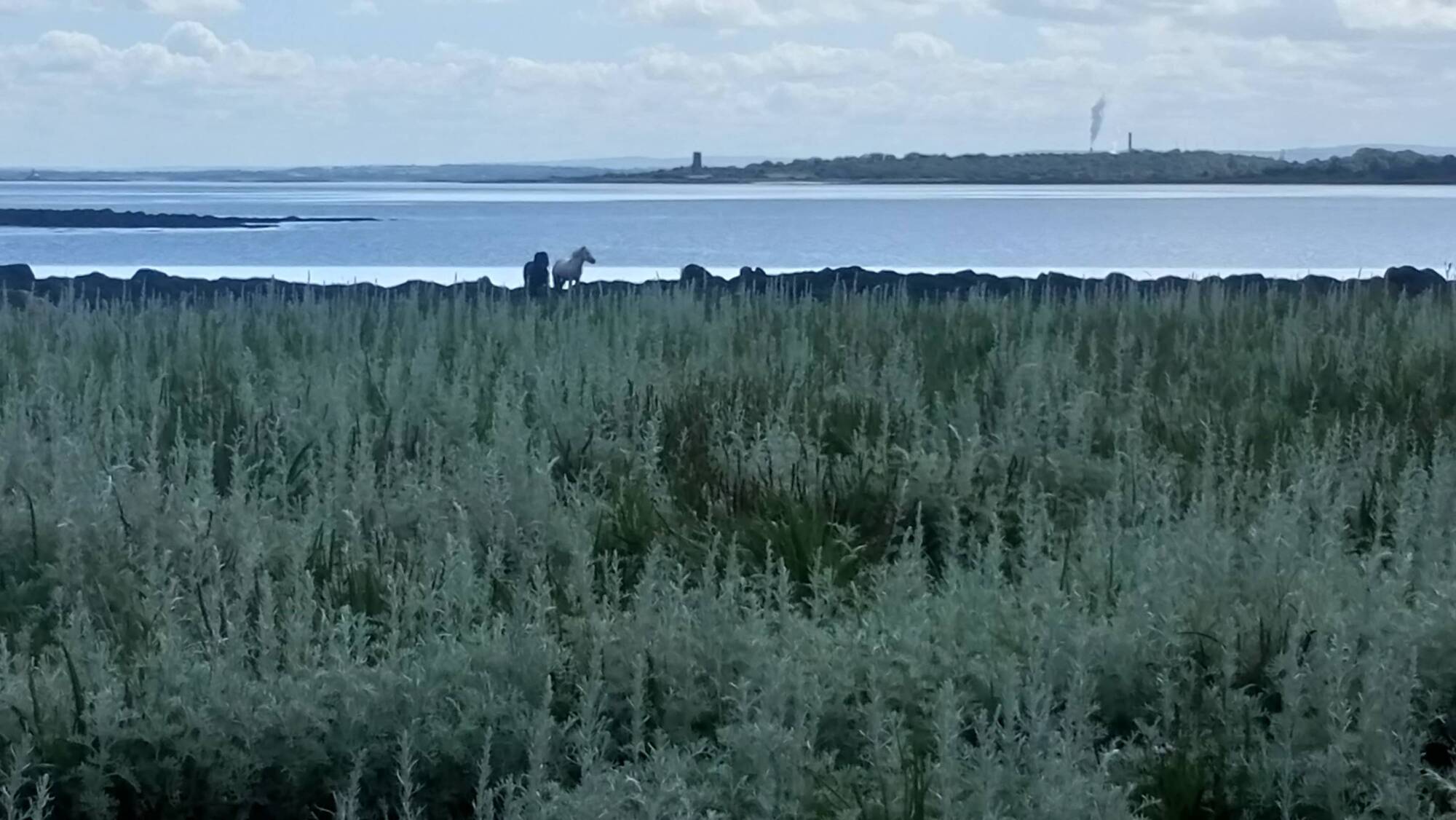
The standout feature of Trummer, however, is a pair of ponies, black and white, which strut this island as if they own the place. When this writer visited in the summer, they appeared at first curious
behind their shaggy fringes — it is safe
to say they do not have to receive many visitors, and the sight of an approaching kayaker must have bewildered them somewhat. A little later they broke into brisk trots which took them to the extremities of the island away from the intruder.
Trummer is swathed in the silvery grey sea wormwood plant which occurs frequently in coastal estuaries in Galway, Limerick, Dublin, and Drogheda and not much elsewhere. The metallic-looking filaments of this plant were used to aid digestion and as a folk remedy for fevers. It was also occasionally used for nervous disorders, convulsions, and insomnia, but is poisonous in large quantities. It is reputed to have a bitter taste and is also known as the ‘old lady’.
Trummer Island was owned by a family of Ginnanes, including Daniel Edward and Jeremiah, in the 19th century, and also by a family of Normiles. Both of these names — Normile and Ginnane — occur frequently on the islands of the Fergus Estuary.
It was also significant enough to be mentioned in the courts. The Irish Independent in 1918 reported that a John Meany took out an interlocutory injunction against his son, Michael Meany, from trespassing on Coney Island, Rat Island, or Trummer. The request was granted for the plaintiff, but the newspaper does not record the reason for the father’s ire.
Trummer will never attract tourists in the way Coney Island or Inishmacowney could do, but there is something pleasing to know that out there where the waters of the Fergus and Shannon meet, a lilliputian island is home to two wild horses.
- How to get there: Inquire at Ballynacally Pier, Co Clare.
- Other: places.galwaylibrary.ie/place

Cancel anytime
CONNECT WITH US TODAY
Be the first to know the latest news and updates