Weekend break: A very special journey back to Clare's old ground
Having enjoyed the magic of Co Clare as a youngster, retraces his steps — now with his own family in tow.

You know something special is happening when your guide recites poetry inside a copse of trees which wrap protectively around a land-version of Skellig Michael — a stream of spring-fresh water bubbling towards a holy well the only other sound in this remarkable landscape.
Amidst the apparent barrenness of the Burren, there is indeed magic. You just have to know where to find it.
I remember experiencing that Burren magic for the first time during a family holiday in Lahinch, Co Clare in the late ’80s, long before the Wild Atlantic Way, and Lahinch was famous for surf.
I remember how the moon-like karst landscape I had been studying for Junior Cert geography seemed to come to life as I lay face-down on its sun-baked clints to inspect delicate Alpine flowers blooming in its deep grikes.
I remember, at the Cliffs of Moher, crawling slowly on all fours, in the days before health and safety policies, towards the steep, unprotected wild edge of Ireland to peer over.
I remember caves and ancient dolmens, roadside stove-fried sausages, and Abba cassettes being played on the car stereo.
Two decades on, it was time to revisit old ground, to see these places anew with my own family. This time, without the Abba cassettes.
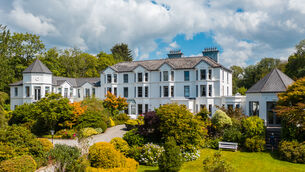
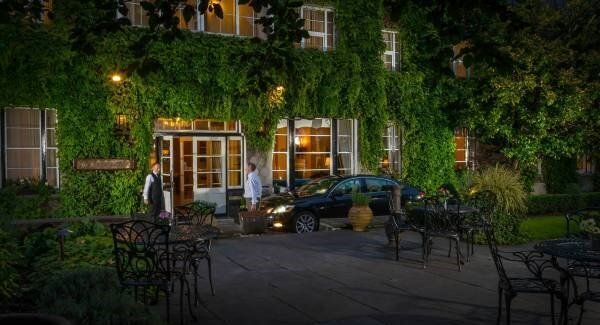
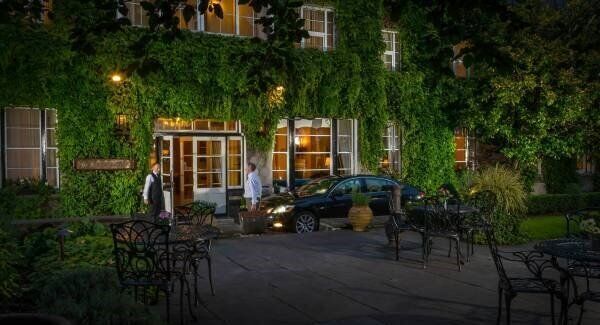
It was a dark and bitterly cold evening, with the threat of sleet in the air, as we arrived at the Old Ground Hotel on O’Connell St in the heart of Ennis.

A welcoming turf fire crackled in the cosy reception area and it felt like we were home. Within minutes, I was sipping a freshly-brewed lungo from the coffee machine in our spacious top-floor junior suite.
The Old Ground was built in the early 18th century as a private house. It’s been a hotel since 1895 and has, since 1995, been part of Flynn Group, which also runs The Imperial in Cork, The Park Hotel in Dungarvan and the Newpark Hotel in Kilkenny.
The four-star property has been extended and refurbished over the years, but still retains all of its historic charm, with its narrow corridors and original exposed stonework in places, its carpets, heavy window drapes, old paintings, and quiet cosy corners where you can sink into a couch and get lost in a book.
While it doesn’t have a pool, it is the perfect base from which to explore the region.
We drove 40 minutes north, into the heart of the Burren National Park, to meet Tony Kirby, a Limerick-born former civil servant who moved from Dublin to the Burren in 2002 to launch his walking tourism enterprise, Heart of Burren Walks.
An expert on the Burren, its history, heritage, flora, and more importantly, on its future, Tony offers a menu of hikes, from easy looped walks showcasing its limestone pavement, flower-rich pastures, and archaeological features, to more challenging coastal routes along pilgrimage trails, taking in ancient field systems and stunning views over Galway Bay and the Aran Islands.
Each walk can be tailored and adapted to suit different ages, abilities and endurance, varying from short 30-minute looped-walks to three-hour hikes over limestone hills.
Given that our youngest is five, Tony suggested we tackle a section of one of seven way-marked walking trails in the Burren National Park.
We parked at the gate to the Eagle’s Rock route, near Carran, and walked over a vast expanse of karst landscape near the Clare/Galway border, dotted with dozens of soon-to-bloom Mountain Avens, or Holtasoley, the national flower of Iceland, bearing northwest up a slight incline towards the base of the imposing Eagle’s Rock cliff.
We passed through a small stand of mature ash, oak, and hazel, and stepped into a sheltered clearing in which stands the remains of a stone oratory which marks the site of an early medieval hermitage associated with St Colman MacDuagh, who reportedly established a hermitage here in the seventh century.
Tony recounted the area’s rich historical, archaeological, religious, and spiritual significance, before we scrambled up a ridge to view the cave where St Colman and his manservant were said to have spent up to seven years meditating.
The entire walk was no more than three kilometres, and the 90-minute tour flew by, thanks to Tony’s easy and informative style. A spontaneous poetry recital capped a memorable morning.
The afternoon was spent exploring the Ailwee Caves, a 25-minute drive west along a stunning stretch of the Wild Atlantic Way near Ballyvaughan, before a mini-blizzard cut short our stop at the Poulnabrone dolmen — Ireland’s oldest megalithic monument.

But not even a horde of possessed housekeepers could prevent us reaching Fr Ted’s house — the real-life Glenquin House in the heart of the Burren which was used as the location for Craggy Island’s parish house. Owned by the McCormack family, it is open — by appointment only — for afternoon tea.
We had a ‘these are small, but the ones out there are far away’ moment as we tried to explain why Craggy Island isn’t, in fact, an island.
This eclectic tourist trail is easily managed in a day on a good Old Ground breakfast. And it worked up an appetite for dinner too.
We dined in the hotel’s adjoining Town Hall Bistro, accessed from the hotel through its cosy wood-panelled pub, and it won us over before the food arrived. As the menus were distributed, our waiter said the children should feel comfortable ordering whatever they wanted if nothing on the menu appealed to them.
“It is a working kitchen after all!” she insisted.
It was refreshing to have one of the finest restaurants in Ennis give us that option. The food matched the service. My fillet of beef, served with fondant potato and a deep and unctuous beef and red wine jus, was magnificent.
The Cliff of Moher are just 45 minutes west and always worth a visit.

The warmth of the welcome, combined with the quality of service and food ensured it won’t be another 20 years before I’m back on old ground.
- www.flynnhotels.com
- www.heartofburrenwalks.com