Unspeakably beautiful wilderness at Yukon Quest International Sled Dog Race
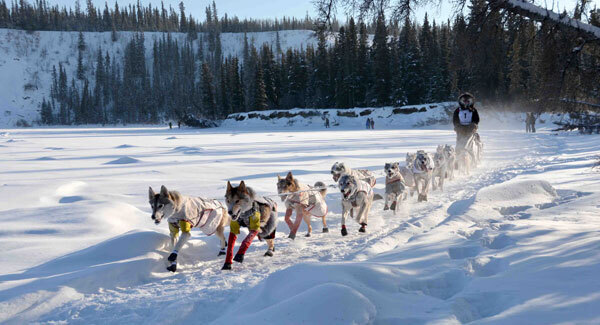
Today a dog race begins at the top of the world in mind-numbingly freezing conditions, writes Jo Kerrigan.

Unspeakably beautiful wilderness at Yukon Quest International Sled Dog Race

At the top of the world in a remote, frozen wilderness, an epic event takes place every February.

The Yukon Quest International Sled Dog Race covers 1,600km between Whitehorse in Yukon Territory, Canada, and Fairbanks, Alaska.

The starting point alternates between these two historic gold rush towns every year.

The race gets its name from the traditional winter highway which is the frozen Yukon River, travelled for generations by prospectors, adventurers, mail and supply carriers between the gold fields of the Klondike and those in the Alaska interior.

Today 25 mushers will start the arduous quest.

Already hardened experts, they are on their own once they are out there, with up to 320km of howling wilderness between checkpoints.

If you’ve seen the movie Snow Dogs, you’ll have some slight idea of what it’s all about, but a Disney film doesn’t give you the reality of the incredible cold, the loneliness, the vast horizons that mushers have to face.

And the stunning, awe- inspiring beauty of this little-known wilderness.

The Yukon Quest lasts from 10 to 16 days until the final dog team arrives at the finish line.

It’s a true test of the capacity of humans and canines, and a tribute to the strength of the ancient bond that unites them.

The dogs, not the humans, get top attention, being checked constantly, not only at the start and finish but at official points throughout the race.

Mushers carry mandatory equipment, food and supplies at all times.

Sleds cannot be replaced without penalty, and mushers are not permitted to accept any assistance, except at the half-way point in Dawson City, once the rowdy capital of the Klondike.

The Yukon Quest Trail crosses frozen rivers and four mountain summits.

Temperatures of -40C, 160kph winds, open water and bad ice are all barriers.

Yet they come.

Eager participants and their supporting teams have been pouring in to the starting point for days now, and the parking sites for their vast motorhomes, caravans, trailers and SUVs are filled to capacity.

Every hotel and guest house has been booked up for months. The restaurants are doing a roaring trade.

Reports are coming in constantly to the quest office, phones ringing, piles of hastily scribbled notes and faxes floating to the rough wooden floorboards where the snow knocked from heavy boots lies unmelted.

Rows of hooks on the wall hold layer upon layer of serious outerwear.

It’s vital to layer up here in the Yukon.

Indoors the heat is kept at roaring temperature, but the moment you step outside, your nose freezes instantly, your eyelashes frost up with icy crystals.

Think double thickness woolly hats, and a hood over that, with a scarf tucked around your face.

Your breath soon freezes on the scarf, while your feet, wrapped in several sets of thermals inside the hiking boots, are lumps of ice.

Get used to it. The locals have.

It’s the morning of the quest and the dogs, undeniable stars of this great event, are being taken out of their boxes and harnessed up.

They know it’s time.

This is what they were bred for, as were their parents and grandparents before them.

The first whine is soon followed by howls of impatience and eagerness, echoed all over the park.

“We want to be on our way. We want to be out there!”

The mushers are carefully fitting on the shoes every dog must wear to protect his feet against the harshness of sharp ice and snow.

Traces are being snapped into place.

Onlookers crowd close, but are advised to keep back. These are emphatically not cuddle bundles, household pets.

They are elite, marathon athletes, descendants of those who powered the Klondike Gold Rush in the 1890s.

Their owners love them with the same ferocity as a mother does her child, but they know each animal’s character to the bone, as well as its staying ability, its courage, its determination.

Out there in the true wilderness, it is this relationship that will bring them through two weeks of hell.

Because that’s what it is.

Easy to forget when you’re here amid hundreds of friends, exchanging last-minute advice and jokes, offering support and reassurance on all sides.

Once you leave the town, and start the first run up the dramatic frozen reaches of the Yukon River, it’s just you and your dogs.

Together you will make it through – you hope.

There goes the starting call.

Wild with excitement, the first team on the list is hauled to the starting line. Hauled, because every single dog is straining, leaping, desperate to be out there doing what he does and knows best.

As they line up, two handlers are still holding tightly to the harnesses, making sure they stay in place until the pistol is fired.

And then the crack of the gun and the dogs leap forward. The heavy sleigh, loaded with everything that must be carried for survival in the wild over a fortnight, creaks as it gathers speed.

The musher runs behind it for a few moments, then steps quickly on board as the dogs head for the smooth surface of the river and turn north.

Now the second team is ready to go, and then the third, the fourth, and so on down the chart list until the last team is vanishing into the suddenly bright sunlight.

Now those in the know are heading for their trucks and jeeps.

The road, they say, is cleared up as far as the next bridge outside town, and that’s where we head too.

Parking in a snowdrift, you pick your way down to the thick ice of the frozen river.

Upstream and down, small knots of people have already gathered, some kindling small fires of brushwood and pinecones to warm their hands while they wait.

A cry in the distance means that the first musher has been sighted and soon he comes into view, his team trotting calmly and regularly, tails waving contentedly.

(It is only in the movies you see them galloping at high speed. Out in the wilderness, it’s slow and steady that ensures survival, let alone winning.)

As the onlookers cheer, the dogs’ eyes flick from side to side briefly, acknowledging their presence, but soon turn back to the way ahead and the kilometres that yet remain to be covered before they rest for the night.

One or two of those nights may be spent in checkpoints where conditions can be slightly more comfortable, but mostly dogs and mushers will sleep out under the huge starlit skies.

And then they have disappeared round the next bend and into a world far removed from roads and trucks, electricity and warmth.

What do the mushers think about out there on their own in the days and weeks ahead?

Survival mostly, then probably how far to the next checkpoint, what the weather is doing, who is running them close, when they should call a brief halt.

Perhaps they ask the big questions of their own lives. You can’t escape reality in that frozen wilderness.

That’s only the start, of course.

At the other end of the quest, the excitement will be growing over the next week, as sightings are reported and times checked against lists.

Within 10 days, the first team should be coming through, and the crowds, as well as the back-up support, will be there to cheer them in, as well as searching anxiously for the one that matters most to them.

They’re on your own out there, musher and dogs, and all too often the only one who can get you out of trouble is yourself.

That’s the law of the wild.

GETTING THERE

The Yukon Quest 2016 begins on February 6 in Fairbanks, Alaska, and continues until the last musher has crossed the line in Whitehorse, Yukon Territory, 14-16 days later.

Next year it will be Whitehorse to Fairbanks.

See it start, cheer them over the finishing line, or follow it on www.yukonquest.com.

FLIGHTS

Fly Fairbanks via Anchorage; Whitehorse via Vancouver. The more stops en route, the lower the fare.

HOTELS

There are plenty of hotels in both Fairbanks and Whitehorse, but you need to book well ahead. Think months, not weeks.

FOOD

Expect rib-sticking meals that warm you up and keep you going throughout the day. Not a place for dieting. Prices on a par with Ireland — say €15 for a main course, beer about €4. They do have to import a lot of it.

WHAT TO DO

Once the last dog has left, go sledding yourself, explore some of the most wonderful wild scenery on earth, and make sure to keep an eye out at night for the Northern Lights.

WHY GO?

If you have to ask that, forget it. This is the big one, the lifetime experience.

If you’re fed up with Irish weather, then go to this unspeakably beautiful wilderness.

More in this section

Lifestyle

Newsletter

Eat better, live well and stay inspired with the Irish Examiner’s food, health, entertainment, travel and lifestyle coverage. Delivered to your inbox every Friday morning.

Cookie Policy Privacy Policy Brand Safety FAQ Help Contact Us Terms and Conditions

© Examiner Echo Group Limited