Visiting Iceland in the footsteps of St Brendan
We were here first.
How often can an Irish person claim that?
Better known for our artists than our adventurers, I canāt help but feel a flip of joy as my tour guide for the day, Albert, tells me it was actually St Brendan and his intrepid monks who historians believe first called Iceland home.
They didnāt last long; the monks that is, hitching their robes and heading home as soon as the Vikings finally arrived. But that wasnāt the end of Irish involvement in Iceland.
Sharing the longboats with the Scandinavian immigrants were Irish slaves and itās our Celtic heritage rather than Christian that lingers; from the place names that bear Irish influence to grand Icelandic sagas inspired by tales of CĆŗ Chulainn and Co.
Genetically, the majority of Icelandic women are actually Irish Celts rather that Nordic.
My history lesson is taking place at Pingvellir (pronounced Thingvellir), 50km north-east of Reykjavik. It was here that the Vikings first held their annual assemblies and it remained the seat of Icelandic government from 930 to 1798.
Itās also where the Eurasian and north American tectonic plates are slowly pulling apart and the landscape is suitably dramatic for a tectonic divorce. Amid a solidified lava field submerged in snow and sweeping frozen lakes of sulphuric water, 6m walls, black, and fresh from the Earthās core, mark the plates edge.
Forget images of Alpine vistas. Iceland is a land that is exploding, literally. Volcanoes regularly burst from the ground, glaciers still push and shove the land in new directions and craters spit out bubbling geothermal springs.
Not that every day in Iceland is hot molten lava and steaming sulphur. These cinematic vistas are a long way from the concrete carpark in Reykjavik where I start my adventure. Iām straight off the airport shuttle. Iām also starving.
I know Iām starving because itās only on an empty stomach that you could think that the first food van you see is a good spot for dinner. A food van called Lobster Hut. Now weāre a country with a grand history of food from vans, Roddy Doyle even got a book out of it, but lobster, from a van, in a carpark, in a bus station carpark has every potential to go very wrong.
Propelled by my complaining stomach and the fear that any restaurant in town will force me to handover my wallet, watch and possibly my passport to pay, I order the half lobster roll.
Itās a showstopper. The lobster is joined by mayo, peppers and a handful of crushed nachos to add some crunch. Fine food meets fast food. Itās also the first of several meals I have in the city that confirm Reykjavik as one of Europeās newest culinary destinations.
More surprisingly, it also confirms a whisper I heard before arriving. At ā¬6 for a lobster roll, I neednāt fear for my wallet. The bubble has burst on Reykjavikās traditionally monstrous prices.
With just 120,000 people, Reykjavik is roughly the same size as Limerick, and feels smaller. The centre is set around just a dozen or so streets and has the intimacy of a village. The clapperboard houses, white picket fences and dusting of snow give it incredible warmth. Itās the sort of city that makes you want to become a schoolteacher by day and knit your own jumpers by night.
Itās beautiful, but in truth Iām only in town for the trips. Many of Icelandās best sights are just an hour or two from the city. I plan to ogle the landscape and catch the Northern Lights.

However, Iām not alone. And nor will you be. There is little choice but to join organised tours - youād need to have watched a lot of Ice Road Truckers to test yourself on Icelandās treacherous roads.
My fear of such tours are deep seated and rooted in bad experiences of euro pop on the radio and forced fun group activities. And as our tour kicks off with the guide asking everyone to put their hands up and say which country theyāre from, my heart sinks.
However, it seems that long dead ancestors arenāt all we have in common with the Icelanders. As Iāll experience several times in the coming days, Icelanders are big on banter and our tour guide Runar has a talent for it.
He needles every nationality as theyāre announced, culminating in one under-pressure but over-confident Englishman blurting out his nationality as London.
Runar shouts back āI didnāt realise youād declared independenceā.
And, with that weāre off.
Every Northern Lights trip is a punt, but Runar likes our odds. Heās got a direct line to the University of Alaska, apparently top tipsters for the lights, and conditions look good.
We drive. We drive some more; through villages and along dirt tracks chasing the lights. Nothing. There are spectacular stops along the way; fields of snow to swallow you up to your knees and a sprawling volcanic crater. We make our third stop at Eyrarbakki beach.
Lights or no lights, one fella decides heās had enough waiting. As we crunch across the blackened volcanic sand and stare at the crests of frozen waves, he pops the question and gains a fiancĆ©e.
Sadly, it seems the University of Alaska has been spinning us a story. Our trip is a failure. Luckily, we get a second chance for free the following night.
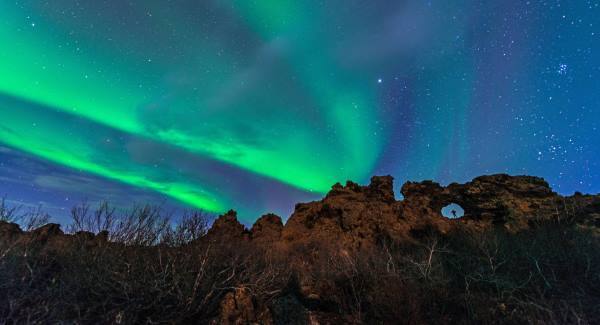
Weāve totalled six hours of craning our neck at the sky over the two days when Runar spots a smudge on the horizon. At first the green hue is almost imperceptible.
Then the sky cracks open and the colours cascade. Lights swing and swim above our heads. The light show lasts just 10 minutes but itās breathtaking.
With the Northern Lights ticked off, my last few days are a blow out and I get the chance to explore Reykjavik a little more.
I sip a rocket-fuelled Swiss mocha at the excellent Reykjavik Roasters ā one of half a dozen independent and intimate bars and cafes I stumble across. The bare wood floors, beards and half a dozen open macbooks confirm Reykjavikās high hipster count, though the style feels less forced than in New York or London. People arenāt posing.
tās a similar story with shops. Independent retailers hog the main street; stuffed with the sort of chunky knitted jumpers that have inspired fashion from Stockholm to Hackney. High prices send me to the Kolaportid weekend flea market (www.kolaportid.is), where I pick up a hand-knitted hat from a nana clicking her knitting needles.
My final trip is the Golden Circle tour ā or Icelandās Greatest Hits ā where I meet Albert. Aside from Pingvellier; the trip takes in the thundering Gullfoss waterfall, the product of a melting glacier, and a trip to the hot springs at Haukadalur. This is where the worldās original geyser can be found ā all the rest borrowed the name. Sadly, the geyser is in semi-retirement, although its partner, Strokkur, goes off every few minutes with alarming violence.
As I stand staring at 9m of boiling water spurting out of a fissure in the earth wondering if St Brendan could really have made it here, Albert sidles up and points out a boulder in the distance.
āItās a fairy house. There are hundreds of them all around the island,ā he says.
āDo people really believe in that stuff?ā I ask.
āOf courseā he says.
āJust like in Ireland.ā