Galway has a chilled tribal beat
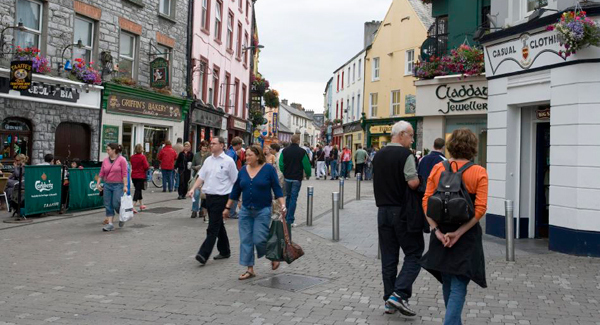
Even for Irish people, the charms of Galway are obvious. It has, for instance, gained a reputation over the past 25 years for being one of the most tourist friendly cities in Ireland.
It hardly ever closes down shutters on what is commonly known as ‘the vibe’.
In fairness to the citizens of this beautiful West of Ireland destination, it’s only right and proper that some people have homes to go to during the core winter months, otherwise the famous buzz that pulses through the city from February to November would be carried on regardless.
Galway is known as ‘the City of the Tribes’, and wears the hallmarks of its past with staunch pride.
The streets of the inner city may have been updated and refurbished in line with late 20th century architectural thinking, but if you peer closely enough at the facades of buildings, you will see the work of ancient stonemasons staring back at you.
These works, carved on Galway limestone, are ancient coats of arms, and refer to the 14 merchant families who ruled Galway during the 17th century.
When the term ‘Tribes of Galway’ was sarcastically used against them by a follower of Oliver Cromwell, the merchants instantly adopted the nomenclature and turned around the original meaning to give the city both substance and self-respect.
Indeed, local history has it that the city’s famous 1651 Pictorial Map compares Galway’s 14 tribes to Rome’s seven. Just to prove the point, like.
Galway began as a tiny fishing village gathered around the estuary of the River Corrib, which was traditionally known as Abhainn na Gaillimhe (the Galway River). It was named after a mythological princess named Galvia, who is said to have drowned in its waters.
By the mid-13th century, the Anglo-Norman de Burgos captured a fort previously erected by local chieftains, and replaced it with a castle, around which a settlement grew into a mediaeval city.
From 1270, the city fortification began, eventually providing a protective surround for mainly Norman and Welsh traders who were taking up residency.
A harbour was constructed in front of what is today known as Spanish Arch, and as Galway’s name as a major trading port grew so did its wealth.
For a time, Galway became the wine capital of Ireland, and in actual size was the most important port in these islands next to London and Bristol.
By the start of the 17th century, Galway was one of the best fortified cities in Ireland; its 14 slender streets and lanes were lined with ornamented stone buildings, and its inhabitants wealthy.
It was not to last, however. Two calamitous sieges by Cromwellian and Williamite forces in, respectively, 1651/52, and 1691, forced the famous merchant Tribes into exile.
When they disappeared, so did the trade, and the city’s material and social confidence – once so strong and self-assured – quickly dissipated.
A brief industrially based recovery of Galway’s fortunes dwindled in the 19th century, effectively leaving the city a broken place with little hope for its future prospects.
To see Galway now one would, of course, find it hard to believe that it was ever poverty stricken. It oozes prosperity, vitality and youth.
Almost a fifth of its population is made up of students from third level education; it’s a city that thrives on the juxtaposition of the old and new, for unlike other Irish cities, it never had a Georgian period.
Brick never replaced stone, and here the observant onlooker can take delight in the architectural paradox of finding old stone door cases and windows amid modern structures.
This is one of the best aspects of the city – it’s thoroughly individualistic in its allure.
If you want a sense of the city’s mediaeval past look no further than Eyre Square Shopping Centre, where a major section of the old city wall was excavated down to its base.
The wall had lain unnoticed for over three centuries until it was eventually integrated into the shopping centre. In Eyre Square itself (one of the focal points of modern Galway) there are collected a number of items of historical interest.
The first is the statue of Padraic Ó Conaire, who was a pioneer of modern Gaelic literature, and who is regarded as being one of the most important Irish language short story writers.
Walking due west at Eyre Square to Shop Street, you’ll come to Lynch’s Castle, an excellent example of how a modern facility (it is currently a branch of Allied Irish Bank) can be complemented by a sense of history – Lynch being the name of one of Galway’s ancient Tribe families.
Just off Shop Street, on Main Guard Street, is the Collegiate Church of St Nicholas. It is said that Christopher Columbus worshipped here in 1477, and legend has it he was inspired by the stories of St Brendan the Navigator, the Irish monk who is believed to have sailed to America in the 6th century.
What else? Well, Spanish Arch, which is by Wolfe Tone Bridge and opposite the Old Claddagh fishing area, is one of the city’s most historic landmarks.
The imposing Galway Cathedral, across Salmon Weir Bridge, dominates the city’s skyline; its Connemara Marble flooring is impressively enveloped by the structure’s cut limestone. West of Galway is Salthill – the coastal walk out to here from the Claddagh area is outstanding.
As are the restaurants, the pubs, the theatres, the atmosphere, the – and we’ll say it again – ‘vibe’.
Have I missed out on anything? Loads, inevitably, but we’ll be back here again and again, so we’re not worrying too much about it. Relax, why don’t you. You’re in Galway, remember?
There are way too many options here, so we’ll pick our favourite two: Ard Bia at Nimmo’s ( www.ardbia.com ), Spanish Arch, is located in an 18th century Custom House, and is, therefore, as atmospheric as they come. It’s a bit funky and more than a bit casual, but the food here is exceptional.
Michelin-star Aniar ( www.aniarrestaurant.ie ), 53 Lower Dominick Street, is terroir-based, which means that the food is deeply connected to the local farming, wildland and coastal surroundings as it’s possible to get. In a word? Supreme.
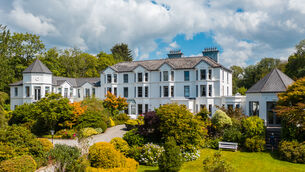
Too many options here, so again, here are our favourite three: The House Hotel, Spanish Parade (thehousehotel.ie), is boutique and cool in all the right ways; Radisson Blu Hotel & Spa, Lough Atalia Road ( www.radissonhotelgalway.com) is more business-like, but as franchise hotels go it’s up there with the best; Jurys Inn, Quay Street ( www.jurysinns.com/hotels/galway ), is here because it’s bang in the centre of the buzz, and its no fuss/all amenities modus operandi works a treat.
With the Galway International Arts Festival over next week, to follow on the social calendar is the Galway Races event, which takes place July 27-August 2.
September sees the Oscar Wilde Festival (September 4-6), and the famous Galway International Oyster Festival (September 24-27).
CONNECT WITH US TODAY



Be the first to know the latest news and updates