In the Eternal City hoping for a brush with a Caravaggio
Rome is a city of many layers: Ancient Rome was mostly destroyed and then built over and bits of it are still being unearthed. Then there’s Renaissance Rome of the great masters and magnificent places of worship, after which come several more historical strata, topped by Modern Rome with its chaotic traffic liberally sprinkled with manic teenage “motorini” drivers and hordes of tourists.
I went for the middle of the sandwich and hand-in-hand with my wife, we went past temples, apartment blocks, palazzi, piazze and paparazzi, through crowds and fluttering pigeons from church to museum and back to church again. We weren’t after the Da Vinci Code, but something more tangible and priceless: the great works of Michelangelo Merisi da Caravaggio.
Caravaggio lived too fast to last into old age like some of his venerable predecessors of the Renaissance era and died in 1610 aged just 38. Supremely talented, he painted according to his own rules, working incredibly fast; sometimes allegedly using illegally-exhumed cadavers as models. Had he lived in the 20th or the 21st century, he would have worn a leather jacket, carried a flick-knife and rode a Harley.
There’s a huge concentration of Caravaggio’s works within the Aurelian Walls of the Eternal City and it’s an impossible task to see all of them in one day. There is one in the Pinacoteca of the Vatican Museums, for example, The Deposition from the Cross, but you need to book in advance and endure long queues. We concentrated, instead, on the many works of Caravaggio that are free to view in places of worship. The Catholic Church was one of the painter’s most important patrons and it gives you the opportunity of viewing masterpieces in precisely the spots for which they were commissioned and for which Caravaggio painted them over 400 years ago. Almost all of them never leave to be exhibited anywhere else.
First stop was the Chiesa Santa Maria del Popolo; a church that was built over a temple to Emperor Nero, consecrated in the 11th century, rebuilt in the 15th century and restored in the 17th. There were plenty of other art-hunters already there, providing welcome moral support. My wife had already scurried across the worn flagstones to the two Caravaggios hanging in a recess set back from stone balustrades. In Crucifixion of St Peter, Peter, inverted and fastened to the cross, strains his neck to get a good look at how his left hand is being nailed. The other The Conversion of St Paul initially looks like an accident scene at the forge, with a foreshortened Paul appearing to fall out of the bottom of the picture frame.
Under the strengthening Roman sun, we zig-zagged our way across the Villa Borghese Park to make our pre-booked appointment at the Villa Borghese gallery. It’s an agreeable 25-minutes through the green heart of the city, complete with its own boating lake. The gallery’s cool interior houses a superb collection, including exquisite sculptures by Bernini, but our main focus were the six Caravaggio’s.
This is the largest permanent collection of the master’s works anywhere and they were all hung together downstairs. They included his “calling card” portrait Boy with a Basket of Fruit, Sick Bacchus and David and Goliath (both of which are believed to be self-portraits).
Next is a half-hour walk and a good time to stop for lunch. You should stumble across the Trevi Fountain bang on half-way, which is close to some of the most atmospheric and lively places to pause for food in Rome.
You never know what you might find when you round a corner in central Rome and as you make your way towards the Church of San Luigi dei Francesi on the Via della Scrofa, you will inevitably come across both Bernini’s wonderful elephant sculpture on the Piazza della Minerva and the Pantheon. The latter is the most complete ancient Roman building that’s still standing and shouldn’t be missed, even if it’s only for a five-minute peek inside.
San Luigi dei Francesi is the official national church of the French in Rome, houses three Caravaggios in the Contarelli Chapel. All depict St Matthew (The Calling of St Matthew, The Inspiration of St Matthew and The Martyrdom of St Matthew) and found in a very dark part of the building but the donation of coin brings divine illumination to the stunning masterpieces.
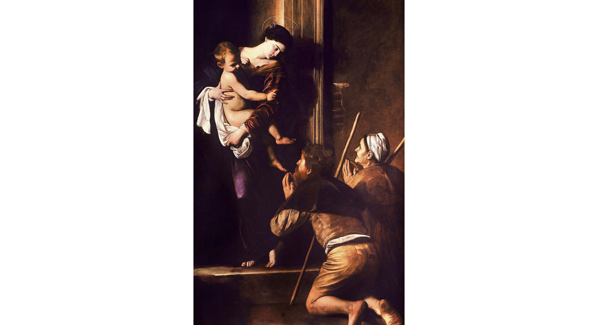
Just around the corner, Sant’Agostino Church on Via Sant’ Agostino houses Caravaggio’s Madonna di Loreto — a low-key Virgin Mary at an ordinary doorway holding the infant Jesus and being beseeched by pilgrims. Both she and the pilgrims are barefoot and the view of the dirty soles of the feet of the pilgrims drew uproar and condemnation on Caravaggio at the time from important patrons, rival artists and concerned citizens alike.
Apart from the one in the Vatican Museums, there are six more confirmed Caravaggio paintings in Rome (three in the Galleria Dora Pamphilj, two in the Galleria Nazionale d’Arte Antica and one of a moody teenage John the Baptist in the Corsini Gallery. Be warned, however, the opening times for the Galleria Dora Pamphilf, in particular, can be sporadic.
Meanwhile, if you want to get a taster before you leave, we have our very own recently-discovered The Taking of Christ in the National Museum in Dublin.
I suppose we’ll just have to go back.
Aer Lingus ( www.aerlingus.com ) operate daily flights direct from Dublin to Rome Leonardo da Vinci Airport.
We stayed at the Regina Baglioni, Via Vittorio Veneto 72, Rome. +39 06 42 11 11 ( www.bagilionihotels.com ); a five-star hotel of glamourous charm close to Harry’s Bar, the Villa Borghese and the Aurelian Walls. Discover Roma. Via Castelfidardo 50, 00185 Rome. +39 06 44 70 31 54, www.discoverroma.com. For a centrally-located hotel/B&B, this friendly establishment is hard to beat with single rates starting at €50 per night .
The sites Apart from the afore-mentioned, the Coliseum is arguably the most iconic building in the city. The shopping Via del Corso. Running a long 1.5km from Piazza Venezia to Piazza del Popolo, this pedestrianized street is a theatre of a cross-section of Roman life, as well as containing every conceivable level of shopping that’s possible to have in one street.
Vineria La Chianti. Via del Lavatore 81/82a, Roma, Italy, +39 06 67 87 550, www.vineriailchianti.com . Serving traditional Tuscan fare such as Macaroni with wild boar sauce and Lasagna, this restaurant is just a few steps away from the Trevi Fountain. Dar Poeta. Vicolo del Bologna 45, 00153 Roma, +39 06 58 80 516, www.darpoeta.com . With pizza margherita starting at é6, people gravitate to this friendly pizzeria for the value and quality.
CONNECT WITH US TODAY



Be the first to know the latest news and updates